
TL;DR:
- Location largely determines property value, accounting for up to 70 percent of its worth.
- Proximity to transit, employment centers, and amenities are key factors driving demand and appreciation.
Location is the single most important determinant of property value in real estate. The role of location in real estate is so dominant that up to 70% of property value derives from where a property sits, not what it looks like. That figure comes from Czech Banking Association data and reflects a pattern seen across every mature market. A renovated apartment in the wrong neighborhood will lose to an unremarkable unit in the right one, every time. Buyers and investors who internalize this fact make faster decisions, avoid costly mistakes, and build portfolios that hold value through downturns.
What is the role of location in real estate values?
Location drives price through a combination of access, demand, and perception. These three forces interact constantly, and understanding each one gives investors a real edge.

Access to transit is the most measurable location premium. Properties within 500 meters of Prague metro stations appreciated 35% over five years, compared to 21% for properties farther away. That 14 percentage point gap represents a direct financial return on proximity. Transit access compresses commute times, which buyers and renters consistently rank as a top priority.
Demographic growth creates sustained demand. The population of Prague 9 grew 23% between 2016 and 2026. That kind of influx puts constant upward pressure on prices because more people compete for the same housing stock. Investors who track population data before buying position themselves ahead of the demand curve rather than behind it.
The key location factors that move prices most reliably include:
- Transit proximity: Metro, rail, and bus access reduce commute friction and attract a wider pool of tenants and buyers.
- Employment centers: Properties within commuting distance of major job hubs command consistent rental demand and lower vacancy rates.
- School quality: Families pay a measurable premium to live within catchment areas of high-performing schools.
- Green space and amenities: Parks, restaurants, and retail within walking distance raise daily quality of life and, by extension, property desirability. You can review how local amenities affect value in the Costa Dorada context specifically.
- Safety levels: Crime rate differences between districts can be nearly threefold, and safe neighborhoods attract families and stable long-term tenants. That stability directly reduces vacancy risk for landlords.
Each of these factors compounds over time. A neighborhood that scores well on three or four of them simultaneously tends to appreciate faster and sell more quickly than one that excels in only a single dimension.
How do neighborhood intangibles affect property pricing?
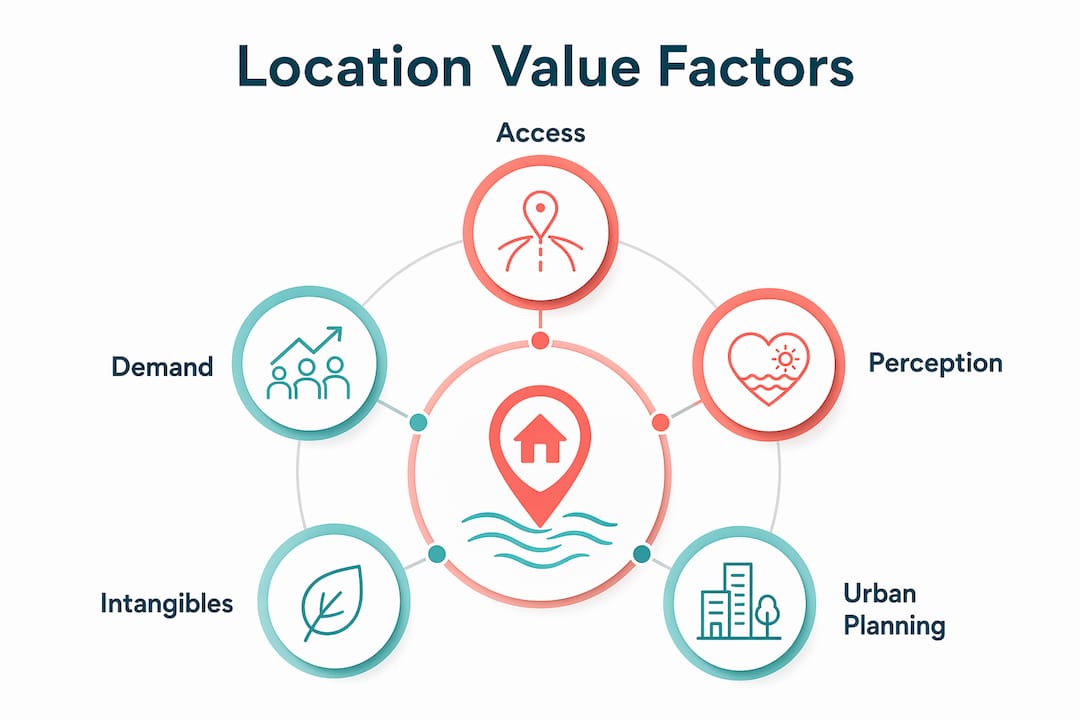
Physical infrastructure explains most of a location’s value, but not all of it. Research from VUT in Brno confirms that a good address and neighborhood cohesion contribute at least 5% to property value, particularly for family homes. That percentage sounds modest until you apply it to a €500,000 property, where it represents €25,000 in value that no renovation can create.
Buyers respond to intangible signals even when they cannot name them. A street that feels safe after dark, neighbors who maintain their facades, and a community with a coherent identity all register as value. Perceived safety after dark can cause a property to stagnate on the market despite strong physical attributes. That is a liquidity risk, not just an aesthetic one.
Pro Tip: Walk the neighborhood at three different times: a weekday morning, a weekday evening, and a Saturday afternoon. The character of a street changes dramatically across those windows, and what you observe tells you more than any listing description.
The intangible factors that most influence buyer decisions include:
- Neighborhood cohesion: Streets where residents know each other and maintain shared spaces signal stability.
- Aesthetic consistency: A block with uniform upkeep reads as desirable even when individual units are modest.
- Community identity: Neighborhoods with a clear character (arts district, family enclave, historic quarter) attract buyers who self-select and stay longer.
- Perceived safety: This overrides physical upgrades in buyer psychology. A beautifully renovated unit in a neighborhood that feels unsafe will sit on the market.
Neighborhood cohesion is statistically significant in residential valuations, often outweighing the impact of kitchen or bathroom renovations. Investors who spend money upgrading interiors in locations with weak neighborhood identity frequently find that the market does not reward them proportionally.
What urban planning trends are reshaping location value?
Modern city planning has introduced new frameworks that directly affect which locations gain value and which stagnate. The most influential concept right now is the 15-minute city model, which organizes urban space so that residents can reach work, schools, healthcare, and retail within a 15-minute walk or bike ride.
The 15-minute city model raises walkability premiums and concentrates demand in neighborhoods with dense, mixed-use amenities. Properties in areas that already function as 15-minute cities, or that are being redesigned toward that standard, attract buyers willing to pay above-market prices for the convenience. The impact of amenities on pricing follows directly from this planning logic.
Infrastructure investment creates some of the most reliable location premiums in real estate. The sequence typically follows this pattern:
- Announcement: A new transit line or urban renewal project is announced. Prices in the affected area begin to move on speculation.
- Construction: Physical work begins. Prices accelerate as buyers and investors confirm the project is real.
- Completion: The infrastructure opens. Prices stabilize at a new, higher baseline.
- Maturation: The neighborhood attracts secondary investment (cafés, retail, services), which reinforces the premium.
Gentrification follows a similar but less predictable arc. Early gentrification signals such as independent cafés, artist studios, and small-scale redevelopment projects often appear years before official urban plans reflect the change. Investors who read these qualitative signals correctly can buy at pre-gentrification prices and hold through the appreciation cycle.
The risk side of urban planning is real. Accessibility improvements require governance to prevent displacement of lower-income residents, and policy changes can redistribute value in ways that hurt early investors. Buyers should always review municipal development plans alongside on-the-ground observation.
How can investors evaluate location before buying?
Location analysis in property buying is a structured process, not a gut feeling. The investors who get it right consistently use a repeatable framework rather than relying on impressions from a single site visit.
Start with data. Pull demographic trends, infrastructure project timelines, crime statistics, and school performance data for the target area. Cross-reference these against real estate market trends to understand where the area sits in its appreciation cycle. A neighborhood with strong fundamentals but early-stage recognition offers better entry prices than one already featured in mainstream investment media.
Pro Tip: Request the municipal urban development plan for any area you are seriously considering. Planned infrastructure, zoning changes, and density allowances are public documents that most buyers never read. They contain the clearest signal of where location value is heading.
The most common mistake investors make is overvaluing fixable property features over fixed location attributes. A dated kitchen is a €15,000 renovation. A bad location is permanent. Location stability buffers market downturns better than renovations alone, which means a well-located property in average condition will outperform a renovated property in a weak location over any meaningful time horizon.
Practical criteria for evaluating location quality:
- Current amenity density: Count walkable services, transit stops, and green spaces within a 15-minute radius.
- Infrastructure pipeline: Identify confirmed (not just proposed) projects that will improve access or attract employers.
- Population trajectory: Is the area gaining or losing residents? Growth sustains demand; decline signals risk.
- Rental yield and vacancy data: High yields with low vacancy confirm that the market values the location, not just the property.
- Resale speed: Average days on market in the area tells you how liquid your exit will be.
Location also determines rental income ceiling. A property in a high-demand location commands rents that a comparable unit in a weaker area cannot match, regardless of interior finish. That income gap compounds over a holding period and represents the clearest financial argument for prioritizing geography over condition.
Key Takeaways
Location accounts for up to 70% of property value, making geographical analysis the most important step in any real estate purchase or investment decision.
| Point | Details |
|---|---|
| Location drives most of value | Up to 70% of property value derives from location, not physical condition or size. |
| Transit proximity pays measurably | Properties near metro stations appreciated 35% versus 21% for distant ones over five years. |
| Intangibles add real money | Neighborhood cohesion and a good address contribute at least 5% to value, especially for family homes. |
| Urban planning reshapes premiums | The 15-minute city model and infrastructure investment create lasting location value uplifts. |
| Fix location first, condition second | Overvaluing fixable features over fixed location leads to longer market time and weaker returns. |
Why location is the one thing I never compromise on
I have watched investors lose money on properties that looked perfect on paper. Good finishes, recent renovation, solid square footage. The problem was always the same: they bought the property and ignored the address.
The market does not reward effort spent on the wrong location. A landlord who installs a new kitchen in a neighborhood with a weak safety reputation will not recover that investment through higher rents. The ceiling is set by the location, not the unit. I learned this early, and it changed how I evaluate every deal.
What surprises most buyers is how much the intangible neighborhood atmosphere matters. I have seen properties sit unsold for months despite strong physical attributes, simply because the street felt off at night. That is not a subjective impression. It is a liquidity problem with a direct cost. The geographical influence on real estate shows up most clearly when you try to sell.
My advice is simple: spend 80% of your evaluation time on location and 20% on the property itself. You can change a floor plan. You cannot change the neighborhood. The investors I respect most treat location as a non-negotiable filter, not a variable to trade off against price.
— Oscar
Prime location properties in Cambrils and Costa Dorada
Costacambrils specializes in properties where location is already doing the heavy lifting. The Costa Dorada region, and Cambrils in particular, combines Mediterranean coastal access with strong infrastructure, growing tourism demand, and a stable residential community.

The Costacambrils team evaluates each property against the location criteria that matter most: proximity to the sea, walkable amenities, transport links, and long-term urban development plans. For investors and buyers who want expert guidance on what makes a property worth its price in this market, the key criteria for luxury properties in Cambrils page covers the full evaluation framework. Whether you are buying for personal use or capital appreciation, location analysis is built into every recommendation Costacambrils makes.
FAQ
Why does location matter more than property condition?
Location is permanent; condition is fixable. A property in a strong location holds value through market downturns and attracts tenants consistently, while a renovated property in a weak location faces a pricing ceiling set by its surroundings.
How much of a property’s value comes from location?
Location accounts for up to 70% of property value, according to Czech Banking Association data. Physical attributes like size and condition account for the remainder.
What are the best early signals of rising location value?
Independent cafés, artist studios, and small-scale redevelopment projects are reliable early gentrification signals that typically appear before official urban plans or price data reflect the change.
How does the 15-minute city concept affect real estate prices?
The 15-minute city model raises demand for walkable, amenity-rich neighborhoods. Proximity to amenities raises property values in areas that meet this standard, creating a measurable premium over car-dependent locations.
What location factors most affect rental income?
Transit access, safety levels, and proximity to employment centers set the rental income ceiling for any property. High demand in these areas keeps vacancy low and supports rent growth over time.