Most buyers of a newly built home in Spain pay 10% IVA on the purchase price in 2026, whether they’re closing on a flat in Cambrils or a villa outside Barcelona. Subsidized housing under the qualifying VPO regime drops to 4%, and standalone garages or commercial units sold separately carry 21%. On top of that comes Actos Jurídicos Documentados, a regional stamp tax that varies by community and adds another meaningful chunk to closing costs. The Canary Islands use IGIC instead of IVA entirely.
TL;DR:
- Most 2026 new-build homes in Spain are taxed at a 10% VAT rate, unless they qualify for the 4% superreduced rate under the VPO regime.
- Garages sold separately are taxed at 21%, while up to two garage spaces sold with a home are taxed at the same rate as the property.
- The applicable VAT is based on the first sale directly from the developer, after which subsequent resales are taxed under a different regime called ITP.
- Regional stamp tax AJD varies by community and must be paid within thirty days of signing the notarial deed, with regional rates and bonifications affecting the final amount.
- Buyers should verify whether the advertised price includes VAT and whether the property qualifies for any bonifications to avoid costly surprises during closing.
Table of Contents
- What Triggers IVA on a New-Build Purchase?
- Which 2026 VAT Rate Applies to Your Purchase?
- How Do You Calculate IVA on a New-Build Purchase?
- AJD in 2026: How Much Does Stamp Tax Add, and Where?
- What Other Costs Should You Budget Beyond IVA and AJD?
- What Should You Check Before Signing on a New Build?
- An Early Tax Check Saves You a Renegotiation Later
- Get a Personalized Cost Estimate for Your New Build
- Sources
- FAQ
What Triggers IVA on a New-Build Purchase?
IVA applies to what Spanish tax law calls the “first delivery” of a newly built property. That means the sale happens directly from the promotor (developer or builder) to the buyer, before anyone else has owned or used the finished unit as a home. Once that first sale closes and a second owner later resells the same property, the tax regime flips: the transaction moves to Impuesto de Transmisiones Patrimoniales (ITP), a transfer tax handled entirely differently and typically set by the autonomous community rather than by national VAT rules.
This distinction matters more than most buyers realize. If you’re purchasing directly from a developer, IVA operations on real estate fall under the Agencia Tributaria’s rules, and the developer’s invoice should show IVA broken out as a separate line. Buying a resale property from a private individual, on the other hand, means ITP applies instead, at a rate the region sets on its own.
A few territorial quirks complicate the picture:
- The Canary Islands don’t use IVA at all for these transactions. They apply IGIC (Impuesto General Indirecto Canario), a separate indirect tax with its own rate structure.
- Ceuta and Melilla use yet another regime, IPSI, which follows different rules than mainland Spain.
- Always check the promotor’s invoice directly rather than assuming the rate. Developers occasionally misclassify a unit, and catching an error before signing is far easier than correcting it afterward.
If you’re a foreign buyer trying to figure out which tax regime applies to your specific purchase, this breakdown of IVA versus ITP obligations covers the distinction in more detail.
Which 2026 VAT Rate Applies to Your Purchase?
The general rate covers the vast majority of new-build residential sales in Spain in 2026 and is typically around 10%. That’s the number to budget for unless your situation fits a specific exception.
The 4% superreduced rate is far narrower than most buyers assume. It applies only to housing classified under the special or promotional VPO regime, not to every property labeled “protected housing” in casual conversation. According to Interforo Abogados’ 2026 guide on new-home IVA, most VPO units don’t automatically qualify for 4%, so verifying the exact administrative classification before you sign is essential rather than optional.
Garages and storage rooms (trasteros) follow their own logic:
- Up to two parking spaces sold together with the dwelling, in the same deed, are taxed at the dwelling’s own rate (10%, or 4% if it’s qualifying VPO).
- A garage sold independently, or a third space beyond the two-unit limit, gets taxed at the general 21% rate, the same as any commercial unit.
Quick reference: 2026 IVA rates for new construction
- 10% — General rate, most new residential deliveries
- 4% — Qualifying VPO under the special/promotional regime only
- 21% — Independent garages, commercial premises, non-residential units
Renovation and rehabilitation work adds another wrinkle. The AEAT’s guidance on works and repairs states that when a contractor’s materials exceed 40% of the total job cost, the operation is usually reclassified as a supply of goods and taxed at 21% instead of the reduced rates that sometimes apply to qualifying renovation work.
How Do You Calculate IVA on a New-Build Purchase?
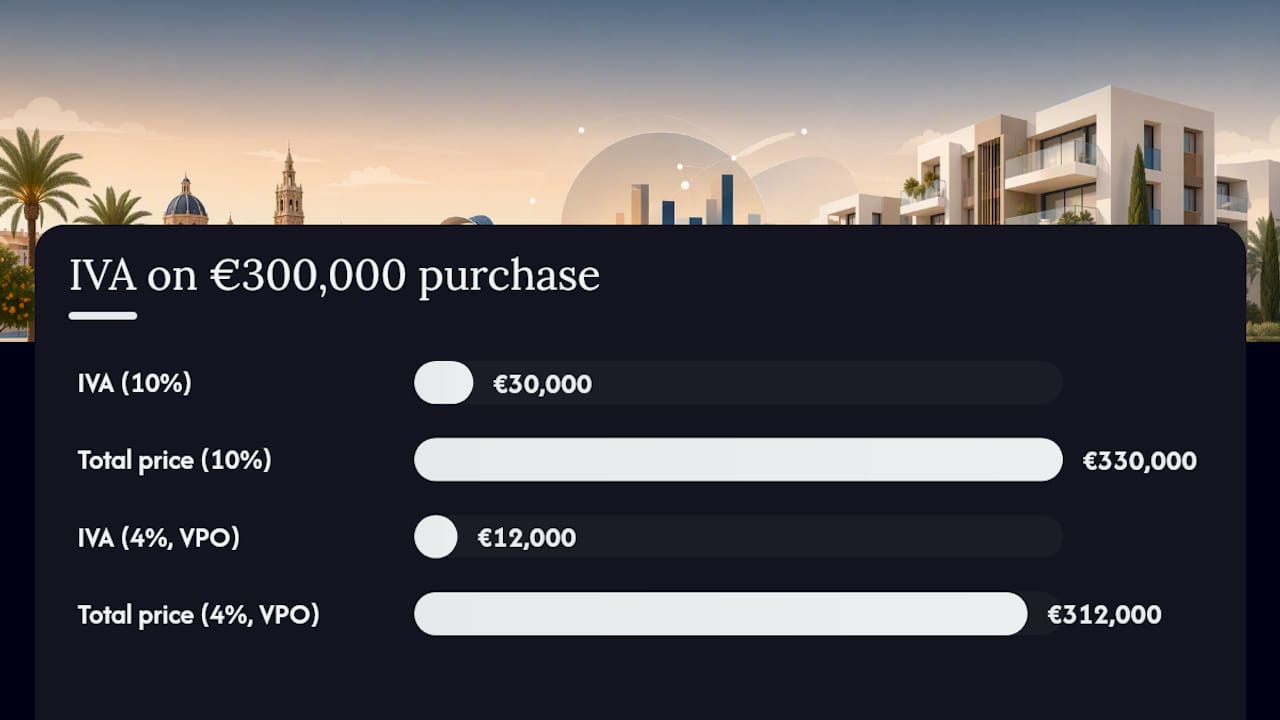
The taxable base is simply the agreed sale price, whether you pay it in one lump sum or in staged installments tied to construction milestones. Each installment gets taxed at the applicable rate when it’s paid, which matters if you’re financing a purchase still under construction.
Here’s how the math works in practice:
- Standard 10% example: A newly built apartment priced at €300,000 carries €30,000 in IVA, bringing your total to €330,000 before AJD and other fees.
- Qualifying VPO at 4%: The same €300,000 price, if the unit genuinely qualifies for the special VPO regime, generates only €12,000 in IVA, for a total of €312,000.
- Confirm the listing basis before anything else. Ask the developer or agent explicitly whether the advertised price already includes IVA or not. A €300,000 listing that’s “IVA excluded” means your real cost is €330,000, not €300,000, and that difference changes how much deposit or down payment you actually need to have ready.
That last step trips up more buyers than any calculation error. Developers don’t always phrase pricing consistently, and a misunderstanding here can blow a carefully planned budget before you’ve even reached the notary.
AJD in 2026: How Much Does Stamp Tax Add, and Where?
Actos Jurídicos Documentados is a separate tax from IVA, charged on the notarial deed itself, and every autonomous community sets its own rate. This is where the total cost of buying a new build can shift substantially depending on where in Spain you’re buying.
The buyer must self-assess and pay AJD using model 600 within thirty working days of signing the notarial deed, according to GuíaFiscal’s 2026 AJD calculator. Miss that window, or fail to submit the right documentation, and you risk being charged the standard rate even when a bonification should have applied.
The base for calculating AJD isn’t always the sale price. For a straightforward obra nueva purchase deed, the base is typically the declared cost of execution stated in the deed. For a mortgage deed, the base shifts to the total liability, meaning capital plus interest plus associated costs, which is why mortgage-related AJD often runs higher than buyers expect.
Rates vary widely by region:
Valencia’s rate change is worth flagging specifically. According to Guía Fiscal’s community-by-community AJD breakdown, the region lowered its AJD from a higher prior rate to 1.4% starting June 1, 2026, a meaningful cost difference for anyone closing a purchase around that date.
Common bonifications reduce the AJD burden for specific groups:
- Young buyers under a set age threshold in several communities
- Large or numerous families meeting local criteria
- VPO purchases, which often carry reduced AJD rates on top of the reduced IVA
None of these apply automatically. As Guía Fiscal notes, the buyer has to supply documentary proof of eligibility at the moment of filing model 600. Buyers who skip this step get charged the general rate and then have to request a correction later, a slower and more frustrating process than getting the paperwork right the first time.
What Other Costs Should You Budget Beyond IVA and AJD?
IVA and AJD are the two biggest tax line items, but they’re far from the only costs in a new-build purchase. A realistic budget needs room for several additional fees:
- Notary fees, set by regulated fee schedules but still running into hundreds or low thousands of euros depending on the transaction value. This breakdown of notary costs in Spain walks through typical ranges.
- Land registry fees, charged to officially record your ownership. Registration costs scale with property value, and this guide to Spain’s land registry covers the fee bands in detail.
- Gestoría fees, for the administrative professional who handles your tax filings and paperwork submission.
- Agency commission, if you’re using a buyer’s agent to help source or negotiate the property.
- Mortgage-related costs, including the bank’s property valuation, plus separate notary and registration charges tied specifically to the mortgage deed itself.
- Small stamp duties per folio, a minor but real line item on the notarial documentation.
Put together, most market explainers, including El País’s 2026 consultation on home-buying taxes, estimate total extra costs at a moderate percentage on top of the purchase price once you combine IVA, AJD, and all the formalization fees. IVA and AJD alone typically account for most of that range, with notary, registry, and gestoría fees filling in the rest.
Before you sign anything, get a written cost estimate from a gestoría or through your agent. It’s a small step that turns a rough percentage into an actual number you can plan around, and this quick-reference guide to Spain’s purchase taxes is a useful starting point for setting that reserve aside early.
What Should You Check Before Signing on a New Build?
A short pre-signing review catches most of the expensive surprises before they become expensive. Run through this list with your agent or gestoría:
- Confirm whether the unit genuinely holds VPO documentation under the special regime, not just a general “protected housing” label.
- Verify whether the advertised price is IVA-inclusive or IVA-exclusive.
- Check exactly which garage spaces are included in the deed and whether they exceed the two-unit limit taxed at the residential rate.
- Confirm the promotor’s legal standing and the property’s construction completion status, including the occupancy license.
- Gather any documentation needed to claim AJD bonifications (age, family status, VPO regime) before filing.
Pro Tip: Collect your AJD bonification paperwork before your notary appointment, not after. Filing model 600 with the right documents already in hand avoids being liquidated at the general rate and having to request a correction later.
Some local agencies support buyers moving through this process with property vetting, direct budget estimates tailored to specific listings, legal and tax advisory, and full transaction management from offer to keys.
An Early Tax Check Saves You a Renegotiation Later
The buyers who run into trouble aren’t usually the ones who misunderstand the IVA rate. They’re the ones who assumed a price included tax, or assumed a unit qualified for a bonification it didn’t, and found out at the notary’s office with no room left to renegotiate.
Verify the IVA and AJD numbers on your specific property before you get anywhere near a final price discussion. It costs you a phone call or an email to a gestoría. Skipping that step costs you thousands of euros in surprises you can’t undo once the deed is signed.
— Oscar
Get a Personalized Cost Estimate for Your New Build
Working out the real cost of a new-build purchase, tax rate, AJD, and every fee stacked on top, is easier with someone who handles these numbers for a living. Some platforms list new-build properties across Cambrils and the Costa Dorada coast and pair listings with practical support: tax and budget estimation specific to each property, legal advisory, and management of the transaction from reservation through signing.
If you’ve found a property you’re serious about, or you’re still comparing new-build options in the region, browse luxury property types in Costa Dorada to see what’s currently available, or look up a specific listing directly through property search by ID to request a full cost breakdown, IVA, AJD, and all, before you make an offer.
This article is general information, not a substitute for advice from a qualified financial advisor. Consult a qualified financial professional about your own circumstances before acting on anything here.
Sources
FAQ
What Is the IVA Rate on New-Build Homes in Spain in 2026?
Most new-build residential purchases carry a 10% IVA rate.
Does IVA Apply to Resale Properties Too?
No. IVA only applies to the first delivery from the promotor; resale purchases from a private owner fall under ITP instead, which is set by the autonomous community.
How Is AJD Different From IVA?
AJD is a separate stamp tax charged on the notarial deed itself, calculated at a rate that varies by community, on top of whatever IVA rate applies to the purchase.
When Do I Have to Pay AJD After Signing?
You must self-assess and pay AJD using model 600 within thirty working days of the notarial deed date.
Can I Get a Reduced AJD Rate as a Young Buyer?
Several communities offer AJD bonifications for young buyers, large families, or VPO purchases, but you must submit documentary proof when filing model 600 to claim them.