
TL;DR:
- Coastal residency involves legal, geographic, and lifestyle factors that vary across contexts, not just owning property near water.
- Establishing residency requires deliberate intent, meeting day-count thresholds, and updating legal documents to reflect your true domicile.
Living near the ocean sounds simple enough, but what is coastal residency, exactly? Most people assume it just means owning a beach house or renting an apartment with a sea view. The reality is more layered. Coastal residency carries distinct legal definitions, regulatory obligations, and lifestyle implications that vary depending on whether you’re talking about tax law, environmental regulations, or health research. This guide breaks down the coastal living definition across all three contexts, explains the real advantages of coastal residency, and walks you through what it actually takes to establish it properly.
Table of Contents
- Key takeaways
- What is coastal residency: definitions that actually matter
- Benefits and lifestyle implications of living by the coast
- Legal and regulatory considerations for coastal residents
- How to establish coastal residency: practical steps
- Coastal residency vs. other residency types
- My perspective on what people get wrong about coastal residency
- How Costacambrils can guide your coastal residency journey
- FAQ
Key takeaways
| Point | Details |
|---|---|
| Coastal residency is multi-layered | It includes geographic, legal, and lifestyle components that don’t always align with each other. |
| Domicile determines legal status | Owning coastal property doesn’t make you a resident; legal tests based on intent and time spent do. |
| Regulations go beyond ownership | Coastal residents face permit requirements and building restrictions that standard property owners don’t. |
| Health benefits are real, with nuance | Coastal living offers lifestyle advantages, but some environmental factors carry health considerations worth knowing. |
| Documentation is your best defense | Voter registration, banking, and family presence matter more than a written statement of intent in residency disputes. |
What is coastal residency: definitions that actually matter
Coastal residency means different things depending on the context, and getting those contexts confused is one of the most common mistakes people make when planning a move to the shore.
In US law, the most precise definition starts with geography. The Coastal Zone Management Act defines the “coastal zone” as coastal waters plus adjacent shorelands, including islands, marshes, wetlands, and beaches. Residency within this zone means your property and daily life fall under a specific set of federal and state regulations that don’t apply to inland residents.
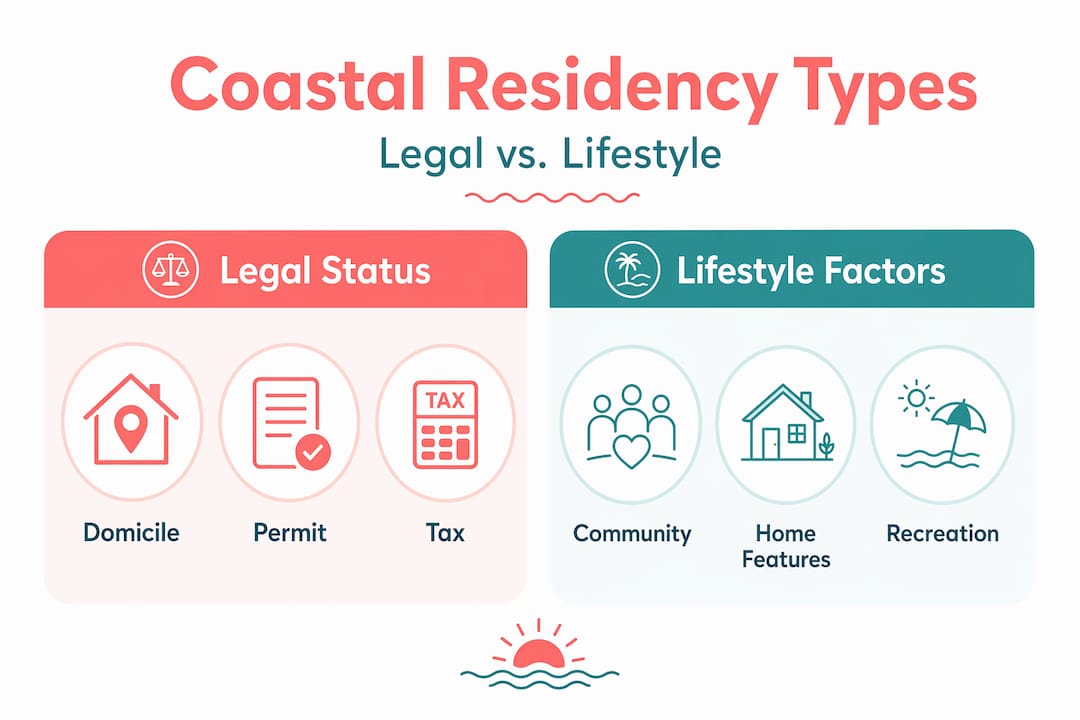
From a tax and legal standpoint, what does coastal residency mean? It comes down to domicile. Your domicile is the place you consider your permanent home and intend to return to. States like Maine require either domicile or spending over 183 days with a permanent abode in the state to establish tax residency. Simply owning a coastal cottage doesn’t qualify.
Health researchers use the term differently again. In epidemiological studies, coastal residency is defined using geographic administrative boundaries to identify population groups living near coastlines, adjusting results for environmental and socioeconomic confounders. Their definition has nothing to do with legal status.
Here’s a quick breakdown of how the term splits across contexts:
- Legal/geographic: Residency within the coastal zone as defined by the Coastal Zone Management Act, subject to permit and development rules.
- Tax/domicile: Established by intent to make a coastal location your permanent home plus day-count tests.
- Epidemiological: A geographic classification used in health studies to analyze populations living near coastlines.
Pro Tip: When you see “coastal residency” referenced in a news article or research paper, check the context before applying that definition to your own situation. A health study’s definition won’t help you in a tax dispute.
Benefits and lifestyle implications of living by the coast
The coastal lifestyle benefits that draw families to the shore are well documented and genuinely compelling. Access to beaches, water sports, fishing, hiking along coastal trails, and a slower pace of community life all contribute to a quality of living that’s hard to replicate inland.
Coastal community living also tends to create a distinctive social culture. Neighbors often share outdoor hobbies and a common appreciation for the natural environment, which can build a stronger sense of belonging. For families with children, that translates into outdoor-focused childhoods with real recreational variety.
“The desirability of coastal living stems from more than scenery. It’s about access to activities, a connected community culture, and a daily rhythm shaped by natural surroundings.”
Health research adds nuance here. Some studies have found that coastal adults face higher hypertension prevalence, with research in Bangladesh showing a 29% higher rate among coastal populations linked to salt intake and stress. Before you over-index on that statistic, it’s worth noting that researchers acknowledge environmental and social confounders complicate direct causation claims. Coastal living itself isn’t the villain. Local dietary habits and economic stressors in specific regions drove those numbers.
The practical lifestyle changes to anticipate include:
- Higher property maintenance demands due to salt air, humidity, and storm exposure.
- Seasonal population shifts in tourist-heavy coastal towns that affect local services and traffic.
- Stronger community identity built around shared natural resources and outdoor culture.
- Proximity to water recreation that reshapes how your household spends weekends and vacations.
For families making this move, reviewing coastal home features before purchasing can prevent expensive surprises down the line.
Legal and regulatory considerations for coastal residents

This is where many aspiring coastal residents get blindsided. Buying property near the water doesn’t just mean different scenery. It often means a completely different regulatory environment.
California provides the clearest example. Under the California Coastal Act, development permits are required for any construction within 300 feet of the inland extent of beaches or public roads running parallel to the sea. That boundary catches a lot of properties that owners assume are safely outside coastal jurisdiction.
The regulatory reach doesn’t stop at permit requirements. In Seidensticker v. California Coastal Commission, the California Coastal Commission imposed conditions requiring homeowners to waive certain property rights before receiving building approval. That’s a level of restriction that goes well beyond what most property owners in non-coastal areas ever face.
| Factor | Coastal residents | Non-coastal residents |
|---|---|---|
| Development permits | Required within coastal zone boundaries | Standard local building permits only |
| Environmental review | Often mandatory for modifications | Typically not required for minor work |
| Property rights restrictions | Possible waiver conditions on approvals | Not standard |
| Tax residency tests | Same domicile and day-count rules | Same rules, fewer geographic triggers |
| Insurance considerations | Flood zone and wind exposure ratings | Generally lower risk classifications |
Tax residency is governed by the same rules for everyone, coastal or not. What changes is the complexity. People who split time between a coastal property and an inland home regularly find themselves in residency disputes, with two states potentially claiming them as residents. The determining factor is always where you maintain the closest connections, not which property you prefer.
Pro Tip: Before buying coastal property in a regulated zone, request a copy of the applicable local coastal program from the county planning office. It will tell you exactly what permit requirements apply to the parcel before you sign anything.
Understanding the legal requirements for buying property in a regulated coastal area is the single most important step you can take before committing to a purchase.
How to establish coastal residency: practical steps
Knowing the advantages of coastal residency is one thing. Actually establishing it legally is another. Here’s how to do it right.
Set your domicile with clear intent. Move your primary residence to the coastal location and document that this is your permanent home. Intent alone won’t hold up in a dispute, but it’s the foundation.
Meet the day-count test. Most states use a threshold of more than 183 days spent in the state with a permanent abode to establish statutory residency. Track your time carefully, especially if you also maintain property elsewhere.
Update your voter registration. Voting is one of the strongest signals of domicile. Register in your coastal community promptly after the move.
Move your banking and financial accounts. Domicile determination relies heavily on objective factors like where you bank, not just where you say you live.
Transfer your driver’s license and vehicle registration. These are standard domicile signals that courts and tax authorities evaluate directly.
Establish local professional relationships. Your primary physician, dentist, attorney, and accountant should all be in your coastal community if you’re claiming it as your domicile.
Document your connection to the community. Club memberships, school enrollment for children, and local service providers all support a residency claim.
The most common pitfall? Maintaining too many ties to your previous state. If your spouse stays at the old address for work, your children attend school there, and your financial accounts remain there, no amount of time spent at the coast will firmly establish the coastal address as your legal domicile.
Pro Tip: Keep a travel log that tracks your days in and out of your coastal state. It’s not exciting paperwork, but it becomes invaluable if a tax authority ever challenges your residency claim.
Coastal residency vs. other residency types
People conflate coastal residency with several related concepts, and the confusion can carry real legal and financial consequences.
Owning a vacation home on the coast is not the same as being a coastal resident. Property ownership is a domicile factor, but tax residency depends on closest connections, not on the deed. Many people own coastal homes for decades without ever becoming legal residents of that state.
Temporary stays don’t establish residency. Spending summers at a beach house for years on end falls short of the day-count and domicile tests unless you’ve genuinely shifted your life’s center of gravity.
In-state residency for tuition or tax purposes follows the same domicile rules. If you’re hoping your coastal address will qualify a student for in-state tuition rates, the university will apply the same intent and connection tests any tax authority would.
Here’s where the distinctions break down in practice:
- Misrepresenting residency status to claim tax benefits in a lower-tax coastal state carries serious legal exposure, including back taxes, penalties, and interest.
- Some states have audit programs specifically targeting dual-property owners who claim residency in lower-tax jurisdictions.
- Short-term rental arrangements at a coastal address do not contribute to residency in any meaningful legal sense.
The bottom line is simple. Coastal residency is a legal status built on genuine life connections, not property ownership or seasonal presence.
My perspective on what people get wrong about coastal residency
In my experience working with buyers and investors in coastal real estate markets, the single biggest mistake I see is treating coastal residency as a lifestyle choice with no legal dimension. People fall in love with the idea of coastal community living, make the move, and then discover months later that their tax situation is a mess or that their renovation plans require permits they didn’t budget for.
The domicile question catches people off guard most often. I’ve seen clients spend months at their coastal property every year while insisting they’re still legal residents of their home state because that’s where they “really” live. What actually matters is where you’ve relocated your banking, your doctors, your social network, and your daily life. The law looks at behavior, not preference.
I also think people underestimate the regulatory side. The idea that you can buy a coastal home and treat it like any other piece of real estate is a fantasy in many jurisdictions. Coastal zone regulations exist for legitimate environmental reasons, but they do add layers of complexity that buyers need to understand before they’re committed.
What I’ve learned is that the families who thrive in coastal residency are the ones who embrace the whole picture: the lifestyle rewards, the maintenance demands, the community ties, and the legal responsibilities. They don’t just buy the property. They build a life there, deliberately and with clear documentation. That’s what makes the difference between a satisfying coastal lifestyle and a regulatory or legal headache.
— Oscar
How Costacambrils can guide your coastal residency journey

If you’re seriously considering coastal residency along the Costa Dorada, the team at Costacambrils specializes in exactly this kind of move. The platform offers a curated selection of luxury properties in Cambrils and the surrounding area, along with luxury real estate services that go well beyond finding a listing. Their experts provide legal guidance on permit requirements, residency implications, and property investment strategy specific to the Costa Dorada coastal zone. Whether you need a personal property buying service tailored to luxury coastal homes or a full evaluation of a specific property, Costacambrils brings the local expertise and regulatory knowledge that this market demands. Reach out to their team before you commit to any coastal property purchase.
FAQ
What does coastal residency mean legally?
Legally, coastal residency refers to establishing your domicile or meeting day-count residency tests in a location within a coastal zone as defined by applicable state and federal law. It carries both tax obligations and property use regulations specific to that zone.
Does owning coastal property make you a coastal resident?
No. Property ownership is one factor in domicile analysis, but legal residency requires intent to make the location your permanent home plus objective connections like banking, voter registration, and daily life presence.
What are the main advantages of coastal residency?
The advantages of coastal residency include access to water recreation, a distinctive community culture, scenic living conditions, and an outdoor-oriented lifestyle. These benefits come alongside regulatory and maintenance responsibilities specific to coastal zones.
How many days do you need to spend to establish coastal residency?
Most states use a threshold of more than 183 days spent in the state combined with maintaining a permanent abode there. Requirements vary by state, so check the specific rules for your target coastal location.
Can coastal residency affect your health?
Research shows mixed results. Some studies link coastal populations to higher hypertension rates due to local environmental factors, but researchers note that confounders like diet and socioeconomic conditions heavily influence those outcomes rather than coastal living itself.