
TL;DR:
- Full property management entails outsourcing all operational and financial responsibilities of a rental property to a professional firm, transforming owners into passive investors. It includes comprehensive services such as marketing, lease management, rent collection, maintenance, legal compliance, and financial reporting, all under one agreement without hidden fees. Choosing a firm involves assessing local expertise, contractor networks, technology use, and transparency to maximize long-term asset value and income.
Full property management is defined as a complete outsourcing arrangement where a professional firm assumes every operational and financial responsibility of a rental property on behalf of the owner. Also called full-service property management in industry practice, this model covers tenant screening, lease execution, rent collection, maintenance coordination, legal compliance, and monthly financial reporting. For property owners in markets like Costa Dorada, where luxury assets demand consistent care and local expertise, full management converts an active landlord role into a genuinely passive investment.
Management fees typically range from 6% to 10% of collected monthly rent. That figure sounds simple, but it represents the transfer of every time-consuming landlord task to a dedicated professional team. Costacambrils works with property owners who discover that the real cost of not having professional management is far higher than any fee percentage.
What is full property management and what services does it include?
Full-service management covers marketing, tenant screening, lease execution, rent collection, 24/7 maintenance, legal compliance, and monthly financial reporting. Each of these functions represents a distinct area of expertise that most individual landlords cannot replicate at the same quality or cost. Understanding what each service delivers helps you evaluate whether a management agreement is genuinely comprehensive or just partially outsourced.

Marketing and tenant placement means the management firm advertises your property across professional channels, conducts showings, and filters applicants through credit checks, employment verification, and background screening. Quality tenant placement is the single highest-leverage activity in rental ownership because a reliable tenant reduces vacancy, maintenance abuse, and legal risk simultaneously.
Lease execution and renewals handled by a professional firm use legally compliant documentation updated for current housing law. This protects owners from lease clauses that courts regularly void in self-drafted agreements. Renewals are tracked proactively, preventing unplanned vacancies.
The remaining core services include:
- Rent collection and delinquency management: Automated collection systems with defined escalation procedures for late payments, reducing the emotional friction owners face when chasing rent from tenants they know personally.
- 24/7 maintenance coordination: Routine, preventive, and emergency repairs dispatched through vetted contractor networks, often at negotiated rates unavailable to individual owners.
- Regular property inspections: Scheduled condition reports that document the property’s state, creating a defensible record for security deposit disputes and insurance claims.
- Legal notices and evictions: Professionally managed eviction procedures that follow jurisdiction-specific timelines, reducing the risk of procedural errors that restart the process.
- Monthly financial reporting: Itemized income and expense statements delivered to owners, replacing guesswork with data for tax preparation and portfolio decisions.
Full-service agreements should include all these services without hidden fees for lease renewals, maintenance coordination, or financial reporting. If a contract charges separately for any of these, it is not a full-service agreement regardless of how it is marketed.
How does full management compare to self-management or lease-only services?
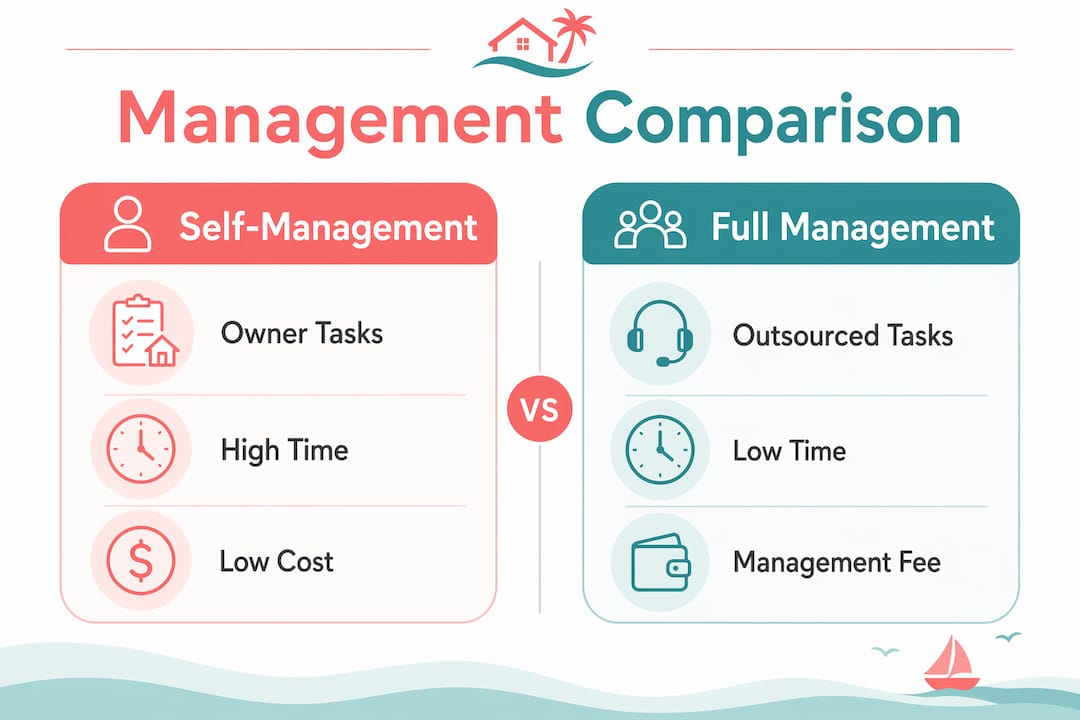
Self-management means the owner personally handles every landlord function. Lease-only services, sometimes called tenant placement services, cover advertising and tenant screening but return all ongoing responsibilities to the owner after the lease is signed. Full management is the only model where the owner’s role is limited to receiving reports and income.
Self-management requires 10 to 20 hours per property monthly, and that estimate assumes the owner already has relevant legal, maintenance, and financial knowledge. Owners who lack that background face compounding risk with every decision. The opportunity cost of those hours, measured against what the owner could earn or accomplish elsewhere, frequently exceeds the management fee.
| Responsibility | Self-management | Lease-only service | Full management |
|---|---|---|---|
| Marketing and advertising | Owner | Included | Included |
| Tenant screening | Owner | Included | Included |
| Lease preparation | Owner | Included | Included |
| Rent collection | Owner | Owner | Included |
| Maintenance coordination | Owner | Owner | Included |
| Legal compliance | Owner | Owner | Included |
| Financial reporting | Owner | Owner | Included |
| Eviction management | Owner | Owner | Included |
The table makes the trade-off concrete. Lease-only services reduce one phase of the workload but leave the owner exposed to every ongoing operational and legal risk. Full management eliminates that exposure entirely.
Pro Tip: When comparing management options, calculate your hourly rate for professional work and multiply it by the hours self-management would require. Most owners find the math favors professional management within the first year, especially for properties more than 30 minutes from their primary residence.
Professional managers outperform self-managed properties by improving market pricing, reducing vacancies, and lowering maintenance costs. This advantage compounds for investors with multiple units or properties in markets where they lack local knowledge, such as international buyers in the Costa Dorada region.
What financial and operational benefits do owners gain from full management?
The financial case for full property management rests on four measurable outcomes: higher net revenue, lower maintenance costs, reduced legal exposure, and time freed for portfolio growth. Each of these benefits compounds over time in ways that a simple fee comparison does not capture.
Proactive management with routine inspections and preventive maintenance protects asset value and drives long-term ROI. A property that receives scheduled maintenance retains its condition, commands higher rents, and avoids the large capital expenditures that result from deferred repairs. This is not a minor operational detail. It is the primary mechanism through which professional management increases property value over a five to ten year horizon.
Deferred maintenance and poor documentation can lead to costly repairs and legal risks that often exceed management fees. Professional firms mitigate this through vetted vendor networks and documented processes that create a paper trail for every maintenance request, inspection, and tenant communication. That documentation is the difference between winning and losing a security deposit dispute or a tenant liability claim.
The operational benefits are equally significant:
- Vacancy reduction: Optimized market pricing and faster tenant placement reduce the days a property sits empty, which is the largest single driver of lost rental income.
- Contractor cost savings: Management firms negotiate volume rates with contractors that individual owners cannot access, often reducing repair costs by a meaningful margin.
- Legal risk reduction: Compliance oversight covering fair housing law, habitability standards, and eviction procedures protects owners from fines and litigation.
- Portfolio scalability: Time freed from day-to-day management allows investors to evaluate and acquire additional properties rather than administering existing ones.
Managing one property takes roughly 2.5 full work weeks per year when accounting for turnover and ongoing tasks. For an investor managing three or four properties, that figure represents a significant portion of productive working time that could be redirected toward acquisition analysis or other income-generating activity. For luxury property investors, where tenant expectations and asset standards are higher, that time commitment increases further.
How to evaluate and choose a full-service property management company
Choosing the right management firm is a decision that affects your rental income, legal exposure, and asset condition for the duration of the relationship. The evaluation process should be systematic, not based on fee percentage alone.
- Verify licenses and certifications. In most jurisdictions, property managers must hold a real estate license. Certifications from organizations like the National Association of Residential Property Managers (NARPM) indicate additional professional training and ethical standards.
- Assess local market knowledge. A firm that manages properties in your specific market understands local rental rates, tenant demand patterns, and jurisdiction-specific legal requirements. Generic national platforms often lack this depth.
- Evaluate the contractor network. Vendor network quality and internal repair spending policies significantly affect cost savings and tenant satisfaction beyond fee percentages. Ask how contractors are vetted, what spending limits require owner approval, and how emergency repairs are dispatched.
- Demand fee transparency. Review the management agreement for every fee category. Lease renewal fees, maintenance coordination markups, and inspection charges are common additions that convert a competitive base rate into a costly arrangement.
- Review the technology platform. Firms using modern property management software, such as AppFolio, Buildium, or Propertyware, provide owners with real-time access to financial reports, maintenance logs, and tenant communications. This transparency is a baseline expectation in 2026.
- Clarify owner involvement options. Some owners want monthly updates only. Others want approval authority over maintenance above a set dollar threshold. Confirm the firm’s communication model matches your preference before signing.
Pro Tip: Ask every candidate firm for a sample monthly owner statement and a sample lease agreement before committing. These two documents reveal more about a firm’s professionalism and transparency than any sales conversation.
A single dedicated management contact improves communication, accountability, and efficiency, preventing the vendor juggling and fragmented communication that increases owner burden. Firms that assign one point of contact per owner consistently outperform those with rotating staff or call-center models. For Costa Dorada investors, local expertise combined with a dedicated contact is particularly valuable given the region’s mix of seasonal rental demand and long-term residential tenants.
Key takeaways
Full property management is the most complete risk mitigation and income optimization tool available to rental property owners, requiring the right firm, fee structure, and service scope to deliver its full value.
| Point | Details |
|---|---|
| Full management scope | Covers marketing, screening, leasing, rent collection, maintenance, compliance, and reporting under one agreement. |
| Fee range | Fees typically run 6% to 10% of collected rent, often less than the owner’s time and risk exposure in self-management. |
| Self-management cost | Managing one property demands roughly 2.5 full work weeks per year, a hidden cost most investors underestimate. |
| Choosing a manager | Evaluate contractor networks and fee transparency first. Management fee percentage alone is a poor selection criterion. |
| Long-term value | Preventive maintenance and documented processes protect asset value and reduce legal risk over a multi-year horizon. |
Why I think most investors misread the cost of full management
The conversation about property management almost always starts with the fee percentage. Owners see 8% or 10% of monthly rent and frame it as a cost to minimize. That framing is wrong, and I’ve seen it lead to poor decisions repeatedly.
The real question is not what management costs. It is what self-management costs when you account for your time, your legal exposure, and the maintenance decisions you make without a vetted contractor network. Many investors underestimate the time required for effective self-management, producing ROI calculations that omit opportunity cost entirely. A property that appears to yield 7% net under self-management may actually yield 4% once time is properly valued.
The other mistake I see is treating management as a fixed-quality commodity. The difference between a mediocre firm and a strong one is not the fee. It is the contractor relationships, the lease documentation quality, and the speed of tenant placement during vacancy. Good property management is a strategic investment that preserves and increases asset value through proactive care. Owners who internalize that principle choose better firms and get better outcomes.
For 2026, the trend worth watching is the integration of AI-assisted pricing tools and digital inspection platforms into standard management workflows. Firms adopting these tools are reducing vacancy periods and catching maintenance issues earlier. When you evaluate a management company, ask specifically what technology they use for rental pricing and property inspections. The answer tells you whether they are operating at current standards or running on processes from five years ago.
— Oscar
Discover full property management services with Costacambrils
Costacambrils offers property owners in the Costa Dorada region a full-service management solution built for luxury and investment-grade properties. From tenant placement and rent collection to legal compliance and financial reporting, the team handles every operational detail so you can focus on growing your portfolio.

Whether you own a chalet in Cambrils, a seafront apartment, or a residential investment property, Costacambrils provides the local expertise and dedicated support that protects your asset and maximizes your rental income. Explore the luxury real estate services available through Costacambrils and find out how full property management can work for your specific investment goals.
FAQ
What does full property management include?
Full property management includes marketing, tenant screening, lease execution, rent collection, 24/7 maintenance coordination, property inspections, legal compliance, eviction management, and monthly financial reporting. A genuine full-service agreement covers all of these without charging separately for individual components.
How much does full property management cost?
Full-service management fees typically range from 6% to 10% of collected monthly rent. Additional fees for lease renewals or maintenance coordination indicate a partial-service arrangement, not a true full-service contract.
Is full management better than self-managing a rental property?
Full management outperforms self-management for most owners because it reduces vacancy, controls maintenance costs through vetted contractors, and eliminates legal risk. Self-management is viable only for owners who live near the property, have relevant expertise, and can commit 10 to 20 hours per property monthly.
How do I choose a property management company?
Evaluate the firm’s contractor network quality, fee transparency, local market knowledge, and technology platform before comparing base fee percentages. A single dedicated point of contact and a clear management agreement with no hidden charges are the two most reliable indicators of a professional firm.
What is the difference between full management and lease-only services?
Lease-only services cover advertising and tenant placement but return all ongoing responsibilities to the owner after the lease is signed. Full management retains every operational and financial function for the duration of the tenancy, including rent collection, maintenance, compliance, and reporting.