
TL;DR:
- Off-market properties are sold privately without public listings, offering access to exclusive assets and reduced competition. Buyers benefit from stronger negotiations, higher sale prices, and faster transactions when prepared with pre-approved financing and trusted relationships. The process requires careful due diligence, legal support, and active networking to find and secure these private deals successfully.
Off-market properties are defined as real estate assets sold privately, without public listing on portals like Zillow, Rightmove, or the MLS. This channel is not a niche workaround. 40–60% of the best investment opportunities in commercial real estate never appear on public portals. That figure alone explains why serious investors and homebuyers are shifting attention toward private channels. The benefits of off-market properties include reduced competition, stronger negotiation positions, and access to assets that the general public simply never sees.
Why consider off-market properties vs. traditional listings
The difference between off-market and publicly listed properties goes far beyond where a listing appears. A public listing on an MLS or property portal is open to every buyer simultaneously. That mass exposure creates bidding wars, emotional decisions, and inflated final prices. An off-market deal, by contrast, reaches only a small, pre-qualified group of buyers.
True off-market sales rely on confidentiality agreements, direct networking, and non-disclosure agreements to protect seller privacy and market value. Many listings advertised as “off-market” on social media or email blasts do not meet this standard. They are semi-public distributions, not authentic private transactions.
Sellers choose off-market channels for three clear reasons: privacy, speed, and price control. A high-profile seller does not want neighbors, competitors, or the press knowing their property is for sale. A seller in a portfolio restructuring needs speed, not a 90-day public campaign. A seller targeting premium buyers wants to avoid the price erosion that comes from a property sitting publicly on the market.
- Confidentiality: Transactions proceed under NDAs, limiting buyer access to vetted parties only.
- Selective distribution: Information Memoranda go to a curated list, not the general public.
- Controlled timelines: Sellers set the pace without public pressure or days-on-market stigma.
- Price protection: Avoiding mass exposure prevents the perception of a “stale” listing.
Pro Tip: If a property is described as “off-market” but appears on a public Facebook group or a general email newsletter, treat it as a semi-public listing. Authentic off-market deals require a signed NDA before details are shared.
What are the primary benefits of off-market property investment?
The single biggest advantage of off-market real estate is the absence of a bidding war. Public listings attract dozens of competing offers within days. Off-market deals reach a handful of qualified buyers, which shifts negotiating power toward the buyer.

Off-market listings provide a competitive advantage because decisions are based on analysis and due diligence rather than mass-market pressure. A buyer who is not competing against 20 other parties can take time to assess the asset properly, structure a realistic offer, and negotiate terms that reflect actual value.
The pricing data is compelling. Properties sold off-market can achieve 8–15% higher sales prices than public listings by targeting pre-qualified investors. For sellers, that is a significant premium. For buyers, understanding this dynamic means entering negotiations with clear data on what the asset is actually worth versus what a seller hopes to achieve.
Off-plan purchases represent a specific category of off-market opportunity worth understanding separately. Buying off-plan 1–3 years before completion can save 10–25% compared to finished units, with an additional 5–8% annual appreciation in growth markets. Costacambrils covers this in detail in its off-plan buyer’s guide for the Costa Dorada region.
- Reduced competition: Fewer buyers in the process means less pressure and more rational pricing.
- Better negotiation terms: Sellers in private transactions often prioritize certainty over maximum price, creating room for favorable conditions.
- Early access to development projects: Off-plan off-market deals allow buyers to lock in pre-launch pricing before public release.
- Access to portfolio restructurings: Institutional sellers offloading multiple assets often do so privately to avoid market disruption.
- Exclusive inventory: The best assets in any market tend to trade privately. Public portals increasingly list residual inventory.
Market bifurcation trends confirm that public portals are becoming the home of leftover stock, while high-value assets move through private channels. Buyers who rely exclusively on public listings are, by definition, competing for second-tier inventory.
What risks come with buying off-market homes?
Off-market deals carry real risks, and buyers who ignore them pay for it. The absence of public disclosure means there is no standardized information package. Every buyer must conduct independent due diligence without the safety net of a public listing’s required disclosures.
- Reduced transparency: Sellers are not obligated to disclose the same information they would in a publicly regulated sale. Buyers must commission independent surveys, title searches, and valuations.
- Speed pressure: Opportunity windows for off-market deals are very short. Buyers without pre-approved financing routinely lose deals to better-prepared competitors.
- Assignment fee complexity: Assignment of rights deals in new developments typically carry assignment fees of 2–3%, plus tax complexities that require early legal consultation.
- Valuation gaps: Without comparable public sales data, assessing fair market value requires professional appraisal, not guesswork.
- Legal exposure: International buyers face additional layers of local property law. The legal aspects of property purchase in Spain, for example, differ significantly from common law jurisdictions.
A comprehensive consultant who manages financing, tax, and legal technicalities is not optional in off-market transactions. It is the primary risk mitigation tool available to buyers.
Pro Tip: Before entering any off-market process, have your financing pre-approved and your legal advisor briefed. Off-market sellers select buyers based on credibility and speed. Arriving unprepared removes you from consideration before negotiations begin.
How to find off-market property opportunities
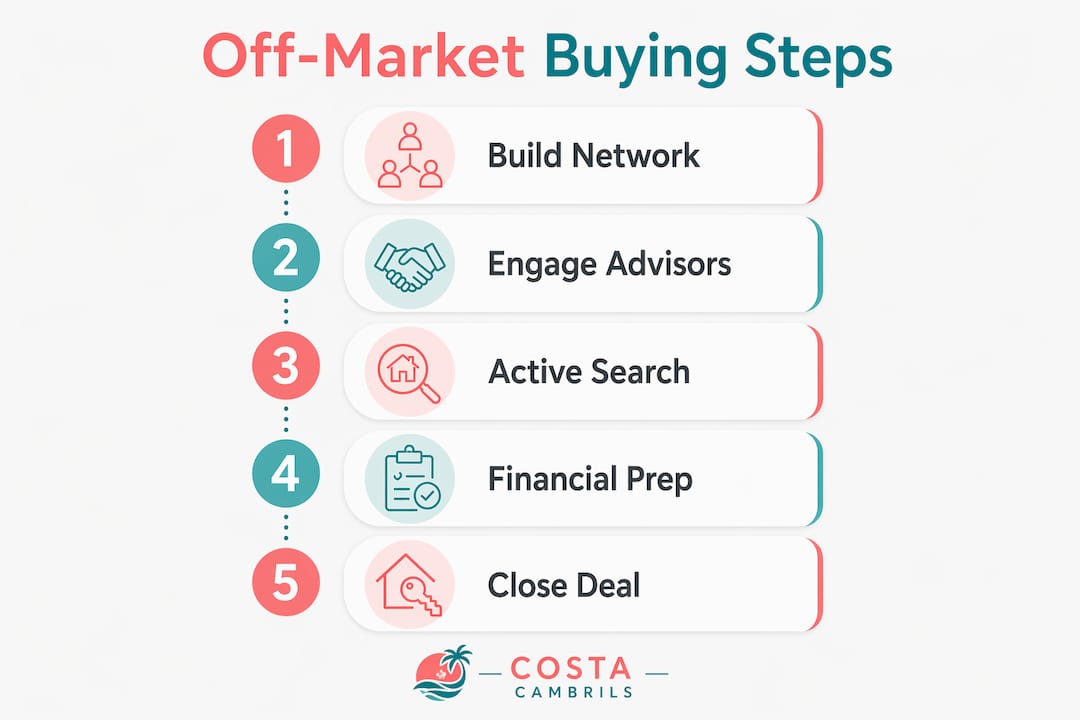
Finding hidden property listings requires a fundamentally different approach than browsing portals. The off-market channel is relationship-driven, not search-driven.
Build the right network
Brokers who specialize in private sales, developers with pre-launch inventory, and estate attorneys handling probate or portfolio sales are the primary gatekeepers. These professionals share opportunities with buyers they know and trust. Showing up once with a vague inquiry does not build that trust. Consistent, professional engagement over time does.
Work with a specialist advisory firm
Off-market sales distribute Information Memoranda to vetted investors, typically generating 3–8 qualified inquiries within a week, followed by due diligence and transaction finalization in 2–4 weeks. That timeline is only accessible to buyers already inside the network. An advisory firm with established relationships puts buyers inside that process from day one.
Use active demand-driven search
Waiting for off-market deals to arrive is passive and slow. Active buyers contact developers directly, reach out to owners of properties they want to acquire, and make their buying criteria known to multiple advisors simultaneously. This approach generates opportunities that never enter any formal listing process.
| Strategy | What it requires | Timeline to first opportunity |
|---|---|---|
| Broker networking | Consistent relationship building | 1–3 months |
| Advisory firm engagement | Clear criteria and pre-approved financing | Days to weeks |
| Direct owner outreach | Research and targeted contact | 2–6 weeks |
| Developer pre-launch access | Established developer relationships | Project-dependent |
Maintain financial readiness
Successful off-market investors maintain pre-approved financing to act within hours, not weeks. This is not a suggestion. It is the baseline requirement for being taken seriously in private transactions. Sellers and their advisors screen buyers on financial credibility before sharing any deal details. Buyers who cannot demonstrate readiness are filtered out immediately.
For investors looking at property investment tips in 2026, financial preparation ranks as the single most cited factor separating buyers who close off-market deals from those who miss them.
Key Takeaways
Off-market properties give prepared buyers access to exclusive inventory, stronger negotiating positions, and pricing advantages that public listings cannot match.
| Point | Details |
|---|---|
| Off-market is a controlled process | Authentic deals require NDAs and pre-qualified buyers, not just unpublished listings. |
| Pricing advantages are real | Off-market sales can achieve 8–15% higher prices, creating leverage for informed buyers. |
| Off-plan savings compound | Buying before completion saves 10–25% upfront, with additional annual appreciation in growth markets. |
| Speed determines access | Pre-approved financing is the baseline requirement for entering any off-market deal. |
| Relationships open the door | Brokers, advisory firms, and developer networks are the primary access points for private inventory. |
Off-market is not a secret. It is a standard.
I have watched buyers spend months refreshing property portals, convinced the right deal will eventually appear. It rarely does. The properties worth owning in any competitive market trade privately, and they trade fast.
What surprises most buyers is that off-market is not about secrecy for its own sake. Off-market is a strategic process that enhances transparency, control, and negotiation leverage for buyers and sellers who are prepared. The seller gets a qualified buyer without public exposure. The buyer gets access to inventory without competing against the entire market. Both sides benefit from a cleaner, faster transaction.
The buyers I have seen succeed in this channel share three traits. They come with financing ready. They work with advisors who have real relationships, not just marketing materials. And they treat off-market access as something earned through preparation and credibility, not something stumbled upon.
The market is bifurcating. Public portals are filling with properties that did not sell privately. The best assets are moving faster and more quietly than ever. Buyers who understand this are not just finding better deals. They are operating in a different market entirely.
— Oscar
Exclusive property access through Costacambrils
Costacambrils specializes in luxury and exclusive real estate along the Costa Dorada, with a particular focus on Cambrils and the surrounding Tarragona region. The team maintains direct relationships with developers, private sellers, and institutional owners who do not list publicly.
For investors and homebuyers seeking access to exclusive properties in Spain, Costacambrils provides pre-vetted opportunities, full legal and financial advisory support, and hands-on guidance through every stage of the transaction. The firm’s network covers new developments, resale villas, and portfolio assets that never reach public portals. Contact Costacambrils directly to discuss your buying criteria and gain access to luxury property opportunities that match your investment profile.
FAQ
What does “off-market property” mean?
An off-market property is a real estate asset sold privately, without public listing on portals or the MLS. Transactions proceed through direct networks, NDAs, and pre-qualified buyer lists.
Why do sellers choose off-market channels?
Sellers choose off-market sales for privacy, speed, and price control. Avoiding public exposure protects market value and allows sellers to target serious, pre-qualified buyers only.
Are off-market properties cheaper for buyers?
Not always. Off-market sellers targeting pre-qualified investors can achieve 8–15% price premiums over public listings. Buyers benefit from less competition and better negotiating terms, not necessarily lower asking prices.
How do I access off-market property listings?
Access comes through broker networks, specialist advisory firms, and direct developer relationships. Buyers with pre-approved financing and clear criteria gain access fastest.
What is the biggest risk in off-market buying?
The biggest risk is reduced transparency. Without public disclosure requirements, buyers must commission independent due diligence, including surveys, title checks, and professional valuations, before committing to any deal.