TL;DR:
- Most international buyers underestimate the Spanish mortgage complexity for non-residents, including requirements for large down payments and extensive documentation.
- Ensuring early preparation of NIE, certified translations, and legal advice is crucial to avoid delays and fulfill lender criteria.
Buying a luxury property on the Costa Dorada sounds like a dream, and it genuinely can be. But here is what most buyers discover too late: the Spanish mortgage process for non-residents is far more demanding than a quick internet search suggests. Banks require large down payments, mountains of paperwork, and certified translations that can take weeks. If you are planning to purchase a villa or high-end apartment in Cambrils, Salou, or the surrounding area, understanding exactly how this process works before you make an offer is not just helpful — it is essential.
Table of Contents
- Understanding Spanish mortgage fundamentals for non-residents
- Essential documents and compliance: What international buyers must prepare
- Step-by-step: How the Spanish mortgage process works
- Hidden challenges and solutions for luxury property buyers
- Our experience: What most guides miss about the Spanish mortgage process
- Get expert help securing your dream property on the Costa Dorada
- Frequently asked questions
Key Takeaways
| Point | Details |
|---|---|
| High down payment needed | Non-resident buyers typically need at least 30–40% cash plus extra purchase costs. |
| Paperwork is complex | Certified translations and apostille requirements often cause avoidable delays. |
| Start early with documents | Preparing and verifying paperwork in advance keeps the process moving. |
| Legal and expert help pays off | Specialized guidance helps avoid pitfalls, especially in luxury transactions. |
Understanding Spanish mortgage fundamentals for non-residents
First, let’s clarify what makes the Spanish mortgage landscape unique for overseas luxury buyers.
The single biggest shock for most international buyers is the loan-to-value ratio, often called LTV. Spanish banks apply stricter limits to non-residents than to Spanish citizens. As a non-resident borrower, maximum LTV is generally capped between 60% and 70% of the property’s appraised value, which means your minimum down payment is typically 30% to 40%. That is before you factor in purchase costs like taxes, notary fees, and legal services, which typically add another 10% to 15% on top.
For luxury properties, this has real financial implications. On a €1.2 million villa in Cambrils, a 35% down payment means you need €420,000 in cash before the bank will even consider your file. This is why following the luxury home buying steps carefully from the start helps you plan your finances realistically.
Here is a comparison of key mortgage terms for residents versus non-residents:
| Feature | Spanish resident | Non-resident international buyer |
|---|---|---|
| Maximum LTV | Up to 80% | 60% to 70% |
| Minimum down payment | 20% | 30% to 40% |
| Income documentation | Spanish payslips or tax returns | Foreign income with certified translations |
| Mortgage term | Up to 30 years | Typically up to 20 to 25 years |
| Interest rate | Competitive | Slightly higher on average |
Several factors determine how lenders assess non-resident applications:
- Debt-to-income ratio: Most Spanish banks want your total monthly debt obligations to stay below 35% to 40% of your net monthly income.
- Employment status: Employed applicants tend to have smoother applications than self-employed individuals, who face more scrutiny.
- Country of residence: Banks apply different risk profiles depending on where you live. Buyers from certain countries may face additional compliance checks.
- Credit history: Some banks request a credit report from your home country, sometimes requiring apostille certification.
Understanding the full picture before searching is why reviewing the full guide to buying luxury property Costa Dorada is a smart first step.
Essential documents and compliance: What international buyers must prepare
With the basics established, it is crucial to understand the paperwork — often a surprise obstacle for international clients.
The most important document you need before anything else is the NIE, which stands for Número de Identidad de Extranjero. This is Spain’s foreigner tax identification number, and without it, you cannot sign any legal document, open a Spanish bank account, or complete a property purchase. You can apply in person at a Spanish consulate in your home country or in Spain through the Policía Nacional. Allow several weeks for processing.
Beyond the NIE, lenders typically require a substantial package of financial documents. Here is a numbered breakdown of what you will need to prepare:
- Valid passport (certified copy, sometimes apostilled)
- NIE certificate (original or certified copy)
- Proof of income (last 2 to 3 years of payslips or business accounts)
- Personal tax returns (last 2 to 3 years from your home country)
- Bank statements (last 3 to 6 months, showing savings capacity and regular income)
- Employment contract or business registration documents
- Credit report from your home country (bank-dependent)
- Proof of existing assets (investment portfolios, other property)
Critically, document preparation for non-residents commonly includes an NIE plus income and identity evidence, and banks often require translated and sometimes apostilled documents. This means every document in a foreign language must be translated by a certified translator into Spanish, and in many cases, that translation itself needs an apostille stamp to confirm its validity under international law.

What makes this particularly challenging is the timeline. Document formalities including certified translations and apostille requirements are a common source of delays for overseas income documents. A certified translation for a full set of tax returns and bank statements can take one to two weeks. Apostille processing in some countries takes another two to four weeks. If you start this process after finding a property, you are likely to miss your timeline.
Pro Tip: Begin gathering and translating your documents at least two months before you plan to make an offer. This keeps you in a strong negotiating position and signals to sellers that you are a serious buyer.
The documentation checklist for non-resident buyers is a practical resource for building your file before you even contact a bank. Equally important is understanding the legal property requirements Costa Dorada, which affect not just the mortgage but the overall purchase validity.
“The biggest mistake international buyers make is assuming their documents from home will be accepted as-is. Spanish banks have specific standards, and a missing apostille can delay closing by weeks.”
Step-by-step: How the Spanish mortgage process works
Once your documents are ready, here is how the mortgage application process actually unfolds in Spain.
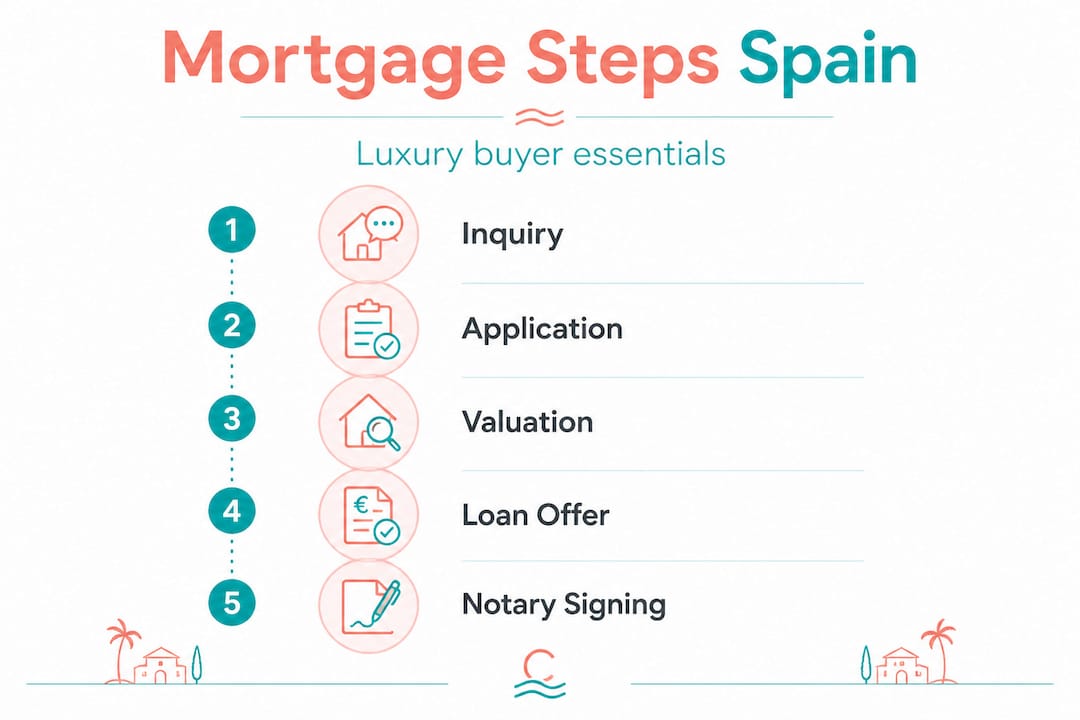
Step 1: Initial inquiry and pre-qualification
Before formally applying, it is smart to approach two or three Spanish banks or mortgage brokers with your financial profile. This gives you a realistic sense of what terms you can expect, including interest rates and maximum loan amounts, without triggering formal credit checks. Some banks offer a “mortgage in principle” letter, which is useful when negotiating with sellers.
Step 2: Formal application and document submission
Once you identify a property and agree on a price, you submit your full document package to the lender. The bank assigns an internal analyst who reviews your income, liabilities, nationality profile, and creditworthiness. This stage typically takes two to four weeks, longer if documentation is incomplete.
Step 3: Property valuation (tasación)
The bank orders an independent property valuation from an approved appraiser, called a tasador. This is a critical step for luxury properties because the mortgage is based on the appraised value, not the purchase price. If the appraised value comes in lower than the agreed purchase price — something that happens more often with premium or unique properties — the bank will only lend against the lower figure. This means you may need to cover the gap in cash.
Step 4: Loan offer (FEIN)
If your application is approved, the bank issues a binding loan offer called the FEIN, or Ficha Europea de Información Normalizada. You have ten calendar days to review this document before signing. It details the loan amount, interest rate (fixed, variable, or mixed), monthly payments, and all associated conditions.
Step 5: Notary signing and fund transfer
The final step involves signing the mortgage deed and the property purchase deed simultaneously at a Spanish notary office. Your lawyer reviews all documents in advance. The bank transfers funds directly at signing, and the notary registers the transaction. The whole process from accepted offer to keys is typically six to ten weeks for well-prepared buyers.
For luxury or exclusive listings, some extra considerations apply. High-value properties sometimes require multiple appraisals, and the bank may request additional security or guarantees. Working closely with a local luxury buyer’s guide Costa Dorada expert ensures no step gets skipped.
Pro Tip: Always have a Spanish-speaking lawyer review the FEIN and the purchase contract before notary day. Conditions buried in mortgage deeds can include clauses about floor rates on variable interest or early repayment penalties that are easy to miss.
It is worth noting again that the minimum down payment for non-residents is typically 30% to 40% of the property value, and this does not include purchase costs. Factor this clearly into your total cash requirement before you commit to a property.
Hidden challenges and solutions for luxury property buyers
The reality is, even well-prepared luxury buyers can stumble. Let’s highlight common roadblocks and how to avoid them.
Foreign income scrutiny
Banks treat foreign income with extra caution. If you are paid in a currency other than euros, the bank will convert your income and may apply a discount to account for exchange rate risk. Self-employed buyers, company directors, or those with complex income streams such as dividends or rental income from multiple countries face the most detailed review. Be ready to explain your income structure clearly with supporting evidence.
Country-specific policies
Not all Spanish banks accept applicants from every country. Some international banks operating in Spain have broad acceptance policies, while regional savings banks (cajas) may restrict non-resident lending to buyers from specific EU countries. Research which banks actively work with buyers from your country before investing time in an application.
Valuation gaps on luxury properties
This is one of the most underestimated risks. A villa listed at €1.5 million may appraise at €1.35 million in the bank’s formal valuation. That €150,000 gap must be paid in cash from your own funds, on top of your existing down payment commitment. Using a recognized and experienced appraiser rather than the cheapest option can reduce the chance of a significant gap.
As noted, document formalities and apostille requirements remain a consistent source of delays for international buyers. The solution is simple in theory but requires discipline: build a document preparation timeline and start at least eight weeks before your target offer date.
- Hire a certified translator who specializes in financial documents.
- Check apostille requirements in your home country early.
- Confirm with your target bank which specific documents they require before translating everything.
- Keep digital and physical copies organized in a single folder.
“Having local legal and financial advisors in Spain is not a luxury — it is a practical necessity that directly speeds up every stage of your purchase.”
Working with real estate agents for international buyers who understand these nuances can mean the difference between a smooth six-week closing and a four-month ordeal.
Our experience: What most guides miss about the Spanish mortgage process
Now that you have the full process, here is a professional perspective on what makes or breaks a smooth deal.
Most online guides about Spanish mortgages make the process sound manageable in a few simple steps. The reality we see at ground level is more nuanced. The bureaucratic load is real, and it does not care about how motivated you are or how much you want the property.
The counterintuitive lesson we have learned from working with international buyers over many years is this: the buyers who move fastest are not the ones with the most money. They are the ones who assembled their legal and financial team before they fell in love with a property. By the time they found the right villa, their NIE was already processed, their documents were translated and apostilled, and their lawyer had already reviewed standard Spanish mortgage terms. They could move quickly because they had done the unsexy work upfront.
Another common mistake is treating the mortgage as a banking issue and the property purchase as a real estate issue. They are deeply intertwined. A lawyer who understands both the legal and financial dimensions in Spain is far more valuable than two separate advisors who do not communicate with each other.
We also want to be direct about something: the Spanish mortgage process is not designed to be easy for non-residents. It is designed to protect lenders and the Spanish financial system. Fighting against this reality by cutting corners on documentation or legal review almost always creates problems that cost more to fix than they saved upfront.
Our consistent advice to any international luxury buyer is to prioritize legal advice for Costa Dorada deals from day one, even before viewing properties. It changes how you search, how you negotiate, and how quickly you can close when the right property appears.
Get expert help securing your dream property on the Costa Dorada
If you want a truly seamless process on the Costa Dorada, expert support makes all the difference.
At Costa Cambrils, we work exclusively with international buyers seeking luxury properties in Cambrils and the wider Costa Dorada region. We understand what luxury real estate means in this market and the specific challenges you face as a non-resident buyer. Our team guides you through every stage, from property selection to mortgage navigation to final signing at the notary.
Our role as a luxury agency on the Costa Dorada goes well beyond listing properties. We connect you with trusted legal advisors, certified translators, and mortgage specialists who work with international buyers daily. Whether you are at the research stage or ready to make an offer, we offer a personalized approach built around your timeline and goals. Discover how our luxury investment agency can make your Costa Dorada purchase faster, safer, and more rewarding.
Frequently asked questions
How much can non-residents borrow for a Spanish mortgage?
Non-residents are usually limited to 60% to 70% LTV, meaning a minimum 30% to 40% down payment is required, not including purchase costs like taxes and legal fees.
What documents are essential for a Spanish mortgage as an international buyer?
You need an NIE, proof of income, bank statements, tax returns, and certified translations of all foreign documents; some banks also require apostille stamps on certain documents.
How long does the Spanish mortgage process take?
The process typically takes six to ten weeks for prepared buyers, but apostille and translation delays can extend this significantly if document preparation starts too late.
Are there extra purchase costs besides the down payment?
Yes, budget an additional 10% to 15% of the purchase price for property transfer tax, VAT on new builds, notary fees, land registry fees, and legal services.
Can I get a Spanish mortgage if my income is from abroad?
Yes, but foreign income documentation requires certified translations and often apostilles, and banks may apply a currency risk discount to your declared income when calculating your maximum loan.
Recommended
- Luxury property buying guide: Costa Dorada’s top real estate – Inmobiliaria Costa Cambrils
- Real estate agents in Spain: what international buyers need – Inmobiliaria Costa Cambrils
- How to buy property in Costa Dorada: luxury buyer’s guide – Inmobiliaria Costa Cambrils
- How to buy luxury property in Spain: Costa Dorada guide – Inmobiliaria Costa Cambrils