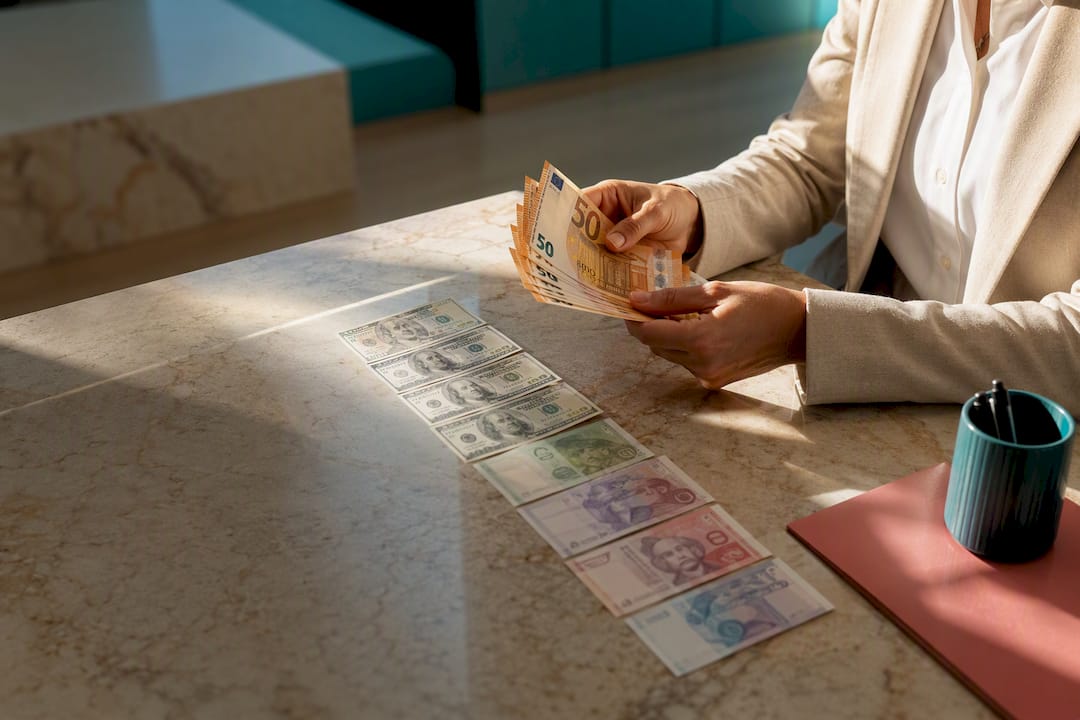
Yes, you can arrange the underlying funds in dollars, pounds, or another foreign currency, but every escritura, deposit, and tax payment in Spain settles in euros. That single fact drives three things you need to nail down before you sign anything: how the tax authorities convert your gain or loss, what a bank or FX provider actually charges to move six figures across borders, and how much a bad exchange-rate swing could cost you between reservation and completion.
TL;DR:
- Foreign currency transfers often take one to three business days, with large transactions flagged for anti-money laundering checks and reporting, so plan extra time for settlement.
- When purchasing from a nonresident seller, buyers must withhold 3% of the sale price and pay it within one month to avoid tax liabilities.
- Converting foreign-currency funds to euros for the final transfer must be done before signing, using the exchange rate on the transmission date to avoid miscalculations.
- Online FX providers like Wise usually offer closer-to-market rates with transparent fees, but large transfers may exceed online caps and require manual processing.
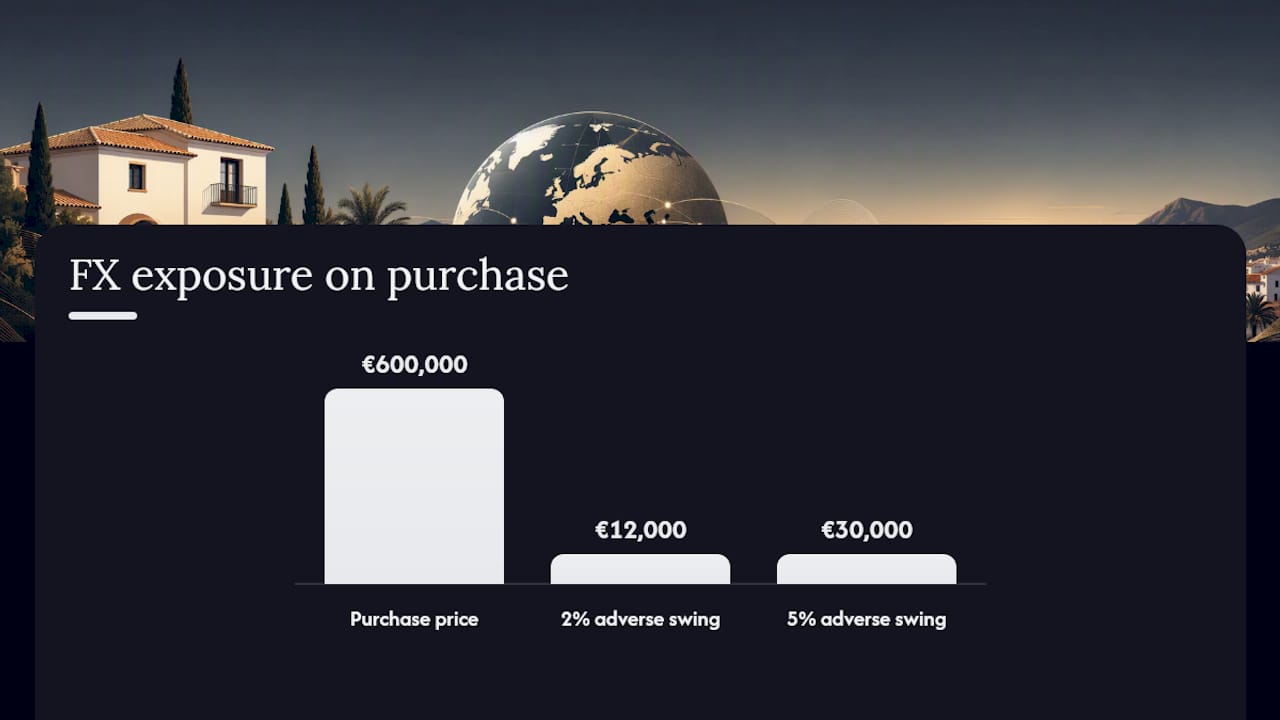
- Lock in exchange rates with forward contracts or split transfers to mitigate currency risk, as a 2% adverse swing can add roughly €12,000 on a €600,000 purchase.
Table of Contents
- Where currency exchange for housing enters the purchase timeline
- Legal and tax rules for foreign-currency transactions in Spain
- Comparing ways to move money for a Spanish property purchase
- Managing exchange-rate risk on a euro-denominated purchase
- Pre-closing checklist: what to prepare 4 to 6 weeks out
- Common mistakes international buyers make with currency timing
- How Costacambrils helps you close without currency surprises
- Sources
- FAQ
Where currency exchange for housing enters the purchase timeline
Currency decisions don’t happen once. They show up at three distinct moments, and treating them as one event is how buyers get blindsided by costs they didn’t budget for.
- The deposit (arras). Most reservation contracts specify a euro amount, even when the buyer’s savings sit in another currency. If you wire foreign funds and the rate moves before the transfer settles, you can end up short of the agreed sum, which puts the deposit contract at risk.
- The final transfer at the notary. Spanish notaries expect cleared euros in a Spanish account before signing. Almost everyone converts well ahead of the appointment, usually days in advance, since a delayed or short transfer can push back the escritura date.
- Tax payments. Transfer tax, notary fees, and any withholding obligations are all calculated and paid in euros, regardless of what currency financed the purchase.
International transfers of any real size typically take one to three business days once compliance checks clear, and Spanish banks routinely flag large incoming wires for anti-money-laundering review. Transfers above certain thresholds also trigger reporting obligations tracked by the Banco de España, so build a few extra days of margin into your closing calendar rather than assuming same-day settlement.
Legal and tax rules for foreign-currency transactions in Spain
Spain’s tax framework doesn’t care what currency financed your purchase, but it cares a great deal about who is selling and how the numbers get converted.
If the seller is a nonresident, the buyer is legally required to withhold 3% of the purchase price and pay it directly to the Agencia Tributaria using Modelo 211, within one month of the sale date. This isn’t optional and it isn’t negotiable at the notary table: it functions as a guarantee against the seller’s Spanish capital gains liability, and skipping it exposes the buyer to the seller’s unpaid tax debt.
In practice: on a purchase from a nonresident seller, the buyer must withhold 3% of the sale price and pay it within one month, separate from any transfer tax.
For transactions actually priced or settled in a foreign currency, the Dirección General de Tributos has clarified the conversion method: calculate the gain or loss in the original transaction currency first, then convert only that final difference into euros using the exchange rate on the date of transmission. Converting each side of the transaction separately before comparing them produces the wrong number and can distort a declared gain or loss significantly.
A few legal sources matter if you want to verify this yourself:
- The Boletín Oficial del Estado publishes the Real Decrees governing nonresident transactions and capital movement declarations.
- Ley 19/2003 sets the framework for foreign capital transactions and reporting.
- Banco de España circulars, including Circular 4/2012, cover how residents must report foreign-currency balances and cross-border transfers.
Our guide to Spanish real estate laws for international buyers walks through the broader legal picture beyond currency specifics.
Comparing ways to move money for a Spanish property purchase
Not all transfer routes are built the same, and the difference between them on a €400,000 wire can easily run into thousands of euros.
Spanish banks offer the comfort of a direct relationship with your notary and lawyer, but their FX margins on international transfers tend to run wider than specialist providers, and international wires often route through correspondent banks that add their own fees along the way.
International bank transfers from your home-country bank work similarly, with the added friction of SWIFT correspondent charges that aren’t always disclosed upfront. You may not know the total cost until the money lands.
Online FX platforms and multicurrency accounts, including providers like Wise, generally quote rates closer to the mid-market rate with transparent, itemized fees. The catch: confirm the provider is authorized to operate in Spain and check its transfer limits, since large property-sized transfers sometimes exceed standard online caps and require manual processing.
Casas de cambio (currency exchange bureaus) are convenient for small cash amounts but rarely practical or competitive for six-figure property transfers.
Before choosing, run this checklist against every quote:
- The FX margin above the mid-market rate (often the biggest hidden cost)
- Any fixed transfer fee
- Correspondent or intermediary bank charges
- Receiving-bank fees on the Spanish side
Pro Tip: A “zero commission” transfer almost always hides its cost inside a wider exchange margin. Ask for the total euro amount you’ll receive, not just the advertised fee, and compare that final number across providers.
Managing exchange-rate risk on a euro-denominated purchase
If your income arrives in dollars, pounds, or another non-euro currency but your mortgage and purchase price are in euros, you carry currency mismatch risk for as long as that loan exists. A mortgage denominated in euros usually reduces this risk compared with financing abroad, since matching your debt currency to the property’s currency removes one variable. Requesting a mortgage from a foreign bank is legally possible, but it’s rarely practical unless your income itself is in that foreign currency. Otherwise the added complexity and FX exposure typically outweigh any interest-rate advantage.
Practical ways to reduce exposure between offer and completion:
- Lock in a forward contract with your FX provider to fix today’s rate for a transfer happening in 30 to 60 days.
- Split the transfer into stages rather than moving the full amount at once, averaging your exposure across several rate points.
- Keep a euro account open in Spain ahead of time so funds can move quickly once you decide to convert.
- Finance part of the purchase in euros through a Spanish mortgage, reducing the foreign-currency portion you need to convert.
Stress-test the numbers before you commit. On a €600,000 purchase, a 2% adverse currency swing between reservation and completion adds roughly €12,000 to your effective cost in your home currency. A 5% move adds around €30,000. Neither scenario is rare over a two-to-three-month closing window, which is exactly why locking a rate early is worth the small premium it usually costs.
Our Spain mortgage guide for international buyers covers financing structures that help limit this exposure further.
Pre-closing checklist: what to prepare 4 to 6 weeks out
Give yourself a full month of buffer before completion, not a week.
- Gather proof-of-funds documentation now: recent bank statements, the source-of-funds trail (sale contracts, inheritance paperwork, business income), and any required apostilled translations. Banks finance nonresidents at lower loan-to-value ratios, typically 60% to 70% versus around 80% for residents, so confirm your financing gap early.
- Confirm beneficiary bank details with the notary or lawyer, including which currency the receiving account accepts and who absorbs transfer costs.
- Confirm the 3% withholding and Modelo 211 timeline with your lawyer if the seller is a nonresident, and budget an extra roughly 10% to 15% beyond the sale price for taxes and closing costs.
Pro Tip: Send your transfer at least five business days before the notary appointment. AML checks on large international wires can add unexpected delays that jeopardize a fixed completion date.
Common mistakes international buyers make with currency timing
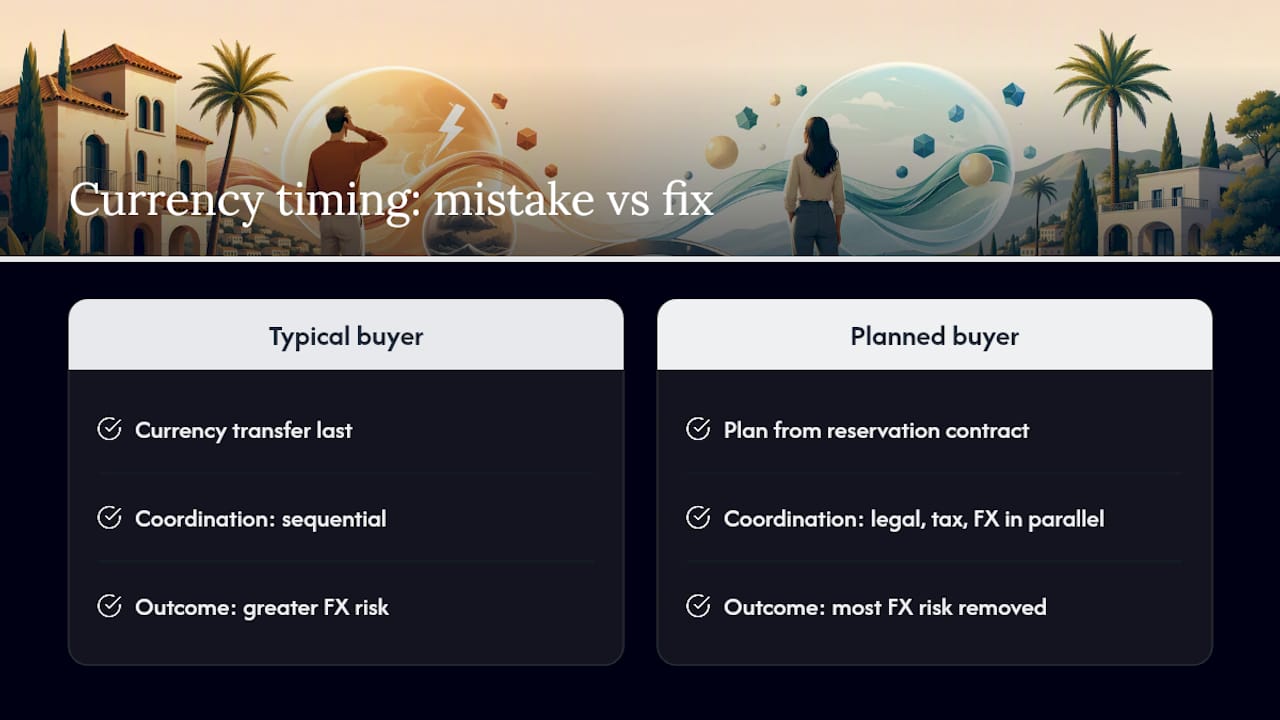
The buyers who run into trouble almost always share the same pattern: they treat the currency transfer as the last box to tick instead of the first thing to plan.
Coordinating legal, tax, and FX planning in parallel from the moment you sign the reservation contract removes almost all of that risk…
— Oscar
How Costacambrils helps you close without currency surprises
Some real estate agencies offer a coordinated service that manages property search, legal and tax paperwork, and introductions to Spanish banks to help avoid last-minute issues with currency timing.
Our team works across new builds, resale villas, and residential developments in Cambrils and the wider Costa Dorada, and we support buyers coordinating remotely from outside Spain just as often as those relocating in person. That includes lining up beneficiary bank details early, flagging the 3% withholding requirement before it becomes a closing-day surprise, and handling document translation so nothing stalls at the notary. If you’re weighing a purchase or preparing to sell, browse current listings and get in touch with our team to start the conversation before your transfer clock starts ticking.
This article is general information, not a substitute for advice from a qualified financial advisor. Consult a qualified financial professional about your own circumstances before acting on anything here.
Sources
- Comprar inmueble si eres no residente: ¿qué impuestos y pasos? — Wise (Spain)
- La DGT aclara el criterio de conversión en euros en transmisiones inmobiliarias realizadas en divisa extranjera — Primera Lectura Ediciones
- Comprar propiedad en España como extranjero — Pellicer Heredia (2026)
FAQ
How much money can you exchange at a casa de cambio in Spain?
Currency exchange bureaus in Spain can handle amounts ranging from small cash sums up to several thousand euros, but they’re rarely the right channel for property-sized transfers. For a home purchase, a bank transfer or online FX platform is the practical route since casas de cambio aren’t built for six-figure conversions.
How much do currency exchange providers charge?
Costs come from two places: a fixed fee (if any) and the exchange margin above the mid-market rate, which is usually the larger cost. A provider advertising “zero commission” can still charge more overall once you compare the actual euros you receive against the mid-market rate, as Wise’s own cost comparison illustrates.
Where can you exchange currency in Spain for a property purchase?
Options include your Spanish bank, an international transfer from your home bank, or an online FX platform authorized to operate in Spain. Each route differs in speed, transparency, and total cost, so compare the final euro amount you’ll receive rather than just the headline rate.
How do you convert currency for a home purchase in Spain?
You typically transfer funds into a Spanish euro account ahead of the notary appointment, either through your bank or a specialist FX provider, giving several business days for AML checks and clearance. If the seller is a nonresident, remember the buyer must also withhold 3% of the price and file it through Modelo 211.
Does buying property in Spain in foreign currency create extra tax steps?
Yes. The DGT requires calculating the gain or loss in the original transaction currency first, then converting that final figure to euros at the exchange rate on the sale date, rather than converting each side separately. This affects how capital gains are reported and can change the tax outcome noticeably.