Yes, non-residents can open a bank account in Spain, and most applicants qualify with a passport, proof of tax residency abroad, and evidence of where their money comes from. Start by gathering your passport, a tax residency certificate from your home country, and either a NIE or a Certificado de No Residente. These accounts cover everyday needs like paying a property deposit, receiving rental income, or settling utility bills without constant currency conversion.
TL;DR:
- Non-residents need to provide a passport, proof of tax residency abroad, and either a NIE or a no-resident certificate to open a Spanish bank account.
- Choosing the correct account type is crucial: current accounts suit property and utility payments, savings accounts are better for parking funds, and online accounts often require a final in-person verification.
- Completing the application process quickly depends on having all documents translated, avoiding soon-expiring IDs, and pre-briefing with the bank’s International Desk.
- Fees typically include maintenance, card, ATM, and international transfer costs, with some banks waiving fees if minimum balances or active use are maintained.
- UK nationals face extra verification steps post-Brexit, so they should start the process early and prepare for longer review times.
Table of Contents
- Types of Non-Resident Accounts and Which One Fits You
- What Documents Do You Need to Open a Non-Resident Account?
- How Do You Open the Account: Online or In-Branch?
- What Fees and Limits Should You Expect?
- How Does Spanish Tax Law Treat Non-Resident Account Holders?
- Practical Compliance Tips to Avoid Delays
- Why Property Buyers in Spain Rely on a Local Account
- Does Brexit Change Banking Rules for UK Nationals?
- Are There Limits on Moving Money In and Out of Your Account?
- Managing Your Spanish Account From Abroad
- What Buyers Get Wrong About Timing Their Bank Account
- How Costa Cambrils Helps International Buyers Get Banking Right
- Sources
Types of Non-Resident Accounts and Which One Fits You
Spanish banks split non-resident products into a few clear categories, and picking the right one saves you fees later. A payment or current account handles day-to-day transactions: debit card, direct debits for utilities, and standard transfers. A savings account pays modest interest but often restricts how often you can withdraw without penalty, which matters if you’re parking funds ahead of a property closing.

Online-only non-resident accounts, like the products offered by Banco Santander, let you apply from abroad using just a passport. The tradeoff is that some still require a branch visit to finish identity verification before the account goes fully live.
For property transactions, notaries and sellers generally expect a standard current account tied to a Spanish IBAN, not a savings product.
- Current account: best for deposits, tax payments, recurring bills
- Savings account: better for holding funds, weaker for frequent transfers
- Online-only account: convenient setup, but check whether final verification needs an in-person step
What Documents Do You Need to Open a Non-Resident Account?
Banks in Spain treat non-resident applications as higher scrutiny by default, so arriving prepared cuts your wait time dramatically. Eligibility itself is simple: you need to be over 18, live outside Spain, and not appear on Spanish financial delinquency registries, according to BBVA’s guidance on non-resident accounts. The document list is where most delays happen.
- Valid passport, or national ID card if you’re an EU citizen
- NIE (Número de Identidad de Extranjero) or a Certificado de No Residente issued by Spanish authorities
- Proof of current address in your home country, usually a recent utility bill or bank statement
- Tax residency certificate from your country’s tax authority
- Proof of income or source of funds, such as pay slips, employment contracts, or recent tax returns
If any document isn’t in Spanish, most banks will insist on an official sworn translation, known as a traducción jurada, before they’ll accept it into your file. Consular certificates can substitute for some paperwork if you can’t get a Spanish-issued document from abroad, but confirm this with the specific branch first since practices vary.
How Do You Open the Account: Online or In-Branch?
The path you choose depends on how quickly you need the account active and whether you can travel to Spain before closing on a property or signing a lease.
Most major banks, including BBVA, Banco Santander, and Banco Sabadell, let you start an application online, but full online onboarding for non-residents often still requires a final identity check in person or at a consulate to satisfy anti-money-laundering rules. Banco Sabadell markets a specific Key Account product aimed at non-residents that bundles this process with dedicated support staff.
Booking time with a bank’s International Desk or Banca Personal team usually moves faster than a standard branch queue, since those staff handle non-resident cases daily and know exactly which documents trigger delays.
- Submit your application online or book an International Desk appointment
- Complete identity verification and AML screening
- Sign the account contract, in person or via a verified digital signature
- Activate online banking and mobile app access
- Receive your debit card and IBAN, usually by mail within one to two weeks
Timelines vary from same-day approval to several weeks if your documents need translation or additional verification.
Pro Tip: Call the International Desk before you travel to Spain and ask them to pre-review your document list by email. Catching a missing paper before your appointment saves you an entire extra trip.
What Fees and Limits Should You Expect?
Non-resident accounts carry the same basic fee categories as resident accounts: maintenance fees, card issuance fees, ATM withdrawal charges outside the bank’s network, and SWIFT transfer costs for international wires. Some banks waive maintenance fees entirely for non-residents who maintain a minimum balance or use the account actively, and Banco Santander’s online passport account is one example marketed with no maintenance fee for qualifying customers.
Watch for these common cost points:
- Monthly maintenance, often waived under conditions
- Card issuance and annual renewal fees
- ATM withdrawal fees outside the issuing network
- SWIFT or international transfer charges, typically higher than SEPA transfers within the euro zone
Non-residents also face tighter limits on credit products. Getting a Spanish credit card or mortgage without local income history is harder than opening a basic account, and some online banking features roll out to non-residents more slowly than for residents. Keeping funds in euros through your Spanish IBAN avoids repeated currency conversion when you’re paying property taxes or community fees.
How Does Spanish Tax Law Treat Non-Resident Account Holders?
The Non-Resident Income Tax, known as IRNR, governs how Spain taxes income you earn inside the country while living abroad, and it’s built on Real Decreto Legislativo 5/2004. Interest earned on your account, and rental income if you’re leasing out a Spanish property, both fall under this framework rather than the resident income tax (IRPF).
Your tax residency status isn’t just a banking formality. The Agencia Tributaria applies a 183-day physical presence test and a center-of-vital-interests test to determine residency, and the same person can sometimes be classified differently for tax purposes than for banking purposes.
Double-taxation treaties between Spain and your home country can reduce or eliminate withholding on certain income types, but only if you provide a valid tax residency certificate to your bank and, where relevant, to the Agencia Tributaria directly.
If you’re generating meaningful income through the account, whether from rent or investments, talk to a Spanish tax advisor before assuming your home-country treaty automatically applies.
Practical Compliance Tips to Avoid Delays
Banks apply enhanced due diligence to every non-resident file, which means you should walk in ready to justify where your money came from, not just how much you have.
- Bring several months of income documentation: pay slips, contracts, or tax returns, since a single bank statement rarely satisfies the source-of-funds check
- Get the actual Certificado de No Residente or physical NIE/TIE. Many banks refuse a resguardo, the receipt confirming your NIE application is pending
- Have non-Spanish documents translated by a certified sworn translator ahead of your appointment
- Don’t start the process with a visa or passport nearing expiration. Banks flag applications where identity documents will lapse soon after opening
Pro Tip: If your NIE application is still pending, request the Certificado de No Residente instead. It’s usually faster to obtain and most banks accept it as a standalone substitute.
Why Property Buyers in Spain Rely on a Local Account
Notaries and sellers strongly prefer a Spanish IBAN when you’re closing on a property, since it removes the delays and fees tied to cross-border wire transfers arriving right before signing. A local account also makes it far simpler to pay the deposit, transfer taxes, and ongoing community charges once you own the place.
Costa Cambrils works with international buyers throughout this process and helps make sure the banking paperwork lines up with what lenders and notaries expect before closing day.
- Coordinating document timing so your account is active before signing
- Explaining which account type suits deposit payments versus ongoing bills
- Connecting buyers with our mortgage guide for international buyers and our breakdown of residency and property purchase steps
Does Brexit Change Banking Rules for UK Nationals?
Brexit didn’t shut British citizens out of Spanish banking, but it did add friction that EU nationals no longer face. UK passport holders now go through the same non-EU application track as applicants from Canada, Australia, or the United States, which typically means more paperwork around proof of funds and residency status than an EU citizen would encounter.
Before Brexit, UK nationals could often lean on EU freedom-of-movement provisions to simplify some administrative steps. That’s gone. A UK applicant today needs the same core package as any other non-EU national: passport, NIE or Certificado de No Residente, tax residency certificate, and proof of income. The practical difference shows up most in how banks assess risk. Non-EU applicants sometimes face closer scrutiny on source-of-funds documentation, and processing can run longer if a bank’s compliance team wants extra verification.
For non-EU nationals generally, whether from the US, Canada, Latin America, or elsewhere, this has always been the standard track. Double-taxation treaties still function independently of EU membership. The UK and Spain maintain their own bilateral tax treaty, so UK nationals can still use a tax residency certificate to manage withholding on Spanish-sourced interest or rental income, just as before Brexit.
The bottom line: UK citizens can absolutely open non-resident accounts in Spain, but they should budget slightly more time and expect the same document rigor that any non-EU applicant faces. If you’re a UK buyer eyeing property on the Costa Dorada, starting your banking paperwork a few weeks earlier than you think you need to is the safest approach.
Are There Limits on Moving Money In and Out of Your Account?
Non-resident accounts don’t cap how much you can hold, but several practical restrictions shape how you move funds. International wire transfers above certain thresholds, generally anything over €10,000 entering or leaving Spain, trigger reporting obligations tied to anti-money-laundering rules, so expect your bank to ask questions about large or unusual transfers even after your account is fully active.
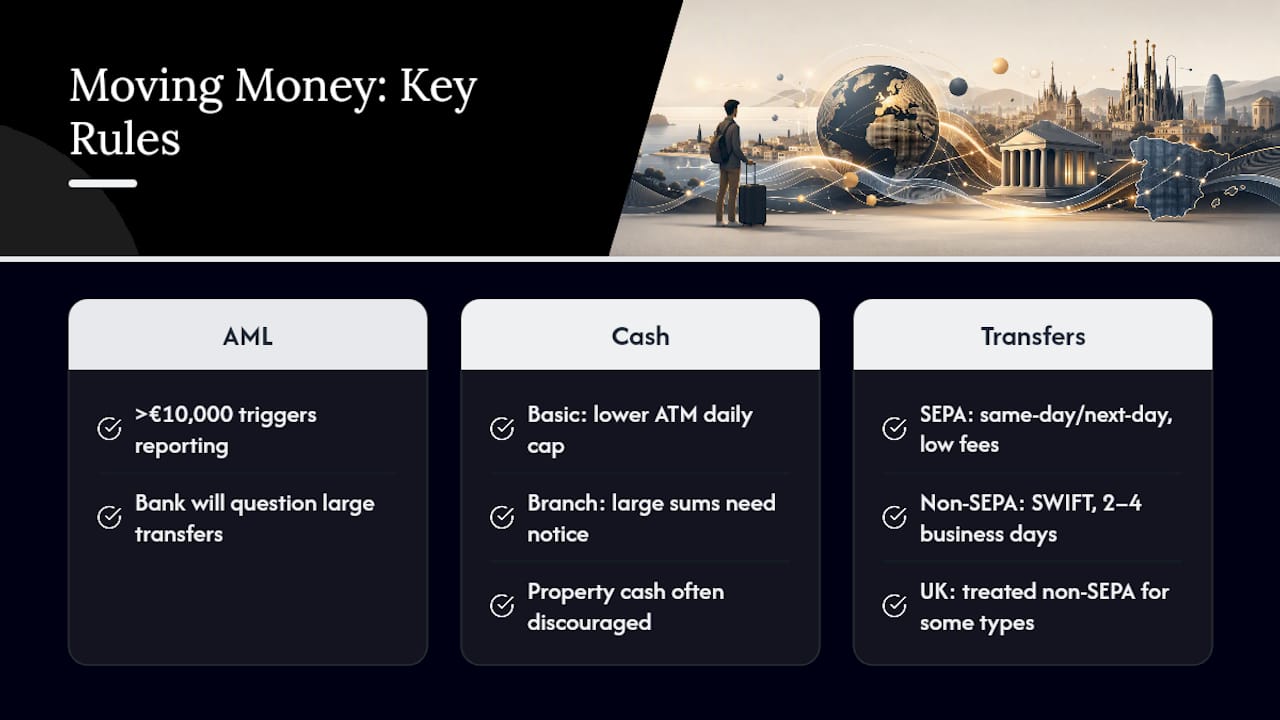
Cash withdrawal limits vary by account tier. Basic non-resident accounts often cap daily ATM withdrawals lower than standard resident accounts, and withdrawing large cash sums at a branch counter may require advance notice, particularly for amounts in the thousands of euros. If you’re planning to pay a property deposit in cash, which is increasingly discouraged and sometimes restricted outright for anti-fraud reasons, check with your notary and bank well before closing day.
Transferring funds abroad works differently depending on whether you’re sending within the SEPA zone (European Union plus a few additional countries) or outside it. SEPA transfers are typically same-day or next-day and carry minimal fees. Transfers to non-SEPA countries, including the UK post-Brexit for some transfer types, and countries like the US or Canada, route through SWIFT and carry higher fees along with slower settlement, often two to four business days.
Some non-resident account tiers also restrict certain online features, like setting up new payees or increasing transfer limits, until you’ve held the account for a few months or visited a branch to confirm your details. If you expect to move significant sums regularly, ask your bank directly about transfer limits and reporting thresholds before you commit to a specific account type.
Managing Your Spanish Account From Abroad
Every major Spanish bank now offers a mobile app with English-language support, and this is where non-resident banking has genuinely improved over the past several years. You can check balances, pay bills, and send SEPA transfers from anywhere with an internet connection, without needing to call a branch during Spanish business hours.
Mobile apps from BBVA, Banco Santander, and Banco Sabadell all support standard functions: viewing statements, scheduling recurring payments for community fees or utilities, and depositing checks via photo in some cases. Two-factor authentication is standard, usually through an SMS code or an app-based confirmation, so make sure your phone number stays current with the bank even after you return home.
Currency exchange is where non-residents often lose money without realizing it. Using your Spanish debit card abroad, or converting euros back to your home currency, typically runs through the bank’s own exchange rate, which carries a markup compared to the interbank rate. For larger transfers, a dedicated currency exchange service usually beats your bank’s standard rate, sometimes significantly, so it’s worth comparing before moving large sums for a property purchase or ongoing rental income repatriation.
If you’re managing a rental property remotely, set up automatic transfers for recurring costs like community fees and property tax before you leave Spain. It’s far easier to adjust a standing order through the mobile app than to arrange a one-off international transfer every quarter from abroad.
What Buyers Get Wrong About Timing Their Bank Account
The clients we talk to most often stumble on the same thing: they wait until a week before closing to start their bank paperwork, then scramble when a translation or certificate takes longer than expected. Start the account process the moment you begin seriously looking at property, and call an International Desk directly rather than waiting for a branch appointment slot. If you’re already planning a purchase, our residency and property purchase guide walks through what else to line up in parallel.
— Oscar
How Costa Cambrils Helps International Buyers Get Banking Right
Buying property from another country means juggling two bureaucracies at once: your bank’s requirements and Spain’s paperwork for foreign buyers. Costa Cambrils works this exact intersection every week with clients purchasing villas, apartments, and townhouses across Cambrils and the Costa Dorada, and we coordinate the banking side alongside the property search so you’re not solving both problems separately.
Our team helps you identify which documents a lender or notary will actually ask for before you’re standing in a bank branch confused about what’s missing, and we connect clients with the International Desk contacts that handle non-resident cases fastest. If you’re evaluating properties right now, browse our current luxury property listings to see what’s available in your budget and get in touch with our team to start the process alongside your banking paperwork rather than after it.
This article is general information, not a substitute for advice from a qualified financial advisor. Consult a qualified financial professional about your own circumstances before acting on anything here.
Sources
- Abrir una cuenta bancaria en España sin ser residente: así puedes hacerlo | BBVA
- Agencia Tributaria — Residency guidance for individuals
- Manual de tributación de no residentes (February 2023)
- Abrir cuenta bancaria como no residente en España: Guía 2026 — Cohen & Aguirre
- Cuenta Online para No Residentes con pasaporte — Banco Santander