
Before you make an offer on any property in Central Europe, do one thing first: model the jurisdiction. That means confirming foreign-buyer permit requirements, running a high-level tax lifecycle estimate, and instructing a local lawyer before you negotiate price. Investors who skip this step routinely discover that transfer taxes, notarial fees, and registration costs add a significant percentage to the purchase price on top of the listing figure, and that some ownership structures that looked efficient at signing create audit exposure on exit.
Here is what to do right now, before anything else:
- Confirm foreign-buyer permit or FDI screening risk. Third-country buyers in Poland, for example, must apply for a permit from the Minister of the Interior and Administration unless a statutory exemption applies. EU/EEA buyers face fewer restrictions but should still verify the current exemption scope with local counsel.
- Run a high-level tax lifecycle model. Map acquisition tax, annual holding cost, and exit tax before you set your offer price. The numbers often shift the effective yield by several percentage points.
- Instruct a local lawyer and notary. They flag timing triggers, registration deadlines, and encumbrances that no amount of remote research will surface.
Documents to prepare now:
- Valid passport (and a certified copy)
- Proof of funds (bank statement, audited accounts, or a letter from your bank)
- Entity documents if purchasing through a company (articles of association, beneficial ownership register extract, board resolution)
- Source-of-funds explanation letter for AML compliance
- Tax identification number from your home jurisdiction
Costacambrils provides a downloadable legal workflow and property checklist for international buyers at costacambrils.com/real-estate-legal-process-workflow. Use it to align your advisors from day one and reduce the back-and-forth that typically delays closings by weeks.
Table of Contents
- Why the jurisdiction decides the deal in cross-border property buying
- Who to hire and when: building the cross-border transaction team
- Due diligence beyond title: a Central Europe checklist
- Tax modelling and ownership structures that matter in Central Europe
- Funding, proof-of-funds, currency management and payment timing
- Contracts, notarization and registration: practical execution steps
- Mortgage availability and lender expectations for non-residents
- Exit planning and ongoing compliance after acquisition
- Common execution and regulatory risks and how to reduce them
- Practical checklist, required documents and a sample legal workflow
- Key Takeaways
- What cross-border buyers actually get wrong
- Costacambrils: your partner for international property in Costa Dorada
- Useful sources and further reading
Why the jurisdiction decides the deal in cross-border property buying
The single biggest mistake international investors make is treating Central Europe as a uniform market. It is not. Transfer tax rates, foreign-buyer permit requirements, land-registry digitalization, and VAT treatment on new builds vary country by country, and sometimes region by region within the same country. Getting this wrong does not just cost money; it can void a transaction entirely.
Transfer taxes, VAT, and notarial costs
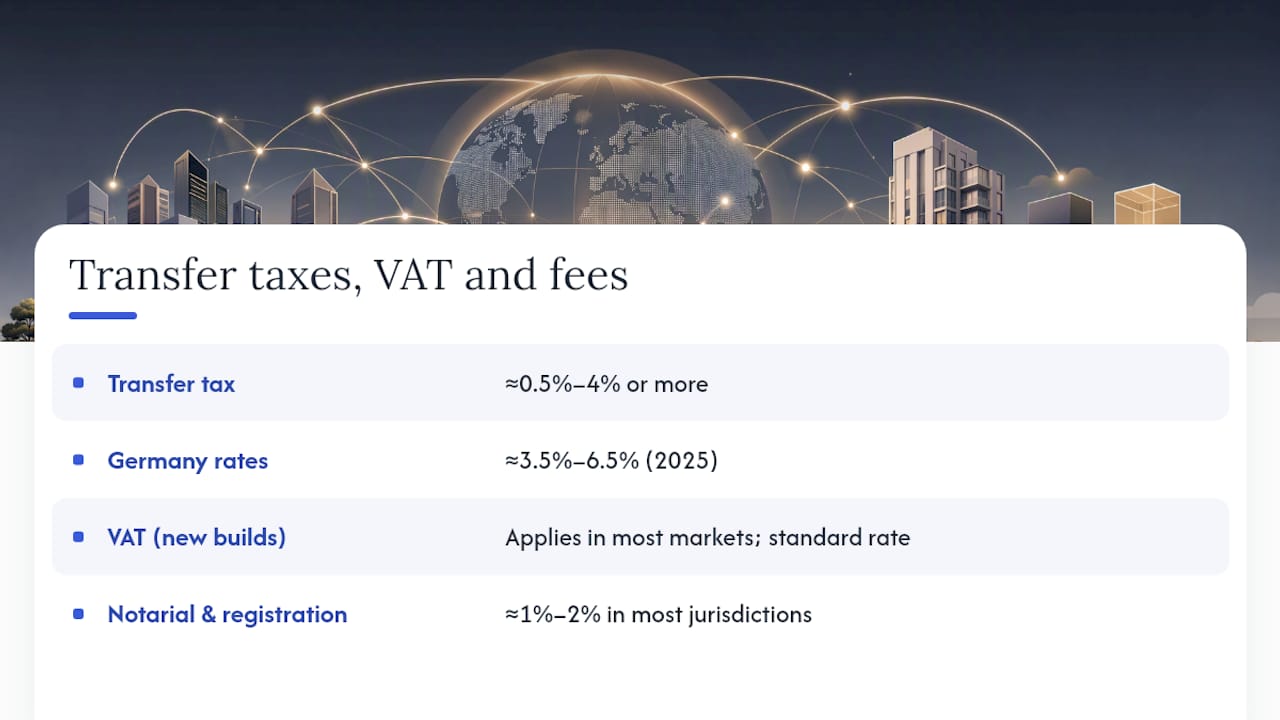
Real estate transfer tax (RETT) rates across Central and Eastern Europe range from roughly 0.5% in specific exempted cases up to 4% or more depending on the jurisdiction and municipality. In Germany, Grunderwerbsteuer (real estate transfer tax) varies by Bundesland, running approximately 3.5%–6.5% as of 2025. VAT applies to new-build purchases in most CE markets, typically at the standard rate, and stacks on top of transfer tax in some structures. Notarial and registration fees add another 1%–2% in most jurisdictions. Model all three before you set your maximum offer.
FDI screening and foreign-buyer permits
FDI screening has expanded significantly across CEE, and national implementations of EU-level guidelines diverge enough that a pan-European assumption will get you into trouble. Two neighboring countries can apply the same high-level rule very differently. Poland is the clearest example: from January 1, 2021, many foreign purchases of real estate or shares in companies owning real estate require a permit from the Minister of the Interior and Administration unless a statutory exemption applies. EEA and Swiss citizens benefit from broader exemptions, but third-country buyers must prove ties to Poland or qualify under a specific statutory carve-out.
Key permit and FDI checks to run before offer:
- Confirm whether the target jurisdiction requires a foreign-buyer permit for your nationality and ownership structure
- Check whether the asset class (agricultural land, forestry, commercial) triggers additional restrictions
- Verify FDI screening thresholds and sector sensitivities under national law
- Confirm whether a corporate vehicle changes the permit requirement or creates a new one
- Ask local counsel whether the permit application runs in parallel with due diligence or must precede it
Land registry access and timing risk
Registry accessibility varies dramatically across Central Europe. Some jurisdictions offer fully digitalized, publicly searchable registers; others require in-person searches at local offices, with entries that may lag actual transactions by weeks. That lag matters because the timing of your tax payment and the date of land-register entry are often linked. A delayed entry can create a window where you have paid but do not yet hold registered title, which is a real risk if the seller has creditors.
Statistic callout: Modelling the purchase at the jurisdiction level, including transfer tax, notarial fees, and registration costs, routinely changes the effective acquisition cost by several percentage points relative to the listing price. In some jurisdictions, the gap between listing price and total cost of acquisition can be notably higher when VAT on a new build is included.
Who to hire and when: building the cross-border transaction team
The team you assemble before making an offer is more important than the offer itself. A weak team costs you money at closing; no team at all can cost you the deal.
Core roles and engagement timing
Local real estate lawyer — instruct before offer. The lawyer reviews title, checks encumbrances, confirms permit requirements, and drafts or reviews the preliminary contract. This is the single most important hire. For legal aspects of international property purchases, Costacambrils coordinates with vetted local legal advisors who understand both the Spanish and broader CE legal frameworks.
Notary — engage pre-completion. In most CE jurisdictions, the notary is a public official who authenticates the deed and triggers registration. The notary does not represent your interests; your lawyer does. Understand the difference.
Tax adviser — instruct before offer, alongside the lawyer. The tax adviser models acquisition tax, rental income tax, and exit tax before you commit to a price or structure. Without this step, you are guessing at your net return.
Surveyor or building inspector — engage at offer stage. The inspector assesses structural condition, planning compliance, and any unauthorized works. In CE markets, unauthorized extensions or reclassified use are common and can affect insurability and resale.
Local agent — already engaged if you found the property through them, but clarify whether they represent you or the seller. Dual agency is common and creates conflicts.
Bank or mortgage officer — engage early if financing. Non-resident mortgage applications take longer than resident ones, and lenders often require local tax registration before approving a loan.
Property manager — engage pre-closing if you plan to rent. A property manager who knows the local rental market can give you realistic yield estimates before you finalize the price.
Minimum deliverables by role:
- Lawyer: title report, encumbrance search, permit status confirmation, preliminary contract review, registration plan
- Tax adviser: acquisition tax estimate, holding cost model, exit tax scenario, structure recommendation
- Inspector: structural report, planning compliance check, utility connection confirmation
- Notary: authenticated deed, registration filing, tax payment confirmation
- Agent: comparable sales data, local market context, seller motivation assessment
Due diligence beyond title: a Central Europe checklist
Title is the floor, not the ceiling, of due diligence. In Central Europe, the hidden risks sit in planning classifications, public law encumbrances, and registry entries that a title search alone will not surface.
Land registry and title chain
Obtain the full land register extract (Grundbuch in Germany and Austria, Kataster in Czech Republic and Slovakia, Földhivatal in Hungary). Verify the ownership chain back at least two prior transfers. Check for mortgages, charges, easements, and any pending court proceedings registered against the property. The registry entry date also triggers certain tax and fee obligations, so confirm with your lawyer exactly when those run.
Registry accessibility varies across CE jurisdictions, and in some markets, parallel non-digital registries still exist. Your lawyer should confirm which register is authoritative and whether a gap exists between the paper and digital records.
Planning, use classification, and agricultural land traps
Use classification is where many cross-border purchases go wrong. Purchasing certain land categories, such as agricultural land or Hungary’s “zártkert” (enclosed garden) classification, can convert what looks like a residential purchase into a restricted acquisition requiring permits or blocked entirely for third-country buyers. Always verify the official use classification in the land register, not just the seller’s description.
Construction and planning permits for any existing structures must be verified against the current building. Unauthorized extensions are common in CE markets. An unauthorized structure affects insurance, mortgage eligibility, and resale.
Environmental and utility checks
Confirm utility connection rights (water, sewage, electricity, gas) are registered, not just physically present. Check for contamination liability, especially on former industrial or agricultural land. Environmental searches are not always standard in CE transactions; instruct your lawyer to commission them explicitly.

| Due Diligence Item | Document / Source | Responsible Party |
|---|---|---|
| Land register extract | National land registry | Lawyer |
| Title chain (2+ prior transfers) | Registry historical records | Lawyer |
| Encumbrances and charges | Land register, court records | Lawyer |
| Use classification confirmation | Planning authority | Lawyer / local authority |
| Construction permits for all structures | Municipal building authority | Lawyer / surveyor |
| Agricultural or restricted land check | Land registry, agricultural authority | Lawyer |
| Environmental contamination search | Environmental agency | Lawyer / specialist |
| Utility connection rights | Utility providers, registry | Surveyor / lawyer |
| Tenant leases and occupancy rights | Seller disclosure, registry | Lawyer |
| Outstanding municipal charges | Local authority | Lawyer |
Documents the buyer should collect before making an offer:
- Land register extract (no older than 30 days)
- Seller’s title deed and prior transfer documents
- Planning permission for the property and all structures
- Energy performance certificate
- Utility bills and connection agreements
- Any existing lease agreements
- Building insurance policy (if transferable)
- Seller’s tax clearance certificate where required by local law
Pro Tip: Ask your lawyer to obtain a “negative certificate” from the local municipality confirming no outstanding public law charges or pre-emption rights. In several CE jurisdictions, municipalities hold a right of first refusal on certain property types, and missing this step can unwind a completed transaction.
Tax modelling and ownership structures that matter in Central Europe
Tax advisers consistently warn that investors who skip lifecycle tax modelling face materially higher overall costs. The issue is not just the acquisition tax; it is the interaction between acquisition, holding, and exit taxes that determines actual net return. For a deeper breakdown of recurring property tax obligations, see Costacambrils’s guide to types of property taxes.
Acquisition taxes
RETT rates across CE jurisdictions vary considerably. The CMS guide to CEE tax regimes documents rates from roughly 0.5% in specific exempted cases to 4% or more depending on jurisdiction and municipality. Germany’s Grunderwerbsteuer rates vary by Bundesland. VAT on new builds typically applies at the standard rate and does not replace RETT in all structures; in some jurisdictions, both apply. Exemptions sometimes exist when property is contributed to company capital, which is one reason structuring decisions matter at acquisition, not just at exit.
Holding costs and rental income tax
Annual property tax (Grundsteuer in Germany, local equivalents elsewhere) applies regardless of residency. In the Czech Republic, non-resident rental income is taxed at 15%, with an option to apply lump-sum expenses. Thin-capitalization rules in several CE jurisdictions limit the deductibility of interest on related-party loans, which affects corporate structures funded by shareholder debt. Transfer-pricing documentation requirements apply when a local entity transacts with a related foreign entity.
Exit taxes and holding-period tests
Several CE jurisdictions apply a speculation tax or reduced capital gains rate based on a holding period. Selling within a short window (often 2–5 years depending on jurisdiction) can trigger a higher tax rate or eliminate an exemption. Model the exit scenario at the time of purchase, not when you decide to sell.
Ownership structure comparison
| Structure | Key Advantage | Key Risk | Best Fit |
|---|---|---|---|
| Personal ownership | Simple, low compliance cost | Full personal tax exposure on rental and gain | Single property, long hold, EU/EEA buyer |
| Local company (e.g., Sp. z o.o., s.r.o.) | Deductible costs, potential lower corporate rate | Thin-cap rules, beneficial ownership reporting, exit via share sale may be taxed differently | Multiple properties, active rental business |
| Foreign holding company | Potential treaty benefits, consolidated ownership | CRS/FATCA reporting, local PE risk, complex compliance | Family office, portfolio of assets |
| Trust | Estate planning benefits | Not recognized in all CE jurisdictions, complex local tax treatment | Succession planning only |
A vehicle that looks tax-efficient at purchase can create thin-capitalization and transfer-pricing exposure that raises audit risk on exit. Work with a tax adviser to model the full lifecycle, including administrative costs, before choosing a structure. For a detailed comparison of personal and corporate ownership options, Costacambrils’s guide to property ownership structures covers the practical tradeoffs.
Worked example (illustrative): On a €500,000 purchase in a jurisdiction with 4% RETT, standard notarial and registration fees of approximately 1.5%, and annual property tax of 0.1% of assessed value, the first-year total cost of acquisition and holding runs to roughly €527,500 before any rental income. At a gross rental yield of 5% (€25,000 per year), the net first-year yield after acquisition costs is materially below 5%. Modelling this before offer is what separates a disciplined investor from one who discovers the math after signing.
Funding, proof-of-funds, currency management and payment timing
Proof-of-funds expectations
Sellers and their lawyers in CE markets expect proof of funds before accepting an offer on a high-value property. For personal buyers, a recent bank statement showing available funds is standard. For corporate buyers, audited accounts or a bank comfort letter confirming available credit lines is typical. AML compliance requirements mean you will also need a source-of-funds explanation, particularly for funds originating outside the EU. Prepare this documentation before you make an offer; a delay here is a negotiating weakness.
Currency transfer and FX risk
Most CE property transactions are denominated in local currency (PLN in Poland, CZK in Czech Republic, HUF in Hungary) or euros (Germany, Austria, Slovakia). If your funds are in a different currency, exchange rate movement between offer and completion can materially affect your cost. A 3% adverse move on a €500,000 transaction is €15,000.
Forward contracts with a specialist FX provider lock in the exchange rate for a future date, eliminating this uncertainty. Book the forward contract once the preliminary contract is signed and the completion date is known. Do not wait until completion week.
Contracts, notarization and registration: practical execution steps
Contract phases and what to insist on
Cross-border property purchases in Central Europe typically move through three contract stages: a reservation agreement, a preliminary contract (przedwstępna in Poland, smlouva o smlouvě budoucí in Czech Republic), and the final notarial deed. Each stage has different legal weight and different deposit-forfeiture consequences.
The preliminary contract is where most of the negotiation happens and where your lawyer earns their fee. Insist on the following clauses:
- A permit-contingent completion condition (if a foreign-buyer permit is required, completion is conditional on its grant)
- Clear deposit-handling provisions specifying who holds the deposit and the exact conditions for return or forfeiture
- A defined completion date with a mechanism for extension if registry or permit delays occur
- Explicit allocation of which party pays which taxes and fees
- A payment waterfall specifying the sequence and timing of each payment tranche
Notarial requirements, translation, and power of attorney
In most CE jurisdictions, the final deed must be executed before a notary. If you cannot attend in person, a notarized and apostilled power of attorney (PoA) allows a local representative to sign on your behalf. The PoA must be prepared in the local language, which means certified translation is required. Allow at least two weeks for this process, more if your home jurisdiction’s apostille process is slow.
For a detailed explanation of how notaries function in property transactions, Costacambrils’s guide to the role of notaries in Spanish property illustrates the mechanics that apply across many CE jurisdictions as well.
Mortgage availability and lender expectations for non-residents
Non-resident buyers in Central Europe can access mortgage financing, but the terms differ from resident rates. In the Czech Republic, non-resident mortgage LTV is typically capped at 60%–70%, compared to higher LTVs available to residents. Similar conservative LTV limits apply across most CE markets for non-resident applicants.
What lenders expect from non-resident applicants
Lenders assess cross-border income differently from local income. Expect to provide:
- Two to three years of tax returns from your home jurisdiction
- Bank statements covering 6–12 months
- Proof of employment or business ownership (audited accounts for self-employed applicants)
- A local tax identification number (required in most CE jurisdictions before a mortgage can be registered)
- Proof of the property’s rental income potential if the loan is partly serviced by rental cash flow
Currency risk with local-currency mortgages
Borrowing in local currency (PLN, CZK, HUF) when your income is in a different currency creates ongoing FX exposure. A weakening of your home currency against the local currency increases your effective repayment cost. Several CE banks offer euro-denominated mortgages to non-residents, which reduces this risk if your income is in euros. Discuss currency matching with your mortgage adviser before choosing a loan product.
Alternative financing options
Developer financing on new-build projects is common in CE markets, particularly for off-plan purchases. Staged payment schedules tied to construction milestones reduce the need for a single large drawdown. Seller credit (vendor financing) is less common but negotiable on private sales where the seller has no immediate liquidity need. Private lending and bridging finance are available through specialist lenders but carry higher rates and shorter terms; use them only as a bridge to conventional financing, not as a long-term solution.
Lender checklist to send before applying:
- Confirm whether the lender offers non-resident mortgages for your nationality
- Ask for the maximum LTV for non-resident applicants
- Confirm whether the loan can be denominated in euros or only local currency
- Ask what income documentation is required for cross-border income
- Confirm whether a local tax ID is required before application or only before drawdown
- Ask for the typical processing timeline for non-resident applications
Exit planning and ongoing compliance after acquisition
Buying is the easy part. The compliance obligations that begin on the day you register title and continue until you sell are where many international investors get caught off guard.
Reporting obligations for cross-border owners
CRS (Common Reporting Standard) and beneficial ownership registers have materially increased transparency for cross-border property owners. Banks report account information to tax authorities in over 100 countries. Claiming effective anonymity through complex ownership chains is no longer reliable and can trigger additional compliance and documentation burdens. FATCA applies to US persons regardless of where they hold assets; US buyers must report foreign real estate held through certain entities on Form 8938 and potentially on FinCEN 114.
Exit scenarios and their tax treatment
Selling directly as an individual triggers personal income tax or capital gains tax on the gain, subject to any holding-period exemption. Selling shares in a local holding company instead of the underlying property can change the tax treatment, sometimes favorably, but the buyer pool for share sales is smaller and the due diligence process is more complex. In some CE jurisdictions, a share sale also avoids RETT for the buyer, which can be a negotiating point.
Annual compliance filings for non-resident owners
Recurring obligations non-resident owners commonly face:
- Annual property tax return or payment (local municipality; typically handled by property manager or local accountant)
- Rental income tax return in the jurisdiction where the property is located (even if tax is withheld at source)
- Home-jurisdiction reporting of foreign income and assets (varies; US persons face the most extensive requirements)
- Beneficial ownership register filings if holding through a company (annual or on change of ownership)
- VAT registration and returns if operating short-term rentals above the local registration threshold
- CRS-related disclosures through the financial institution holding the purchase funds
Assign each filing to a named adviser (tax adviser, accountant, or property manager) before closing. A gap in coverage is how penalties accumulate.
Common execution and regulatory risks and how to reduce them
| Risk | Probability | Impact | Mitigation |
|---|---|---|---|
| FDI/permit refusal or delay | Medium (third-country buyers) | High | Permit-contingent completion clause; instruct counsel pre-offer |
| Title/registry delay post-signing | Medium | Medium | Escrow release tied to registration confirmation; title insurance |
| Currency volatility (offer to completion) | High | Medium–High | Forward FX contract booked at preliminary contract stage |
| Planning/use classification surprise | Medium | High | Full planning search pre-offer; conditional contract |
| Hidden encumbrances (charges, tenants) | Medium | High | Full land register search; seller warranty clause |
| Agricultural or restricted land trap | Low–Medium | High | Use classification confirmed by lawyer before offer |
| Thin-cap/transfer-pricing audit risk | Low (corporate structures) | High | Tax adviser models structure; documentation prepared at acquisition |
| Registry backlog delaying entry | Medium | Medium | Build 12-week post-signing buffer into financing and FX arrangements |
Contract clauses and insurance to request
- Permit-contingent completion (deposit returnable if permit refused)
- Seller warranty on absence of undisclosed encumbrances
- Penalty clause for delayed completion by seller
- Title insurance (available in most CE markets through specialist insurers; covers defects not apparent from registry search)
- Political risk insurance for large investments in jurisdictions with elevated regulatory uncertainty
Mitigation checklist:
- Conditional offer language referencing permit grant and clean title confirmation
- Escrow structure with independent third-party holder
- Forward FX contract booked at preliminary contract stage
- Title insurance instructed before final deed signing
- Legal permit contingency clause in preliminary contract
- Surveyor sign-off on planning compliance before deposit release
Practical checklist, required documents and a sample legal workflow
The checklist below is the working document you hand to your advisors at the start of the transaction. Costacambrils’s full downloadable legal process workflow expands on each step with jurisdiction-specific notes and document templates.
Step-by-step pre-offer to post-closing checklist
Pre-offer (before submitting any offer):
- Confirm foreign-buyer permit requirement for your nationality and structure
- Run jurisdiction-level tax model (acquisition, holding, exit)
- Instruct local lawyer and tax adviser
- Obtain land register extract and confirm use classification
- Prepare proof-of-funds documentation and source-of-funds letter
- Confirm financing approach and lender pre-qualification
At offer and preliminary contract:
- Include permit-contingent and title-contingent conditions
- Confirm deposit amount, holder, and release conditions
- Instruct surveyor/inspector
- File permit application if required
- Book forward FX contract for completion funds
During due diligence:
- Obtain full planning and construction permit verification
- Complete environmental and utility search
- Confirm no outstanding municipal charges or pre-emption rights
- Receive and review surveyor’s report
- Confirm mortgage offer (if applicable)
Pre-completion:
- Prepare notarial deed (lawyer drafts; notary authenticates)
- Arrange PoA if attending remotely (allow 2+ weeks for apostille)
- Confirm transfer tax payment deadline and amount
- Transfer completion funds in local currency via forward FX contract
Post-completion:
- Confirm land register application filed
- Pay transfer tax within statutory deadline
- Register with local tax authority for property tax
- Set up rental income tax compliance if letting
- Brief property manager on ongoing compliance filings
Sample timeline for a typical Central Europe purchase
| Phase | Duration | Key Milestones |
|---|---|---|
| Pre-offer preparation | 1–2 weeks | Lawyer instructed, tax model complete, proof-of-funds ready |
| Reservation to preliminary contract | 1–2 weeks | Reservation deposit paid, preliminary contract signed |
| Due diligence and permit | 4–12 weeks | Registry search, planning check, permit decision |
| Mortgage processing (if applicable) | 6–10 weeks | Runs in parallel with due diligence |
| Final deed and completion | 1–2 weeks | Notarial deed signed, balance transferred, tax paid |
| Land register entry | 4–12 weeks post-signing | Entry confirmed; title legally transferred |
Costacambrils coordinates legal, tax, inspection, and property management tasks for international buyers, reducing the coordination overhead that typically extends timelines. The expat property checklist is a practical companion document for buyers working through these steps.
Key Takeaways
Successful cross-border property investment in Central Europe requires jurisdiction-first modelling, a local advisory team instructed before offer, and conditional contracts that protect your deposit against permit and title risks.
| Point | Details |
|---|---|
| Jurisdiction modelling first | Transfer tax, notarial fees, and registration costs routinely add a substantial amount to the listing price; model before setting your offer. |
| Permit risk is real | Third-country buyers in Poland require a permit from the Minister of the Interior and Administration; check permit status before offer in every CE market. |
| Tax lifecycle before structure | Corporate vehicles can reduce acquisition tax but create thin-cap and transfer-pricing exposure; model the full lifecycle with a tax adviser. |
| Currency timing matters | Book a forward FX contract at preliminary contract stage; registry entry delays mean completion can slip weeks beyond the signed date. |
| Costacambrils workflow | Costacambrils provides a downloadable legal workflow and checklist that coordinates legal, tax, and inspection tasks for international buyers from pre-offer to post-closing. |
What cross-border buyers actually get wrong
Most international investors arrive in Central Europe with a clear budget and a shortlist of properties. What they rarely have is a clear picture of the jurisdiction they are buying into. The assumption that EU membership means a uniform legal and tax environment is the single most expensive misconception in CE real estate.
The permit issue in Poland is the obvious example, but the subtler version plays out in every CE market. A buyer who structures through a foreign holding company to reduce headline acquisition tax may be creating a transfer-pricing documentation obligation that costs more in annual compliance than the tax saving was worth. A buyer who purchases what the seller describes as a residential plot in Hungary may be acquiring a “zártkert” classification that restricts what can be built and who can own it. These are not edge cases; they are routine.
The other thing most guides understate is the registry timing risk. In several CE jurisdictions, the land register entry does not happen at signing; it happens weeks or months later, after the tax authority confirms payment. During that window, you have paid but you are not yet the registered owner. If the seller has undisclosed creditors, that gap is your exposure. Title insurance exists precisely for this scenario, and it is underused by international buyers who assume the notarial process eliminates the risk.
The practical answer is not to avoid CE markets; the fundamentals in many of them are strong. The answer is to treat the jurisdiction check as the first investment decision, not an administrative step after you have already fallen in love with a property. The buyers who do this consistently close faster, pay less in surprises, and hold assets that perform closer to their modelled returns.
Costacambrils: your partner for international property in Costa Dorada
For international buyers targeting the Costa Dorada region, the complexity of a cross-border transaction does not have to mean months of coordination across disconnected advisors. Costacambrils specializes in luxury property sales and rentals in Cambrils and the surrounding Costa Dorada area, and the firm’s service model is built specifically around the needs of foreign buyers: property search with advanced filters by type, location, and specification; legal coordination with vetted local lawyers and notaries; introductions to tax advisers familiar with non-resident acquisition and holding structures; and full property management and post-closing support.
The difference from working with a standard listing platform is the coordination layer. When your lawyer needs the planning permit history, your tax adviser needs the cadastral reference, and your inspector needs access to the property, Costacambrils handles the scheduling and document flow so those parallel tracks do not stall each other. For buyers considering the Costa Dorada’s luxury property market, that coordination typically shortens the time from offer to completion and reduces the back-and-forth that inflates legal costs.
Contact Costacambrils directly to request a consultation, download the legal workflow checklist, or browse current exclusive property listings in the Costa Dorada region.
This article provides general information about cross-border real estate transactions and is not legal, tax, or financial advice. Confirm current rules, rates, and permit requirements with a qualified local adviser in the relevant jurisdiction before making any investment decision.
Useful sources and further reading
The sources below are the primary references for the legal, tax, and procedural claims in this guide. Each one is worth reading directly before instructing advisors or making an offer.
Apply for a permit to acquire real estate, shares and stocks by foreign citizens (gov.pl): — The official Polish government page for foreign-buyer permit applications. Use this to confirm current documentation requirements and exemption categories.
Property ownership in Europe (BDO): — Covers CRS, FATCA, and beneficial ownership reporting obligations for cross-border owners. Essential reading before choosing an ownership structure.
CMS guide to tax regimes in Central and Eastern Europe (CMS): — Jurisdiction-by-jurisdiction RETT rates, VAT treatment, and exemption structures. Use this to build your acquisition tax model before offer.
Property tax in Germany: guide for non-residents (TaxesForExpats): — Covers Grundsteuer, Grunderwerbsteuer by Bundesland, and interaction with US tax reporting for American buyers. Relevant for any acquisition in Germany or Austria.
Owning Czech property as non-resident 2026: Tax + Rental (Flyto): — Practical non-resident tax rates (15% rental income tax) and mortgage LTV expectations for Czech Republic acquisitions. A useful benchmark for neighboring CE markets.
Costacambrils legal workflow and checklist: Available at costacambrils.com/real-estate-legal-process-workflow. A downloadable, step-by-step workflow for international buyers coordinating legal, tax, and inspection tasks from pre-offer to post-closing.
Recommended
- Legal Aspects of Property Purchase: International Buyer’s Guide – Inmobiliaria Costa Cambrils
- Guía legal inmobiliaria internacional: claves para España – Inmobiliaria Costa Cambrils
- Explaining Property Ownership Structures: Investor’s Guide – Inmobiliaria Costa Cambrils
- Spain mortgage guide for international luxury buyers – Inmobiliaria Costa Cambrils