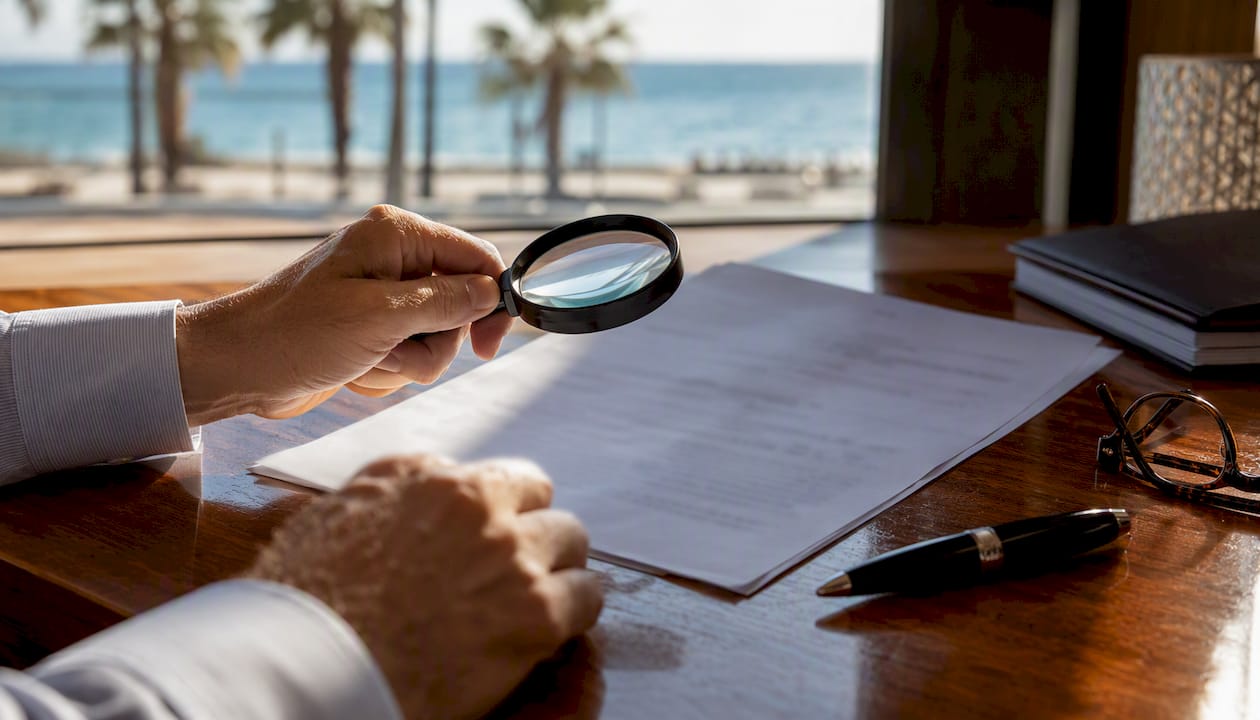
Before you sign anything, get two documents: the land-registry extract (called the nota simple in Spain, or its equivalent in other Central European jurisdictions) and the public deed (escritura pública). The nota simple is the single most revealing piece of real estate legal paperwork you can hold — it shows the registered owner, the property’s boundaries, and every mortgage, lien, or encumbrance on record. Order it before you even draft a purchase agreement.
Here is the core property document checklist every buyer needs before closing:
- Deed / escritura pública — the notarized public act that formalizes the transfer of ownership
- Land-registry extract / nota simple — the official registry snapshot showing owner, encumbrances, and annotations
- Private purchase agreement (contrato de arras or contrato de compraventa) — the binding pre-sale contract
- Cadastral reference — the official land-use and physical description identifier
- Mortgage documentation — loan terms, lender conditions, and any existing mortgage to be canceled
- Power of attorney (if applicable) — verified authorization for anyone signing on behalf of a party
- Energy performance certificate — legally required before listing or transferring in most EU jurisdictions
- Tax receipts — proof that property taxes (IBI in Spain) and community charges are current
First action: Request the land-registry extract through the official registrar’s portal or ask your notary to order it on your behalf. In Spain, that means the Registro de la Propiedad. In Poland, Hungary, the Czech Republic, and Slovakia, each country operates its own national land register — the process differs, but the principle is identical: verify ownership and encumbrances before committing funds.
Key Takeaways
Ordering the land-registry extract before signing is the single most protective step in any property transaction, because it reveals ownership status, encumbrances, and annotations that no other document captures.
| Point | Details |
|---|---|
| Order the registry extract first | Request the nota simple or equivalent before signing or paying any deposit. |
| Verify the registered owner | Confirm the seller’s name matches the registry entry exactly before proceeding. |
| Register the deed immediately | Present the escritura to the land registry on signing day to activate legal ownership protection. |
| Check for annotations and mortgages | Any active embargo, mortgage, or restriction requires legal review before funds are released. |
| Use a notary and consider a lawyer | Notaries verify identity and present deeds; a lawyer is advisable for complex or annotated titles. |
Table of Contents
- What does each property document actually mean?
- How do you check title and order a registry extract?
- Who does what: notary, registrar, bank, agent, and lawyer?
- What do registration costs and timelines look like?
- What are the biggest red flags in property documents?
- Spain’s nota simple, escritura, and registration: a worked example
- Can you transfer a deed without a lawyer, and how do you draft a purchase agreement?
- What experienced advisers actually check first
- Sources
What does each property document actually mean?
Understanding real estate legal paperwork starts with knowing what each document does, not just what it is called. The terminology shifts across Central Europe, but the underlying concepts are consistent.
Deed / escritura pública: A public instrument drawn up and authenticated by a notary. It records the sale, the parties, the price, and the property description. The escritura is the document banks require for mortgages and the one used to register the transfer at the land registry. Banks and registries rely on it as primary proof of ownership.
Title vs. deed: “Title” is the legal concept of ownership rights. The deed is the physical document that evidences and transfers those rights. You can hold a deed without having registered it — but unregistered title carries real risk, because a third party who registers first may take priority.
Land-registry extract / nota simple: A certified snapshot of the registry entry for a specific property. In Spain, the nota simple is public information available to anyone with a legitimate interest. It lists the current registered owner, the property’s physical description, and all encumbrances — mortgages, easements, embargoes, and annotations. Equivalents exist across Central Europe: in Poland it is the Księga Wieczysta extract; in the Czech Republic, the výpis z katastru nemovitostí; in Hungary, the tulajdoni lap; in Slovakia, the list vlastníctva.
Private purchase agreement: A contract signed before the notarized deed, often accompanied by a deposit (arras). It binds both parties to the transaction terms but does not transfer legal title. It should include conditions precedent, payment schedule, and what happens if either party withdraws.
Cadastral reference: A unique alphanumeric code assigned by the national cadastre (Spain: Catastro) that identifies the physical plot and building. It appears on tax documents and must match the registry entry — discrepancies are a red flag.
Mortgage documentation: If the property carries an existing mortgage, you need the outstanding balance certificate and the cancellation deed. If you are taking a new mortgage, the lender will require the escritura and registry extract before approving funds.
Power of attorney: A notarized authorization allowing one person to sign on behalf of another. Any power of attorney used in a transaction must be verified as current, properly notarized, and within its stated scope.
Energy performance certificate: Mandatory across the EU before a property can be listed for sale or rent. It rates the building’s energy efficiency and must be provided to the buyer before signing.
Tax receipts: Proof that the annual property tax (IBI in Spain) and community of owners charges are paid. Unpaid amounts can follow the property to the new owner.
Pro Tip: The registry extract is the document most likely to reveal hidden risk — undisclosed mortgages, embargoes, or restrictions that the seller has not mentioned. The registered deed, once inscribed, is what gives you legal proof of ownership. Get the extract first; get the deed registered immediately after signing.
How do you check title and order a registry extract?
Order the registry extract first and read it for the registered owner, encumbrances, mortgages, easements, and any annotations before you sign or pay a deposit.
Step-by-step: ordering and reading the extract
Identify the property’s registry details. You need the property’s registry number, municipality, and ideally the cadastral reference. The seller or agent should provide these; if not, the cadastral reference alone is usually enough to locate the registry entry.
Choose your request channel. In Spain, requests go through the official Registradores portal or through a notary. Your notary can order it on your behalf and often does so as a standard pre-signing check. In Central European countries, national land-register portals (Poland’s Elektroniczne Księgi Wieczyste, the Czech ČÚZK portal, Hungary’s Takarnet) provide equivalent online access.
Select the extract type. Spanish registries issue three types: the nota simple ordinaria (standard snapshot), the nota simple continuada (updated automatically for a period), and the nota simple de localización (finds the registry entry from a partial address or owner name). For most buyers, the ordinary extract is sufficient; the continued version is useful if there is a gap between signing and registration.
Supply the required information. Provide the property’s full address, registry number, and your identification. Turnaround for an online request in Spain is typically within 24–48 hours.
Read the extract carefully. The document is structured in sections: the property description, the current ownership entry, and the encumbrances section (cargas).
What to look for on the extract
- Registered owner: Does the name match the seller? If not, stop immediately.
- Mortgages: Are there one or more active mortgages? What is the registered maximum liability? Confirm the outstanding balance with the lender before signing.
- Embargoes and judicial annotations: These signal legal disputes, unpaid debts, or court orders against the property. Any recent annotation warrants a lawyer’s review.
- Easements and rights of way: Check for recorded access rights, utility easements, or use restrictions that could affect how you use the property.
- Subrogation notes: Indicates an existing mortgage may transfer to the buyer — confirm whether you intend to subrogate or require cancellation.
- Community charge flags: Some registries note unpaid community fees; always request a separate certificate from the community of owners.
Warning: If the extract shows annotations you do not recognize, or if the registered owner differs from the person selling, do not proceed without consulting a notary or property lawyer. A single unexplained annotation can indicate a pending embargo or a disputed ownership claim that could invalidate your purchase.
Who does what: notary, registrar, bank, agent, and lawyer?
Each professional in a property transaction has a distinct, non-overlapping role. Knowing who to call for each task saves time and prevents costly mistakes.
Notary: Drafts and authenticates the escritura pública. Notaries verify the identity of both parties, the legitimacy of any power of attorney, the property description, and the existence of encumbrances. Critically, the notary commonly presents the deed to the land registry the same day as signing — this closes the window during which a hidden claim could be recorded against the property. You have the right to choose your own notary freely; do not let the seller or developer dictate this choice.
Land registrar: Records the transfer in the official land register and issues the registry extract. The registrar does not advise parties — the role is to qualify the legal validity of presented documents and inscribe them. Once inscribed, registration produces legitimación registral, a legal presumption that the registered owner holds the rights as recorded.
Bank / lender: Provides mortgage documentation, including the loan offer, the binding mortgage conditions, and the cancellation certificate for any existing mortgage being discharged. The bank requires the escritura before releasing funds and will often coordinate directly with the notary on signing day.
Real estate agent: Handles transaction logistics — property viewings, offer negotiation, and coordination between parties. A good agent will provide the cadastral reference and basic registry details early. The agent does not verify title or authenticate documents; that is the notary’s job.
Lawyer / solicitor: Advises on title defects, complex encumbrances, disputed ownership, and contract terms. For straightforward transactions, a notary’s checks may suffice. For anything involving annotations, multiple owners, off-plan purchases, or international buyers unfamiliar with local law, independent legal advice is worth the cost. The lawyer also handles post-sale obligations: tax filings, notifying the cadastre, and correcting registry errors.
For understanding the notary’s role in Spanish property in more detail, Costacambrils has a dedicated guide that walks through each step of the notarization process.
What do registration costs and timelines look like?
The buyer typically pays registration fees and transfer taxes; the seller usually covers the cost of the first notarial copy of the deed. Exact rates vary by jurisdiction and property type, so treat the table below as a structural guide rather than a fixed tariff.
| Stage | Who normally pays | Typical turnaround |
|---|---|---|
| Registry extract (nota simple) | Buyer | 24–48 hours (online request) |
| Private purchase agreement / deposit | Negotiated (deposit held by agent or notary) | Same day as signing |
| Notary fees for escritura | Buyer (first copy); seller (original) | Signing day |
| Transfer tax or VAT (new builds) | Buyer | Due within 30 days of signing in Spain |
| Land-registry inscription fee | Buyer | 15 days qualification window; inscription within weeks |
| Mortgage arrangement and bank fees | Buyer (some lender costs now borne by bank in Spain post-2019 law) | Coordinated with signing day |
The registration step is the one buyers most often underestimate. Presenting the escritura to the registry on the same day as signing is standard practice when the notary handles it directly. Once presented, the registrar has a maximum qualification period (commonly 15 days in Spain) to review the document’s legal validity before inscribing it. Until inscription is complete, the buyer’s title is not fully protected against third-party claims.
Registration is not optional paperwork. The Registro de la Propiedad is the public record that legally cements ownership — the escritura shows the transaction happened, but registration is what protects the buyer against hidden claims recorded after the sale.
For buyers financing through a mortgage, the bank will not release funds until the escritura is signed and the mortgage deed is ready for inscription. Coordinating the signing of the sale deed and the mortgage deed on the same day is standard practice.
Pro Tip: Ask your notary to present the deed to the registry on the day of signing. This is common practice and closes the gap during which a creditor of the seller could file an embargo against the property before your title is recorded.
What are the biggest red flags in property documents?
The most common risks in a property transaction are undisclosed mortgages, forged or expired powers of attorney, mismatched cadastral data, and unpaid community charges. Most of these show up in the documents before you sign — if you know where to look.
Red flags on the registry extract and documents
- Seller not listed as registered owner — the most serious flag; do not proceed without a full explanation and legal review
- Multiple active mortgages — each must be accounted for and either canceled or subrogated before or at closing
- Recent judicial annotations or embargoes — signals a pending legal dispute or unpaid debt that could attach to the property
- Restrictions or prohibitions on transfer — some properties carry recorded conditions that limit who can buy or how the property can be used
- Cadastral reference mismatch — if the physical description in the registry differs from the cadastral record, there may be undeclared construction or boundary disputes
- Power of attorney that is expired, limited in scope, or unverified — a seller’s representative must have a current, properly notarized authorization that explicitly covers the sale
Pro Tip: To verify a power of attorney, ask the notary to confirm it is still in force and that it has not been revoked. In Spain, notaries can check the Central Notarial Register of Powers of Attorney (Registro Central de Poderes Notariales) before signing. If the power was granted abroad, it must be apostilled and, in most cases, translated by a sworn translator.
Two scenarios and what to do
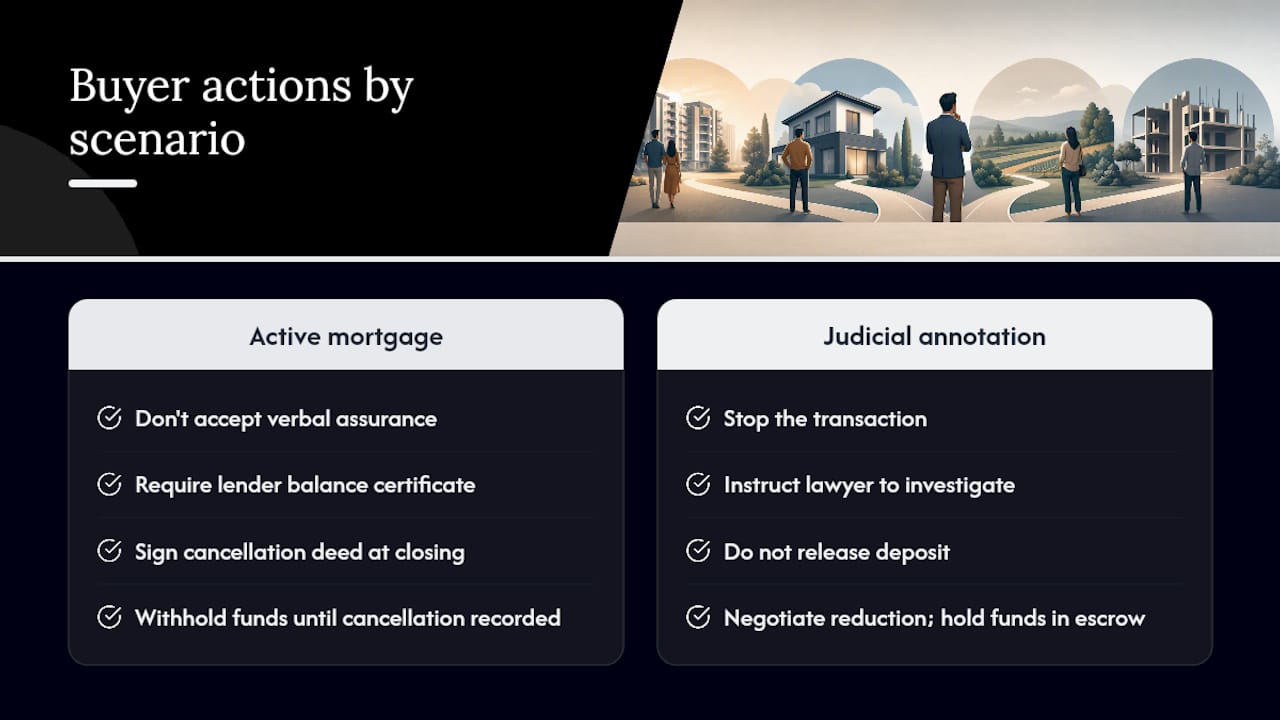
Scenario 1: The registry extract shows an active mortgage the seller claims is already paid. Do not accept a verbal assurance. Require the lender’s outstanding balance certificate and, at closing, insist that the mortgage cancellation deed is signed simultaneously with the sale deed. Funds should not be released until the cancellation is presented to the registry.
Scenario 2: The extract shows a judicial annotation you were not told about. This could be a creditor’s embargo, a pending inheritance dispute, or a court-ordered restriction. Stop the transaction, instruct a lawyer to investigate the annotation’s origin and status, and do not release any deposit until the annotation is either lifted or fully explained. In some cases, the buyer can negotiate a price reduction and hold funds in escrow pending resolution — but only with legal advice.
For a broader look at why property documentation matters and the most common buyer mistakes, Costacambrils covers these scenarios in practical detail.
Spain’s nota simple, escritura, and registration: a worked example
In Spain, the process follows a clear three-step sequence: get the nota simple first, sign the escritura before a notary second, and present the deed for registration immediately after. This workflow is the most fully documented in Central Europe and serves as a practical template for understanding equivalent systems elsewhere.
The Spanish workflow, step by step
Step 1 — Order the nota simple. Request it through the Registradores portal or via your notary. Confirm the registered owner, check for encumbrances, and verify the cadastral reference matches the property being sold.
Step 2 — Review the private purchase agreement. Once the nota simple is clean, the parties typically sign a contrato de arras (deposit agreement) or a private compraventa contract. This binds both sides and sets the timeline for the notarial signing.
Step 3 — Sign the escritura pública before a notary. The notary verifies both parties’ identities, checks the power of attorney if applicable, confirms the registry data, and reads the deed aloud. The escritura pública formalizes the sale and is the document banks require for mortgage registration.
Step 4 — Pay transfer taxes. In Spain, the buyer must pay the applicable transfer tax (ITP for resale properties) or VAT (for new builds) within 30 days of signing. Tax payment is required before the registry will inscribe the deed.
Step 5 — Present the deed to the Registro de la Propiedad. The notary typically handles this on signing day. The registrar then has a qualification period to review the deed’s legal validity before completing inscription.
Step 6 — Inscription and legitimación registral. Once inscribed, registration produces legitimación registral — a legal presumption of ownership that protects the buyer against prior unregistered claims. The Colegio de Registradores and the Consejo General del Notariado are the official bodies overseeing these processes in Spain.
For off-plan purchases, additional checks apply: verify the developer’s registration in the Mercantile Registry, confirm the developer owns the land, and check that municipal building permits are in place before signing any reservation or purchase agreement.
Equivalents in neighboring Central European systems
| Country | Registry extract name | Registry portal |
|---|---|---|
| Spain | Nota simple (Registro de la Propiedad) | Registradores.org / e-Justice |
| Poland | Odpis z księgi wieczystej | Elektroniczne Księgi Wieczyste (EKW) |
| Czech Republic | Výpis z katastru nemovitostí | ČÚZK (Nahlížení do KN) |
| Hungary | Tulajdoni lap | Takarnet / Földhivatal |
| Slovakia | List vlastníctva | Kataster nehnuteľností (UGKK SR) |
Each system records ownership and encumbrances; each issues a certified extract that serves the same function as the nota simple. The operational differences lie in access methods, fees, and turnaround times — but the buyer’s first action is the same everywhere: order the extract, read it, and verify the seller is the registered owner before committing funds.
For legal requirements specific to buying in Spain, including the full sequence of steps for international buyers, Costacambrils provides a jurisdiction-specific guide.
Can you transfer a deed without a lawyer, and how do you draft a purchase agreement?
You can complete many steps in a property transaction without a lawyer in some jurisdictions — but the critical protections against title defects and complex encumbrances usually justify at least notarial advice, and often independent legal counsel. The notary is not your lawyer; the notary’s duty is to the transaction, not to either party individually.
When you can proceed without a lawyer
For a straightforward resale with a clean registry extract, no annotations, a single registered owner, and no mortgage complications, many buyers in Spain and Central Europe complete the transaction relying on the notary’s procedural checks. The notary will verify identity, read the deed, and flag obvious problems. That covers a lot of ground.
Where independent legal advice becomes genuinely necessary: any annotation on the registry extract, a power of attorney signing on behalf of the seller, an off-plan purchase, an inheritance-related sale, a property with multiple co-owners, or any transaction where the buyer is unfamiliar with local law. The cost of a property lawyer for a few hours of review is small relative to the transaction value.
What a simple purchase agreement must include
A private purchase agreement (contrato de compraventa or contrato de arras) is a binding contract. Draft or review it with these clauses:
- Identification of parties: Full legal names, passport or national ID numbers, and addresses of both buyer and seller
- Precise property description: Address, cadastral reference, registry entry number, and a description matching the nota simple
- Purchase price and payment terms: Total price, deposit amount, payment method, and schedule
- Deposit / arras terms: Whether the deposit is arras confirmatorias (simple advance) or arras penitenciales (penalty clause allowing withdrawal at double or forfeiture)
- Conditions precedent: Mortgage approval, satisfactory registry results, resolution of any annotation
- Who pays which fees: Specify notary costs, taxes, registry fees, and agent commission
- Completion date: The date by which the escritura must be signed
- Dispute resolution: Jurisdiction and governing law
Reviewing the draft deed a few days before signing is standard practice recommended by notary bodies — it gives you time to query clauses without the pressure of signing day. Notary guidance specifically recommends examining the public deed in advance and paying close attention to any interest variation clauses in mortgage agreements.
When to stop and get a lawyer
- The registry extract shows any annotation, embargo, or restriction
- The seller is represented by a power of attorney you have not independently verified
- The property is off-plan or involves a developer
- The price or payment terms are unusual (deferred payments, seller financing)
- You are an international buyer unfamiliar with the local legal framework
What experienced advisers actually check first
The registry extract is the first document any experienced property adviser pulls, every time, without exception. Not the brochure, not the floor plan, not the agent’s summary. The extract.
What you are looking for in the first 30 seconds: is the seller’s name the registered owner? Are there active mortgages? Any annotations in the last 12 months? Those three questions catch the majority of problems before a single euro changes hands. Everything else — the energy certificate, the community charge certificate, the cadastral match — matters, but it comes after you have confirmed the seller actually has the right to sell.
Two habits worth adopting immediately: first, never release a deposit without having a clean registry extract in hand. A verbal assurance that “the mortgage will be canceled at closing” is not a substitute for seeing the cancellation deed signed simultaneously. Second, once the escritura is signed, follow up with the notary to confirm the deed has been presented to the registry. The gap between signing and inscription is the window of maximum risk — a creditor of the seller can file an embargo in that window, and it will take priority over your unregistered title.

Sources
These are the primary official portals and bodies for property registry and notarial information across Central Europe. All are publicly accessible; most offer at least partial English-language navigation.
- Land registers — e-Justice (European Commission)
- Compraventa de bienes inmuebles. Notarías y Registros de la propiedad — administración.gob.es
- Los notarios explican los pasos a seguir en la compraventa de una vivienda y en la solicitud de un préstamo hipotecario — Consejo General del Notariado (PDF)
- Registro de la Propiedad — Ministerio de Justicia (Spain)
- Guía para escriturar una vivienda: los documentos necesarios, costes y cómo se realiza este procedimiento — 20minutos
When using any foreign-language portal, a local notary or property lawyer can order and interpret the extract on your behalf. For buyers purchasing in the Costa Dorada region, Costacambrils offers legal advisory services and property documentation support alongside its full listing platform.
Recommended
- Why Property Documentation Matters for Every Buyer – Inmobiliaria Costa Cambrils
- Property Buying Checklist: Steps for Smart Buyers in 2026 – Inmobiliaria Costa Cambrils
- Property Inspection Explained: What Every Buyer Should Know – Inmobiliaria Costa Cambrils
- Legal Aspects of Property Purchase: International Buyer’s Guide – Inmobiliaria Costa Cambrils