
To negotiate a lower home price, run this five-step sequence before you submit anything: secure mortgage pre-approval or proof of funds, pull the nota simple from the Land Registry, commission an independent inspection, build a comparable market packet (price per m² from recent closed sales), and deliver a written offer with contingencies, earnest money, and a clear walk-away position. Buyers who arrive with all five elements in hand negotiate from a position of credibility that sellers and their agents recognize immediately. Negotiation margins vary by zone: prime coastal markets often allow 0–3%, while slower interior markets can yield 8–15% or more depending on condition and seller motivation. The nota simple is a non-negotiable first step — it confirms ownership and surfaces hidden mortgages or embargos that become objective grounds for renegotiation or withdrawal.
Quick-action checklist (copy this into your offer email):
- Get a pre-approval letter or bank-issued proof of funds before contacting the seller
- Order the nota simple from the Land Registry and review it for charges
- Commission an independent inspection and attach a contractor repair estimate
- Prepare a comparable sales packet showing price per m² for recent closed sales in the same neighborhood
- Submit a written offer with a financing contingency, inspection clause, proposed closing date, and earnest money amount
Use the property buying checklist to track each step before signing anything.
Key Takeaways
Buyers who negotiate home prices successfully combine financial credibility, objective data, and legal verification before submitting a single written offer.
| Point | Details |
|---|---|
| Pre-approval is leverage | A pre-approval letter or proof of funds signals credibility and shortens seller risk perception. |
| Nota simple first | Order the Land Registry extract before paying anything; undisclosed charges are grounds for renegotiation. |
| Inspection drives price cuts | A contractor-signed repair estimate converts vague defects into quantified cost items sellers must address. |
| Margin varies by zone | Prime coastal markets allow 0–3%; slower interior markets can yield 8–15% depending on condition and urgency. |
| Costacambrils local expertise | Costacambrils provides local market data, legal check support, and negotiation guidance for buyers in the Costa Dorada region. |
Table of Contents
- What do you need to prepare before negotiating a home price?
- How to assess the property and seller motivation to find real leverage
- How to construct a written offer that wins
- Concrete negotiation tactics and scripts you can use today
- What discount can you realistically negotiate on a home price?
- Seven buyer mistakes that weaken your negotiating position
- Mandatory legal and financial checks before you sign
- What to do when negotiations break down
- The buyer credibility checklist and negotiation scripts
- What negotiating luxury and second-home properties actually teaches you
- Costacambrils gives you local negotiation advantage in the Costa Dorada
- Sources
What do you need to prepare before negotiating a home price?
The negotiation is often decided before the numeric offer is made. Buyers who come prepared with solid data, clear financing, and a credible timeline tend to negotiate better outcomes than those who improvise. Here is what to assemble.
Mortgage pre-approval and proof of funds
A pre-approval letter from a recognized lender tells the seller you can close. Without it, any offer you make is theoretical, and sellers know it. For cash buyers, a bank-issued statement of funds works the same way. Either document shortens the seller’s perceived risk, which is leverage in itself.
If you need a mortgage, understand the timeline before you offer. Spanish lenders typically take four to eight weeks to process a mortgage application after the tasación (official appraisal). Sellers with a fixed departure date or an inheritance situation will often accept a slightly lower price from a buyer who can close on schedule over a higher offer from someone whose financing is uncertain.
Pro Tip: Ask your lender for a pre-approval letter that specifies the maximum loan amount without revealing it to the seller. Share only the letter, not the ceiling figure — that ceiling is your private anchor.
Building a comparable market packet
Pull recent closed sales (not active listings) for comparable properties within a half-kilometer radius, expressed as price per m². Active listings show what sellers are asking; closed sales show what buyers actually paid. The gap between those two numbers is your starting evidence.
Data sources for Spain include the Ministerio de Vivienda’s published transaction statistics, notarial records available through the Colegio de Notarios, and portal-level price indexes. Your buyer’s agent should be able to pull a summary within 48 hours.
The team you need in place
- Buyer’s agent: Local market knowledge, access to off-market data, and a negotiation channel that keeps emotion out of direct seller contact
- Independent tasador (appraiser): A Banco de España–approved appraisal firm provides an objective valuation that counters the seller’s asking price with a credentialed number
- Independent inspector: Identifies defects that become repair requests or price reduction arguments
- Local attorney or notary advisor: Reviews the nota simple, contract type, and tax exposure before you commit earnest money
Documents to assemble before the offer
- Pre-approval letter or bank proof of funds
- National ID or passport (NIE for foreign buyers)
- Comparable sales summary (price per m², last 6 months)
- Inspection report and contractor repair estimate (if property has been viewed)
- Nota simple from the Land Registry
How to assess the property and seller motivation to find real leverage
Leverage is not invented — it is found in the property’s condition and the seller’s situation. Your job before making an offer is to identify both.
What to look for in the property
Walk the property with the inspector’s checklist in mind even before the formal inspection. Visible signs of deferred maintenance — water stains on ceilings, aging electrical panels, cracked exterior render, outdated plumbing — each translate into a quantified repair cost. A professional inspection is the strongest objective instrument for requesting price reductions, repair work, or cost-sharing. Inspections typically cost a few hundred euros but can unlock thousands in negotiation value, because they convert vague impressions into line-item costs a seller can evaluate.

Attach a contractor-signed repair estimate to your inspection report. Sellers respond to numbers, not adjectives. “The roof needs work” is easy to dismiss; “Roof replacement: €14,000 per attached contractor quote” is not.
Reading seller motivation signals
- Days on market (DOM): A property listed for more than 60–90 days without a price reduction suggests either an overpriced listing or a seller who has not yet felt urgency. Both are negotiating opportunities.
- Price reduction history: Multiple reductions signal a motivated seller. Check the listing history on portal sites.
- Estate, inheritance, or divorce: These situations create time pressure and sometimes multiple decision-makers who prefer a clean, fast exit over maximum price.
- Relocation timelines: A seller who has already bought elsewhere is paying two sets of carrying costs. That pressure is real and negotiable.
Title and charge verification
Request the nota simple from the Registro de la Propiedad before committing to anything. It reveals the true registered owner, any outstanding mortgages, embargos, or servidumbres (easements). An undisclosed mortgage or embargo is an objective, non-emotional reason to demand a price reduction or walk away entirely. The nota simple costs a few euros and takes 24–48 hours to obtain online.

Pro Tip: If a seller resists your request to see the nota simple before signing arras, treat that resistance as a red flag. Legitimate sellers have nothing to hide in the registry.
Negotiation margins widen significantly when the property carries undisclosed charges or visible repair needs — two factors that shift the burden of proof to the seller.
How to construct a written offer that wins
A verbal offer is a conversation. A written offer is a negotiation. The moment you put terms on paper, you signal seriousness, create a record, and force the seller to respond formally.
Core offer components
- Offered price: Grounded in your comparable sales packet, not the asking price
- Earnest money (arras): Typically 5–10% of the purchase price in Spain; a higher amount signals commitment and can offset a lower price
- Financing contingency: Protects you if the bank’s tasación comes in below the agreed price
- Inspection clause: Allows renegotiation or withdrawal if the inspection reveals material defects
- Proposed closing date: Specific and realistic given your mortgage timeline
- Included items: Appliances, parking spaces, storage units, furniture — anything you want included should be listed explicitly
Trading terms for price
Price is not the only lever. In competitive markets, sellers often care more about certainty and timing than squeezing the last euro. A buyer who can close in 30 days instead of 90 is worth a discount to a motivated seller. A larger earnest money deposit reduces the seller’s perceived risk of a deal falling through. Flexible possession dates — letting the seller stay an extra 30 days after closing — cost you almost nothing and can unlock a meaningful price concession.
Framing the opening number
In a market where negotiation room runs 0–3% (prime coastal or urban), opening at 5% below asking is aggressive but not insulting if you attach supporting data. The tone of the written offer matters: factual, respectful, and data-referenced. Never frame a low offer as a personal judgment of the property.
Set a 48–72 hour response window in the offer letter. Shorter creates pressure; longer lets the seller shop your offer to competing buyers.
Concrete negotiation tactics and scripts you can use today
Anchor and escalate
Open below your true ceiling. Your first offer is an anchor, not a final position. If the seller counters, you have room to move — but only if you started with room to give. Never open at your maximum.
Inspection-leverage options
After the inspection, you have three clean asks: (1) request the seller repair specific items before closing, (2) request a price reduction equal to the repair cost, or (3) request a credit at closing so you handle repairs yourself. Option 3 is often the cleanest because it avoids disputes about repair quality.
Sample inspection-repair request (email):
Conditional concessions
Never give a concession without getting something in return. “We can move to €[X] if you include the parking space and confirm a 2026 closing” packages your move as a trade, not a retreat.
Counteroffer reply script (phone or email)
Deadline tactics and last-and-final offers
When negotiations stall, a written last-and-final offer with a hard expiration date forces a decision. Format it simply: state the price, the terms, the expiration (48 hours from delivery), and the consequence of non-acceptance (you will proceed with alternative properties). Keep the tone neutral.
Pro Tip: Silence is a tactic. After delivering a counteroffer by phone, stop talking. The next person to speak often concedes. Emotional detachment is a genuine tactical advantage — buyers who avoid showing excessive interest preserve bargaining power and negotiate better terms.
A professional inspection converts vague concerns into quantified cost items. That shift from subjective to objective is what moves sellers from “no” to “let’s talk.”
What discount can you realistically negotiate on a home price?
The answer depends almost entirely on where the property is and why the seller is selling. A national average figure misleads more than it helps.
| Market Type | Typical Negotiation Range | Key Drivers |
|---|---|---|
| Prime coastal (Costa Dorada, Barcelona coast) | 0–3% | High demand, low inventory, competing offers |
| Secondary coastal / mid-size cities | 3–8% | Moderate demand, some DOM pressure |
| Slower interior markets | 8–15% | Low demand, longer DOM, price overestimation |
| Distressed / inheritance / divorce | 8–15% or more | Seller urgency, multiple decision-makers, time pressure |
| Properties needing major repairs | Add 5–10% to base range | Repair cost quantified by inspection |
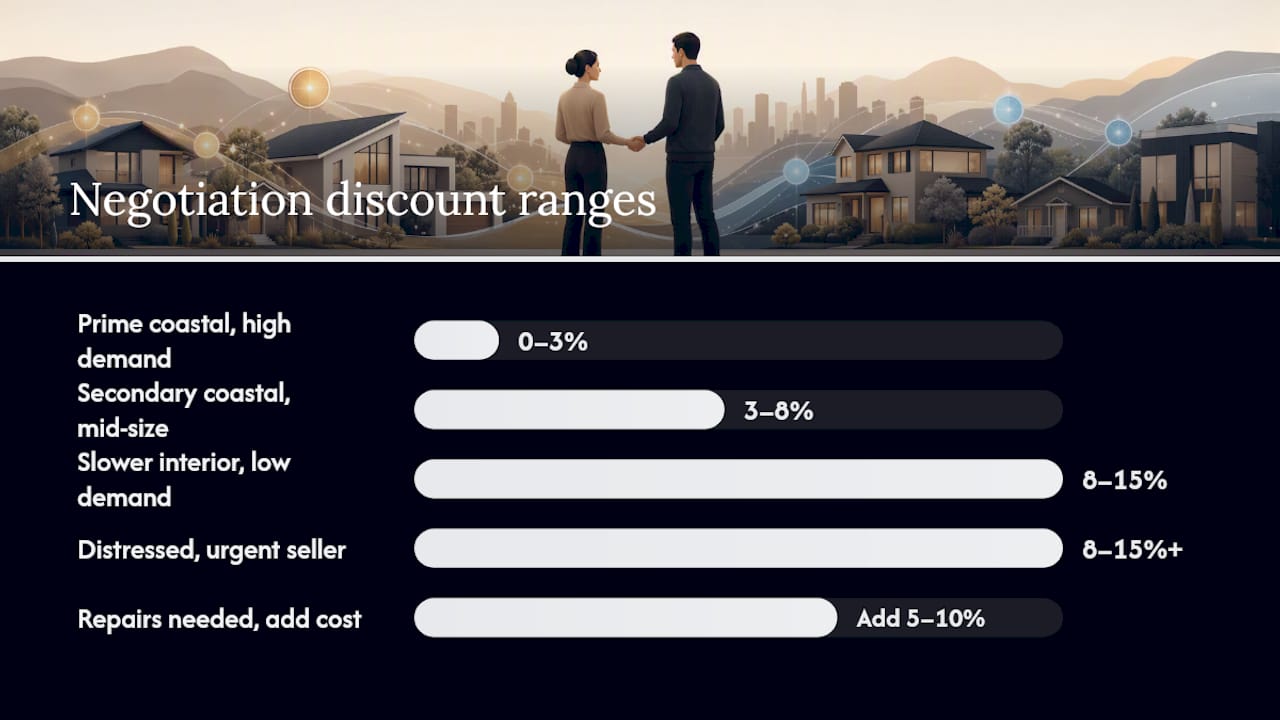
In prime urban and coastal markets, negotiation percentages shrink; buyers should negotiate extras (parking, appliances, timing) rather than an outright price cut.
Seven buyer mistakes that weaken your negotiating position
1. Showing desperation
Telling the agent “we love this house” or “this is exactly what we’ve been looking for” hands the seller a free concession. Keep your enthusiasm internal.
2. Offering without pre-approval
An offer without financing documentation is not taken seriously. Sellers and agents know that unverified buyers fall through. Pre-approval is table stakes.
3. Skipping the inspection
Waiving the inspection to speed up a deal is one of the most expensive shortcuts a buyer can take. The inspection is also your primary negotiation tool after the offer is accepted.
4. Ignoring the nota simple
Hidden mortgages, embargos, and unregistered easements are not rare. Skipping the Land Registry check is how buyers inherit someone else’s legal problems.
5. Making an insulting low offer without data
A low offer without supporting comparables or a repair estimate reads as uninformed, not strategic. It can close the seller off entirely. Always attach data.
6. Failing to document concessions in writing
Verbal agreements on included appliances, repair credits, or closing date flexibility disappear at the notary. Every concession goes into the written contract.
7. Over-committing on timelines
Promising a 30-day close when your mortgage needs 60 days creates a breach risk. Confirm your lender’s timeline before you write it into the offer.
Pro Tip: Practice the negotiation conversation before you have it. Role-play the seller’s likely counters with your agent. Buyers who have rehearsed their responses stay calmer and give away less.
Mandatory legal and financial checks before you sign
The nota simple and what it tells you
Order the nota simple from the Registro de la Propiedad before you pay anything. It confirms the registered owner (the person you are actually buying from), the property’s legal description, and any charges: outstanding mortgages, embargos (court-ordered liens), servidumbres (easements), or community debts. Any of these can be grounds for price renegotiation or withdrawal. The legal buying process in Spain requires this check before the arras contract is signed.
Budgeting for total purchase costs
Budget roughly 10–12% above the purchase price for taxes and transaction costs. The split depends on the property type:
- Second-hand property: Impuesto de Transmisiones Patrimoniales (ITP), which varies by autonomous community (typically 6–10% in Catalonia and surrounding regions)
- New build: IVA (10% for residential) plus Actos Jurídicos Documentados (AJD, typically 1–2%)
- Both types: Notary fees, Land Registry inscription fees, and legal/advisory costs
Buyers who do not model this upfront sometimes find themselves short at the notary.
Contract types: arras penitenciales vs. arras confirmatorias
The arras contract is the earnest money agreement signed before the final notarial deed. The type matters enormously. Penitential arras allow either party to exit: the buyer forfeits the deposit, the seller returns double. Confirmatory arras create a firmer obligation and may expose either party to specific performance claims. Verify the arras type with your attorney before signing.
When to pause or walk away
- Undisclosed charges on the nota simple the seller cannot or will not clear
- Inspection reveals structural defects the seller refuses to price-adjust for
- Bank tasación comes in significantly below the agreed purchase price and the seller will not renegotiate
- Seller refuses to provide documentation (nota simple, community fee receipts, IBI tax receipts)
Legal checklist (get each item signed off by your attorney):
- Nota simple reviewed and charges confirmed clear or priced into the offer
- Arras type confirmed as penitenciales with correct deposit amount
- Financing contingency clause included in the arras contract
- IBI receipts and community fee statements reviewed (no arrears)
- Notary appointment confirmed and deed reviewed before signing date
What to do when negotiations break down
Not every negotiation ends in a deal. Knowing how to exit cleanly keeps your options open.
Immediate steps if you withdraw
- Confirm your deposit return in writing before you sign any withdrawal document
- Document all communications (emails, WhatsApp messages, written offers) in a single folder
- Notify your lender and attorney that the transaction is not proceeding
- Confirm the inspection and legal fees are settled
Keeping the door open
Withdraw politely and without burning the relationship. A brief note to the seller’s agent — “We were unable to reach terms at this time but remain interested if circumstances change” — costs nothing and occasionally pays off. Sellers who reject an offer in March sometimes call back in September after two more price reductions.
Triggers to re-enter
- A new price reduction on the listing (set a portal alert)
- Expiry of an exclusivity period with another buyer
- Change in seller circumstances (new relocation deadline, estate settlement pressure)
- Property re-listed after a failed sale
Non-price concessions to ask before walking
Before you formally withdraw, ask whether the seller would consider including items that change the value equation without changing the headline price: furniture, appliances, a parking space, a storage unit, or a pre-paid community fee period. Sometimes a seller who will not move on price will move on terms.
The buyer credibility checklist and negotiation scripts
E-E-A-T credibility checklist
A buyer who presents this package is taken seriously from the first call:
- Pre-approval letter or bank-issued proof of funds (current, dated within 90 days)
- Comparable sales summary (price per m², last 6 months, same neighborhood)
- Independent appraisal from a Banco de España–approved tasación firm
- Inspection report with contractor-signed repair estimate attached
- Nota simple reviewed and annotated by attorney
- Written offer template with all contingencies pre-filled
Script 1: Initial offer (phone)
Script 2: Inspection-repair request (email)
Pro Tip: In the Costa Dorada and broader Catalonia market, negotiation culture tends to be direct but relationship-aware. Attaching data (comps, repair estimates) is expected and respected. Aggressive verbal pressure without documentation tends to backfire. Customize scripts to match the formality level of the seller’s agent — a formal agency expects formal language; a private seller often responds better to a brief, personal note.
For a printable negotiation template and buyer checklist, visit the Costacambrils buyer resources page.
What negotiating luxury and second-home properties actually teaches you
Most negotiation guides treat price as the primary variable. After working through transactions in the Costa Dorada market, the more interesting observation is how rarely price alone determines the outcome.
In the luxury and second-home segment, sellers are often not in financial distress. They have time. What they respond to is certainty — a buyer who will not fall through, who has financing confirmed, who has done the legal homework. Two transactions stand out as examples of this pattern. In one case, a buyer secured a meaningful concession not by pushing on price but by offering to assume responsibility for a pending community renovation assessment, removing the seller’s uncertainty about a future liability. In another, a buyer who agreed to a 45-day possession delay after closing — letting the seller stay through a school year transition — received a price adjustment that more than compensated for the inconvenience.
The lesson for luxury buyers specifically: the seller’s non-financial concerns are often more negotiable than the price. Find out what they actually need (certainty, timing, a clean exit from a specific liability) and price that into your offer structure. A buyer who asks “what matters most to you in this sale besides price?” in the first conversation often learns something no comparable analysis could reveal.
For buyers considering luxury property types in the Costa Dorada, the same principle applies: understand the seller’s situation before you build the offer, and you will negotiate better terms than any percentage-off formula can deliver.
Pro Tip: In the Costa Dorada market, sellers of high-value properties often have emotional ties to the home. Acknowledging the property’s qualities briefly in your written offer — without gushing — signals respect and keeps the seller from becoming defensive about a price adjustment.
Costacambrils gives you local negotiation advantage in the Costa Dorada
Knowing how to negotiate home prices is one thing. Having a local team that knows which sellers are motivated, which properties are overpriced relative to recent closed sales, and which legal checks are non-negotiable in this specific market is another.

Costacambrils operates in the Costa Dorada luxury market with direct access to local transaction data, vetted inspection and appraisal partners, and legal advisory support that covers nota simple review, arras contract verification, and tax cost modeling. For buyers targeting Cambrils, Tarragona, and the surrounding coast, that combination means you walk into a negotiation with the same information the seller’s agent has — and often more. The agency’s buyer consultation process starts with a market data briefing specific to your target neighborhood, so your opening offer is grounded in real closed sales, not portal asking prices.
To see what is currently available and get a buyer consultation, visit the Costa Dorada luxury property guide or contact the Costacambrils team directly to request a market briefing for your target area.
This article is general information, not a substitute for advice from a qualified financial advisor. Consult a qualified financial professional about your own circumstances before acting on anything here.
Sources
- 10 consejos para negociar el precio de una casa — Tinsa
- Comprar piso en España 2026: guía completa (arras, escritura, ITP y gastos)
- Proceso de Compraventa de un Inmueble en España: Guía completa paso a paso – Ríos Espinosa
- Cómo negociar precio vivienda Datos 2026 | Trustin
- Comprar vivienda: pasos y guía detallada — El Confidencial