
Yes, you can negotiate most rental contracts. Start by pulling comparable listings in the same neighborhood before you contact the landlord. The three levers that move almost every negotiation are rent, lease length, and deposit terms.
Your highest-priority negotiation targets:
- Monthly rent — the most obvious ask, but often not the easiest win
- Lease length — offering a longer commitment frequently unlocks rent reductions or move-in concessions
- Deposit terms — the legal maximum under Spain’s LAU is one month’s rent as a deposit for residential use, and up to two additional months may be required in supplementary guarantees
Table of Contents
- How to negotiate rental contracts: research and landlord profiling
- When is the right time to open a lease negotiation?
- What can you actually negotiate in a lease agreement?
- Negotiation scripts and tactics you can use right now
- Contract clauses and legal pitfalls to watch for
- Documents and financial offers that strengthen your position
- How your approach changes with private landlords vs. agencies
- How long does a rental negotiation take, and what should you expect?
- When should you hire a lawyer or tenant advisor?
- Key Takeaways
- The part of lease negotiation most guides get wrong
- Costacambrils can handle the negotiation side for you
- Useful sources and next-step resources
How to negotiate rental contracts: research and landlord profiling
Arriving at a negotiation with data beats arriving with a wish. Vacancy rates and comparable rents give you direct leverage, especially when a property has been sitting on the market.
Comparable data to collect:
- Location, size (square meters), condition, floor, and included amenities
- Asking price vs. actual closing rents where visible
- Days on market for similar listings
- Vacancy signals: the same listing reappearing, price drops, or “reduced” flags
Where to find reliable comps:
- Major listing portals covering Spain and Central Europe (filter by neighborhood and size)
- Recent screenshots of competing listings with dates visible
- Local market reports from real estate associations or municipal statistics offices
How to profile the landlord:
- Private owner vs. management agency: private owners often have more flexibility and care more about tenant reliability than maximizing rent
- Time on market: a listing that has been active for more than 30 days signals flexibility
- Multiple listings from the same owner: a landlord with several vacant units has stronger motivation to fill them quickly
Documents to prepare before you open the conversation:
- Recent payslips (last 2–3 months)
- Employment contract or proof of stable income
- Bank statements (last 3 months)
- Reference letter from a previous landlord
- Rental payment ledger from your current or previous tenancy
Pro Tip: A property that has been listed, withdrawn, and relisted is a strong signal the landlord has already missed their target rent. That history is public and worth mentioning politely.
When is the right time to open a lease negotiation?
Timing is the variable most renters underestimate. The best moments to negotiate are before signing a new contract and at renewal, but the window and your leverage differ significantly between the two.
Key timing windows:
- Before signing: your leverage peaks here. The landlord has not yet secured income, and you can negotiate from a position of choice.
- During the listing period: the longer the property has been on the market, the more receptive the landlord tends to be.
- At renewal: start renewal talks roughly six months before the contract expires. That timeline gives you room to research the market, draft a proposal, and avoid reacting to a sudden rent hike with no alternatives ready.
Market seasonality matters too. Rental markets in Spain and Central Europe tend to tighten in late summer (August–September) when demand from students and relocating workers peaks. Negotiating in November or February, when fewer renters are actively searching, gives you a softer market to work with.
Positioning advice: open with a collaborative frame. Something like “I want to stay long-term and make this easy for both of us” lands better than leading with a price complaint. Landlords respond to stability signals.

Pro Tip: If you are genuinely considering two properties, let the landlord know you are evaluating options. You do not need to name the other property. The mere existence of an alternative shifts the dynamic without burning goodwill.
What can you actually negotiate in a lease agreement?
More than most tenants assume. Presenting yourself as an ideal tenant and offering trade-offs often secures better terms than focusing solely on price.
Primary levers (highest impact):
- Monthly rent
- Move-in concessions: one free month, reduced first month, or waived agency fee
- Lease length: a longer commitment often justifies a lower monthly rate
- Rent-indexation clause: negotiate the index used (CPI, IRAV, or a fixed cap) and the frequency
- Break clause terms: under Spain’s LAU, tenants may exit after six months with 30 days’ notice; whether an indemnity applies and at what rate can be negotiated within the legal boundaries
Secondary levers (worth asking):
- Who pays community fees and property tax (IBI)
- Repair and maintenance responsibilities (who handles what, and within what timeframe)
- Subletting or guest rules
- Pet policy
- Furnished items included or excluded
Items that are often non-negotiable under mandatory law: minimum contract duration protections, the legal deposit cap (one month’s rent as a deposit for residential use, and up to two additional months as supplementary guarantees), and the tenant’s right to early exit after six months. Clauses that override these protections in the tenant’s favor cannot be waived; clauses that harm mandatory tenant rights may be null and void under LAU Article 6. Always verify the specific rules in your jurisdiction with a local legal professional.
| Concession | Typical landlord trade-off | What you offer in return |
|---|---|---|
| Rent reduction (5–10%) | Longer vacancy risk eliminated | Two-year lease commitment |
| Free first month | Immediate occupancy, no gap | Sign within 72 hours |
| Reduced deposit | Less upfront cash for landlord | Bank guarantee or guarantor letter |
| Utilities included | Simplified billing | Slightly higher monthly rent |
| Flexible break clause | Tenant comfort, lower churn | Higher deposit or longer notice period |
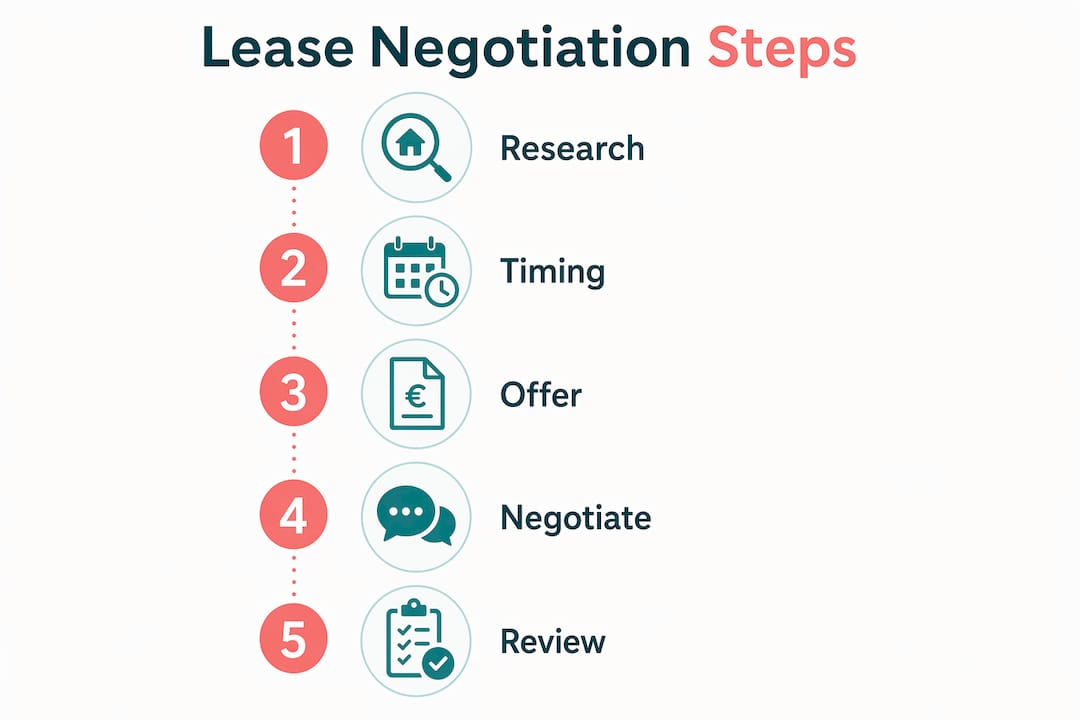
Pro Tip: Order your requests from landlord-friendly to renter-friendly. Lead with the concession that costs the landlord the least (a longer lease, a faster signing), then introduce the ask that benefits you most (lower rent). Reversing that order puts landlords on the defensive immediately.
Negotiation scripts and tactics you can use right now
Concrete language closes deals faster than vague requests. Tenants who lead with a clear, written trade-off close faster than those who make open-ended asks.
Opening tactics:
- Anchoring: name a specific number based on your comps, not a range. “Based on three comparable properties in this area currently listed at €X, I’d like to propose €Y” is more effective than “I was hoping for something lower.”
- Timing hooks: reference the listing duration. “I noticed this has been available for several weeks” signals awareness without being aggressive.
- Trade-off framing: pair every ask with an offer. “I’ll sign a two-year lease at €X if you can include one month free at the start.”
Email template — before signing:
Subject: Rental application — [Property address]
Dear [Landlord/Agent name],
I am very interested in the property at [address] and would like to move forward. Based on comparable rentals in the area, I’d like to propose a monthly rent of €[X] in exchange for a two-year lease commitment. I can provide payslips, references, and a bank statement immediately. Please let me know if we can discuss this week.
Best regards, [Your name]
Email template — at renewal:
Subject: Lease renewal — [Property address]
Dear [Landlord name],
My lease expires on 2026 and I would like to renew. I have been a reliable tenant and would like to continue. Given current market rents in the area, I’d like to propose [gradual increase / no increase / specific figure] for the next [period]. I am happy to discuss and can offer [longer lease / additional guarantee] in return. Could we arrange a call this week?
Best regards, [Your name]
In-person talking points:
- “I’ve looked at what similar properties are renting for nearby, and I’d like to talk about the rate.”
- “I’m looking for somewhere to stay long-term. If we can agree on [X], I’m ready to sign quickly.”
Pro Tip: If an agent stalls, set a clear next step before you leave the conversation: “Can we confirm by Thursday?” A deadline you name is more effective than waiting for them to come back to you.
Contract clauses and legal pitfalls to watch for

Not every clause in a rental contract is enforceable. Some are simply unenforceable under local law; others are technically legal but carry serious financial risk.
Checklist of risky clauses:
- Excessive break penalties beyond what local law allows
- Ambiguous repair allocation (who pays for what is not defined)
- Automatic rent increases tied to uncapped or non-standard indexes
- Unlimited additional guarantees beyond the legal maximum
- Clauses that waive the tenant’s right to early exit after six months
- Vague language about deposit return timelines and conditions
Under Spain’s LAU, certain tenant protections are mandatory and clauses that modify them to the tenant’s detriment are null and void. The same principle applies broadly across Central European jurisdictions, though the specific rules vary. Always confirm the applicable law for your location with a local legal professional.
When you spot a risky clause, you have two options: request a redline (a specific rewrite of that clause) or walk away. For high-value or complex rentals, professional legal review is strongly advised to detect ambiguous clauses and hidden liabilities before you sign.
Key principle: Any clause that appears to override mandatory tenant protections should be treated with suspicion. Local laws commonly render such clauses void, but you still need to know they are there before signing.
Pro Tip: Ask for a short written addendum that specifies: who is responsible for each repair category, the timeline for completing repairs, and the exact process and deadline for deposit return. This one page prevents most post-tenancy disputes.
Documents and financial offers that strengthen your position
A strong document package signals low risk. Landlords and agents who see a complete, organized file move faster and negotiate more generously.
Essential documents:
- Government-issued ID
- Recent payslips (last 2–3 months)
- Employment contract showing stability
- Bank statements (last 3 months)
- Reference letter from a previous landlord
- Rental payment ledger showing consistent on-time payments
Optional documents that boost credibility:
- Guarantor letter from a creditworthy third party
- Bank reference letter
- Proof of rental insurance
- Credit score printout from a recognized bureau
Financial offers to consider:
- Prepay two or three months upfront to reduce landlord risk perception
- Offer a larger deposit in exchange for a lower monthly rent
- Propose a short-term rent premium (slightly above market) in exchange for a longer lease at a fixed rate
Minimal document bundle for an email negotiation: ID copy, two recent payslips, one bank statement, and a brief cover note summarizing your rental history. Keep it to one email with clear attachments. Document everything and attach market evidence alongside your personal file.
How your approach changes with private landlords vs. agencies
The counterpart across the table shapes your entire strategy. Private owners and management companies respond to different signals.
Private landlords:
- Value tenant reliability and personal rapport above almost everything else
- Often have more flexibility on price but less tolerance for uncertainty
- Respond well to stability signals: long lease, clean rental history, local employment
- May be open to informal concessions (painting a room, minor repairs) that agencies cannot approve
Management companies and agencies:
- Usually follow internal pricing policies with limited room to move on headline rent
- Can approve concessions from a portfolio perspective: free parking, included utilities, flexible move-in date
- Require documented proposals. A written offer with comps attached carries more weight than a verbal request.
- Decision-making is slower; expect at least one round of internal approval
Red flags to watch regardless of counterpart:
- Refusal to provide written terms before signing
- Pressure to sign immediately without time to review
- Unclear or verbal-only deposit handling
- Refusal to supply proof of property ownership or landlord identification
Always get agreed changes in writing. A verbal concession that does not appear in the signed contract or a written addendum does not exist legally. Before you sign, read the final document against your negotiated terms line by line. If something is missing, ask for it in writing before you hand over any money.
How long does a rental negotiation take, and what should you expect?
Simple concessions at signing can close in 24–72 hours. Renewal negotiations, especially when rent increases are contested, often take several weeks.
Typical timelines:
- Signing-time negotiation: a few days for straightforward asks (free month, minor rent reduction)
- Renewal negotiation: a few weeks, depending on market conditions and landlord responsiveness
- Complex lease redlines or legal review: may take additional time
Realistic outcomes by market strength:
- Strong renter market (high vacancy, slow season): rent reductions of 5–10%, move-in concessions, flexible break clauses
- Strong landlord market (low vacancy, peak season): concessions shift to non-monetary terms (longer lease, included utilities, flexible move-in date)
Rules of thumb for when to walk away: if the landlord refuses to put agreed changes in writing, insists on deposit amounts above the legal maximum, or will not negotiate any term at all, those are signals worth taking seriously.
Next steps after reaching an agreement:
- Get every concession written into the contract or a signed addendum
- Adjust your payment schedule to match the agreed terms
- Photograph the property thoroughly before move-in and share the photos with the landlord in writing
- Confirm the deposit has been registered with the relevant regional authority
When should you hire a lawyer or tenant advisor?
Most standard lease negotiations do not require a lawyer. A few situations do.
Triggers for professional help:
- High-value or luxury rentals where monthly rent or deposit amounts are significant
- Ambiguous liability clauses (who pays for structural repairs, who is responsible for appliances)
- Significant requested renovations or works before or during the tenancy
- Large rent increases at renewal that you want to formally contest
- Any clause you do not fully understand after reading it twice
What professionals provide:
- Clause-by-clause redlining of the contract
- Negotiation on your behalf with the landlord or agency
- Local law interpretation (especially relevant when renting across borders in Central Europe)
- Drafting of addenda that protect your interests
Cost vs. benefit: a short fixed-fee contract review typically costs far less than one month’s rent on a high-value property. Full negotiation representation costs more but is often worth it when the annual rent is substantial or the liability clauses are complex. For luxury property rentals, a specialist review that catches one ambiguous clause can save multiples of its fee. See also why legal advice matters for high-value transactions in the Costa Dorada region.
Pro Tip: Before hiring anyone, ask for a written scope of work and a fixed fee estimate. An advisor who cannot define what they will do and what it costs is not the right advisor for a lease negotiation.
Key Takeaways
Negotiating a rental contract works when you combine market data, a clear trade-off offer, and the right timing — starting at least six months before renewal and always securing agreed changes in writing.
| Point | Details |
|---|---|
| Research comps first | Collect at least three comparable listings with rent, size, and days on market before any conversation. |
| Start renewal talks early | Begin renewal negotiations roughly six months before contract expiry to preserve leverage and avoid reacting under pressure. |
| Offer trade-offs, not just asks | Pair every request with something of value: a longer lease, a faster signing, or a larger deposit. |
| Insist on written changes | Any concession not written into the contract or a signed addendum has no legal standing. |
| Costacambrils for local support | Costacambrils provides local market data, contract review, and negotiation support for renters in the Costa Dorada region. |
The part of lease negotiation most guides get wrong
Most negotiation advice focuses on tactics: what to say, when to say it, how to anchor a number. That is useful. But the bigger mistake most tenants make is treating the negotiation as a one-time event rather than a relationship decision.
Landlords, especially private owners of luxury properties, are not primarily optimizing for the highest rent. They are optimizing for the lowest friction. A tenant who pays reliably, communicates clearly, and does not generate maintenance calls is worth more to a private landlord than an extra fifty euros a month. That is the real leverage most renters never use.
The practical implication: your document package, your tone, and your willingness to commit to a longer lease are often more persuasive than any price argument. A landlord who has had a difficult previous tenant will trade a rent reduction for certainty almost every time.
One pattern that comes up repeatedly in the luxury rental segment: a tenant proposes a two-year lease at a rate slightly below the landlord’s asking price, with a modest annual increase built in. The landlord accepts because the math works and the certainty is worth more than holding out for full price with an unknown tenant. Neither side “won.” Both got what they actually needed.
The negotiation that feels collaborative closes. The one that feels adversarial usually does not, even when the numbers are identical.
Costacambrils can handle the negotiation side for you
Knowing how to negotiate a lease is one thing. Having someone in your corner who knows the local market, the landlords, and the contract language is another.

Costacambrils works with renters across the Costa Dorada region, offering local market data, contract review, and direct negotiation support for residential and luxury rentals. If you are looking at a high-value property or a complex lease, the team can identify risky clauses, benchmark the rent against current comps, and help you structure a trade-off offer that actually lands. For renters who want a clear process from search to signed contract, the rental process guide covers every step. When you are ready to move forward, contact the Costacambrils team to discuss your specific situation and get a clear picture of what the current market will support.
This article is published by Costacambrils and is intended as general information. For advice specific to your contract or jurisdiction, consult a qualified local legal professional.
Useful sources and next-step resources
The sources below back the claims in this article and are worth bookmarking for your own negotiation research.
Legal and regulatory sources:
- LAU (Ley de Arrendamientos Urbanos) — Legia.es: the primary reference for Spain’s residential tenancy law, including mandatory protections, deposit rules, and early-exit rights
- LAU actualizada 2026 — Aurora Homes: plain-language summary of the current LAU with 2023 amendments explained
- Rental contract clauses and tenant rights — Klaro Legal: practical guide to reading and understanding a Spanish rental contract
Market and negotiation guidance:
- How to negotiate rent — Hogar Mapfre: covers comparable data collection and landlord motivation analysis
- Renewal negotiation expert guide — El Español: expert commentary on timing, trade-offs, and gradual increase proposals
- What you can negotiate before signing — Febrer Asesores: practical checklist of negotiable items and when to seek legal review
- Long-term rental negotiation — Tegeisa: documentation and evidence-gathering guidance
- Smart Tenant’s Guide — Coast CCU: broader tenant negotiation framework useful for cross-referencing Central European practice
For local law vs. market comps: use the LAU sources for legal questions specific to Spain. For market comps, rely on current listing portals and local real estate association reports for your specific city or region. Save screenshots of competing listings with dates visible and attach them to any written negotiation proposal.
Recommended
- How to Negotiate Rental Terms in Spain: 2026 Guide – Inmobiliaria Costa Cambrils
- What Is a Rental Contract? A Guide for Renters and Investors – Inmobiliaria Costa Cambrils
- Apartment Buying Checklist 2026: Your Step-by-Step Guide – Inmobiliaria Costa Cambrils
- The Role of Negotiations in Property Sales – Inmobiliaria Costa Cambrils