
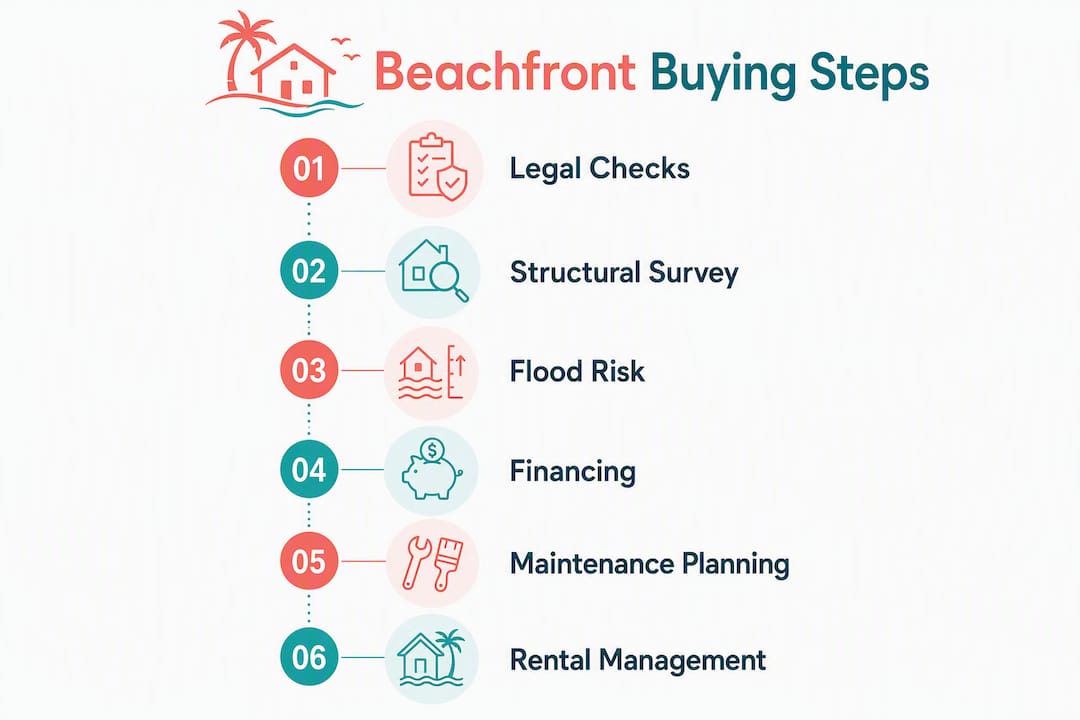
Choosing a beachfront home comes down to five priorities you should apply before you fall in love with any view: (1) verified coastal legal status via a Demarcación de Costas certificate confirming the property sits outside the public maritime-terrestrial domain (DPMT), (2) site elevation and erosion risk backed by an altimetry report, (3) build quality and salt-resistant materials including SATE insulation, A4/316 stainless steel hardware, and thermal-break glazing, (4) realistic operating economics covering insurance, maintenance, and property management fees, and (5) market and liquidity factors such as a substantial price premium that true first-line properties command over second-line alternatives. Request those three documents — the Demarcación de Costas certificate, an altimetry report, and an energy certificate — at your very first enquiry. If a seller cannot produce them promptly, treat that as a red flag, not a minor administrative delay.
- Verified coastal legal status (DPMT/deslinde certificate)
- Site elevation and erosion risk (altimetry report, flood maps)
- Build quality and marine-grade materials (SATE, A4/316 hardware, thermal glazing)
- Realistic operating economics (insurance, maintenance, management fees)
- Market and liquidity factors (first-line premium, rental demand, resale depth)
Pro Tip: When a property ticks all five, run the numbers on ongoing costs — insurance plus annual maintenance plus management — before making a full offer. The monthly carrying cost often surprises buyers who focused only on the purchase price.
Table of Contents
- What “first-line beachfront” actually means and why it changes everything
- 1. Structural materials and energy efficiency: what to check in the building itself
- 2. Legal and flood risk checks you must complete before bidding
- 3. On-site inspection checklist and which specialists to hire
- 4. Financing, taxes, insurance, and rental economics
- 5. Matching the property to your buyer profile
- 6. Long-term maintenance planning and property management realities
- 7. Costa Dorada market snapshot and what local rules mean for buyers
- 8. From shortlist to closing: your buying timeline and negotiation levers
- Key Takeaways
- What buyers consistently underestimate about beachfront purchases
- Costacambrils makes coastal due diligence faster and less risky
- Authoritative sources and tools for your due diligence
What “first-line beachfront” actually means and why it changes everything
The phrase “beachfront” gets used loosely in listings, and that looseness has real legal and financial consequences. A true first-line property has direct littoral access and an unobstructed sea view with no intervening road, building, or public promenade. Second-line properties sit nearby but with some separation — a road, a row of palms, or a promenade between them and the water. The distinction matters because Spanish law, specifically the Ley de Costas and its DPMT framework, treats the two categories very differently.
Under Spanish coastal law, the public maritime-terrestrial domain extends from the waterline inland across beaches and dunes. Properties that fall within or adjacent to this zone are subject to servidumbres — legally binding easements for protection, transit, and public access — that restrict what you can build, rebuild, or modify. The deslinde (coastal delimitation) is the official survey that draws the boundary. If a property sits inside the DPMT, the owner holds a concession rather than freehold title, and that concession can expire or be revoked. If it sits in the adjacent protection zone, rebuilding after storm damage may be prohibited even when the original structure was legal.
Documents to request at first contact:
- Property registry extract (nota simple) confirming title type and any recorded encumbrances
- Coastal delimitation map and deslinde certificate from the Demarcación de Costas
- Municipal urban planning fiche (ficha urbanística from the PGOU) confirming permitted uses
- Altimetry note showing the property’s elevation above mean sea level
1. Structural materials and energy efficiency: what to check in the building itself
Salt air is relentless. A property that looks pristine in summer photographs can have corroded hinges, failing window seals, and spalling concrete by the time you move in. The materials specification tells you more about long-term cost than the asking price does.

Corrosion-resistant hardware and finishes
Every exposed metal fitting — hinges, locks, balustrade posts, shutter mechanisms, garage motors — should be A4 (316-grade) stainless steel or marine-grade aluminum. Standard A2 (304-grade) stainless corrodes visibly within two to three years in a first-line environment. Exterior paints should be polyurethane or epoxy-based; standard acrylic emulsions blister and peel within one season. Floor finishes on terraces and external areas should be porcelain or natural stone with non-slip ratings; timber decking requires annual treatment and replacement cycles of roughly five to seven years.
Thermal envelope and moisture control
SATE (External Thermal Insulation Composite System) applied to external walls dramatically reduces heating and cooling loads and protects the structural wall from salt-laden moisture. Pair it with double or triple glazing using thermal-break aluminum profiles. Single-glazed aluminum frames with no thermal break are a liability: they condensate heavily in winter, corrode faster, and push energy bills up. Cross-ventilation design — windows and openings on opposing facades — reduces the need for mechanical cooling and prevents the moisture buildup that accelerates mold and corrosion indoors.
Foundations, drainage, and roofing
Ask specifically about foundation type and depth. Shallow strip foundations on sandy or eroded ground are a structural risk. Check that drainage paths slope away from the building and that garages or basement areas have sump pumps with battery backup. Roofs should use robust materials — concrete or clay tile, metal standing-seam, or membrane systems — with documented waterproofing layers and terrace drainage outlets that cannot block with debris.
Energy certification and sustainability
An A-rated energy certificate is not just a green credential; it reduces utility costs and protects resale value in a market where buyers increasingly price efficiency into offers. Check whether the property has photovoltaic readiness (conduit and panel space), a heat pump or aerotermia system, and low-flow water fixtures. These features lower the monthly carrying cost and appeal to the rental market.
Pro Tip: A building with modern thermal control and well-specified marine hardware will save more in lifecycle costs over ten years than any cosmetic upgrade. Prioritize the spec sheet over the staging.
2. Legal and flood risk checks you must complete before bidding
The documents that prevent catastrophic transaction risk are not the ones agents typically lead with. You need to request them yourself, early.

Coastal legal status
Registrars can and do suspend deed registrations when Demarcación de Costas coordination is missing. A property that cannot be registered is a property you cannot legally own in the conventional sense, and one that may carry demolition risk if it was built without proper coastal clearance. Obtain the formal certification of non-affection before signing any contract — not after.
The Ley de Costas defines the public maritime-terrestrial domain as constitutionally inalienable and imprescriptible. That means no private claim, however long-standing, can override it. Properties that encroach on the DPMT are legally vulnerable regardless of how many years they have been occupied.
Flood and erosion risk
Request an altimetry report and cross-reference it with local flood maps and historical inundation records. In exposed coastal sites, a minimum elevation of 6–8 meters above mean sea level is the commonly recommended threshold for storm surge mitigation. Coastal erosion is often permanent; it cannot be reversed with cosmetic repairs, and it can change a property’s legal status if the shoreline retreats to the building’s footprint.
Insurance implications
Before you make an offer, ask an insurance broker to simulate a real premium for the property. Coastal household policies carry loadings for storm surge, salt damage, and subsidence that standard inland policies do not. Some insurers exclude erosion-related claims entirely. Discovering an uninsurable exposure after exchange is a transaction-ending problem.
Planning and usage restrictions
Check for servidumbres de protección (typically a 100-meter inland strip), servidumbre de tránsito (a 6-meter public access strip), and any existing concessions or retranqueos. Confirm whether the property can be legally rebuilt to its current footprint if destroyed. If it cannot, the insurance payout after a major storm may be worthless because you cannot reconstruct what you lost.
Documents checklist:
- Nota simple from the Land Registry
- Demarcación de Costas certificate of non-affection
- Deslinde and coastal delimitation maps
- Municipal PGOU planning fiche
- Altimetry report and local flood/inundation maps
- Insurance broker’s premium simulation
3. On-site inspection checklist and which specialists to hire
A viewing without a checklist is a tour. You need a structured inspection and, for any serious offer, specialist reports that materially affect negotiability.
Before the viewing
Request seller disclosures, photographs taken during recent storms, maintenance records for the past three to five years, and documentation of any past insurance claims or coastal remediation works. Gaps in this record are informative on their own.
On-site checklist
- Orientation and prevailing wind exposure (southwest-facing terraces take the most punishment)
- Visible corrosion on hinges, balustrades, shutters, and garage mechanisms
- Window and door hardware condition, seal integrity, and frame corrosion
- Drainage slope on terraces and external areas
- Condition of waterproofing membranes on flat roofs and terraces
- Wear and cracking on stone or tile finishes
- Evidence of past flooding: tide marks, efflorescence, or salt staining at low levels
- Access road condition, parking, and emergency vehicle access
Specialist surveys to commission before making an offer
| Survey type | What it assesses | Key output |
|---|---|---|
| Structural engineer | Foundation integrity, slope stability, scour risk | Written report with remediation cost estimate |
| Geotechnical/altimetry | Soil type, elevation, erosion trajectory | Altimetry certificate and risk classification |
| Coastal engineer | Shoreline erosion rate, scour protection adequacy | Risk rating and recommended works |
| Certified energy assessor | SATE condition, glazing spec, thermal performance | Energy certificate (A–G rating) |
| Insurance broker | Insurability, premium loading, exclusions | Written premium simulation |
Pro Tip: Insist on written remediation scopes and get at least one contractor quote for any structural or waterproofing defect before final negotiation. That quote becomes your price reduction lever.
4. Financing, taxes, insurance, and rental economics
The purchase price is the starting point, not the total cost. Buyers who model only the acquisition miss the carrying costs that determine whether a beachfront property is genuinely affordable.
Financing
Lenders treat coastal second homes as higher-risk assets. Expect stricter loan-to-value ratios than for primary residences, with varying requirements for non-residents and residents depending on lender criteria. Some lenders require additional insurance coverage or structural surveys before approving coastal property loans. Check lender eligibility through a regulated mortgage broker listed on NMLS Consumer Access.
Taxes and transaction costs
In Spain, buyers pay Impuesto de Transmisiones Patrimoniales (ITP) on resale properties, with rates set by each autonomous community varying between regions. New builds attract IVA at 10% plus Actos Jurídicos Documentados (AJD). Add notary fees, Land Registry fees, and legal advisory costs. Foreign buyers should also account for annual Impuesto sobre Bienes Inmuebles (IBI) and, where applicable, non-resident income tax on imputed or actual rental income. For rental income reporting, the IRS publication on rental income and expenses is a useful framework for US-based buyers tracking obligations across jurisdictions.
Operating cost estimates
Salt air drives maintenance costs well above inland norms. First-line properties typically require higher annual maintenance spending than second-line properties, reflecting exposure and salt air effects. Budget separately for insurance loadings, which can run 30%–50% above standard household rates for exposed coastal positions.
Rental economics
Professional property management for holiday rentals typically costs 15%–25% of gross rental income because of the operational intensity: check-ins, professional cleaning between stays, rapid repair response, and guest communication. Vacation rental viability generally requires occupancy above 65% to cover management fees, maintenance, and financing. Long-term lets produce lower gross yields but far lower operational costs and no license risk. Rental licenses are required in most Spanish autonomous communities, and some municipalities or communities of owners restrict or ban short-term holiday lets entirely — verify this before factoring rental income into your purchase decision.
5. Matching the property to your buyer profile
The right beachfront property depends entirely on what you are buying it for. The same first-line villa that makes a perfect holiday retreat can be a poor investment and an exhausting primary residence.
Primary resident
Year-round comfort is the priority. That means energy efficiency (SATE, triple glazing, heat pump), low noise exposure, reliable public services, and proximity to schools, healthcare, and transport. Elevated second-line properties often win here: they avoid the worst salt exposure, carry lower maintenance costs, and typically sit in quieter residential streets rather than tourist-facing promenades. The view trade-off is real but so is the quality-of-life gain.
Holiday buyer
Access and charm matter, but so does the management burden when you are not there. Gated or managed communities with on-site maintenance reduce the hands-on work significantly. Consider how many weeks per year you will actually use the property and whether the rental income during vacant periods realistically offsets the carrying cost. A property that requires your personal attention for every repair is not a holiday home; it is a second job.
Investor
Legal clarity is non-negotiable. DPMT exposure, missing deslinde certificates, or rental license restrictions can each destroy the investment thesis. An elevated second-line property with a clean registry record, a documented rental history, and a valid tourist license often outperforms a flashier first-line asset with legal ambiguity. Liquidity matters too: properties with clear title and no coastal encumbrances sell faster and at tighter discounts in a downturn.
Decision rules by profile:
- Primary resident: prioritize energy efficiency + noise profile + public services; second-line elevated sites often win
- Holiday buyer: weigh access and charm against management burden; favor managed communities
- Investor: prioritize legal clarity (DPMT certificate) + rental license status + resale liquidity
6. Long-term maintenance planning and property management realities
Maintenance on a beachfront home is not optional, and it is not cheap. The buyers who treat it as optional discover this when they try to sell.
Typical maintenance program
Exterior metalwork — hinges, motors, balustrade fittings — needs inspection and lubrication every six months and replacement every 2–5 years depending on exposure. Exterior paintwork on first-line properties typically needs recoating every 3–4 years. Glazing seals and frame joints should be checked annually; failed seals allow moisture ingress that accelerates internal corrosion and mold. Roof membranes and terrace waterproofing need inspection after every significant storm, not just on an annual schedule.
Budgeting
Plan on 1.5%–2.5% of property value annually for first-line homes; second-line properties typically run closer to 1%. These figures cover routine maintenance and modest replacements but not major structural works or full exterior repaints, which should be held as reserves separately.
When to hire a property manager
High-turnover holiday lets need professional management. The 15%–25% management fee covers guest logistics, professional cleaning, emergency contractor access, and the rapid response that keeps reviews positive and bookings flowing. Self-managing from a distance is possible for long-term lets with stable tenants; it is rarely viable for short-term rentals without local support. For owners planning to rent out a coastal property, a preventive maintenance contract with documented schedules is worth more than reactive repairs.
Service checklist for property managers:
- Emergency contractor network with guaranteed response times
- Guest communication and check-in/check-out coordination
- Preventive maintenance schedule with written records
- Seasonal ventilation and winterization plan for idle months
- Post-storm inspection protocol
Pro Tip: A preventive maintenance contract with documented schedules cuts long-term costs and preserves resale value more effectively than reactive repairs. Buyers who inherit a property with complete maintenance records also negotiate from a stronger position.
7. Costa Dorada market snapshot and what local rules mean for buyers
The Costa Dorada and its surrounding Central European coastal markets show clear price stratification. Islands and southern Mediterranean hotspots command the highest price per square meter; northern and Atlantic coasts tend to be more affordable and less maintenance-intensive due to lower tourist pressure and milder salt exposure. Within the Costa Dorada, Cambrils and its immediate surroundings sit in a mid-to-premium band: established infrastructure, strong seasonal rental demand, and a mix of new-build promotions and resale stock.
The 20%–60% first-line premium is real in this market, but it is not uniform. Properties with clean registry records, modern thermal systems, and documented altimetry reports trade at the top of that range. Properties with legal ambiguity — missing deslinde certificates, unresolved servidumbres, or outdated energy ratings — trade at discounts that reflect the risk buyers are absorbing.
Spain’s Ley de Costas is the governing framework for all coastal transactions. The Demarcación de Costas is the administrative body that issues the certificates buyers need. In practice, the most common transaction-blocking issue in this market is a missing or outdated coastal certification. Buyers who make this their first document request, rather than an afterthought, avoid the most common closing delays.
For Costa Dorada specifically:
- Favor properties with clean Land Registry records and no recorded coastal encumbrances
- Require modern thermal systems (SATE, thermal-break glazing) as a baseline, not a premium feature
- Confirm documented elevation and altimetry reports for any property within 200 meters of the shoreline
- Verify tourist rental license status before modeling rental income into your offer price
8. From shortlist to closing: your buying timeline and negotiation levers
A beachfront purchase in Central Europe typically runs several weeks to a few months from initial shortlist to closing. The range is wide because specialist surveys and coastal certifications add time that standard residential purchases do not require.
Typical timeline
- Research and shortlist (1–3 weeks): define your criteria using the five priorities, filter listings by legal status and elevation data, and identify 3–5 properties worth viewing.
- Initial enquiries and document request (1–2 weeks): request nota simple, Demarcación de Costas certificate, altimetry note, and PGOU planning fiche from each seller.
- Viewings and on-site inspection (1–2 weeks): use the on-site checklist above; note any visible defects for specialist follow-up.
- Specialist surveys (2–6 weeks): commission structural, geotechnical, coastal, and energy assessments; obtain insurance broker premium simulation.
- Contract negotiation and conditional deposit (1–3 weeks): use survey findings to negotiate price reductions or request escrowed remediation funds; sign a conditional arras agreement.
- Final due diligence and closing (4–8 weeks): confirm legal requirements for buying in Spain, complete mortgage formalities, and sign before a notary.
Negotiation levers
Survey findings are your strongest negotiating tools. DPMT exposure, required structural remediation, insurance exclusions, and missing coastal certifications all justify price reductions or seller-funded escrow. A contractor quote for any waterproofing or structural defect gives you a documented, defensible number to put on the table. Sellers who refuse to provide coastal documentation are, in effect, telling you the risk is real.
Immediate next actions
- Request the nota simple and Demarcación de Costas certificate for any property you are seriously considering.
- Obtain an altimetry note confirming elevation above mean sea level.
- Ask an insurance broker to simulate a real premium before committing to surveys.
- Get at least one contractor estimate for any visible coastal remediation work.
- Confirm tourist rental license status if rental income is part of your financial model.
Key Takeaways
Selecting a beachfront home in Central Europe requires verified coastal legal status, a documented elevation above storm surge risk, marine-grade construction, and a clear-eyed model of annual operating costs before any offer is made.
| Point | Details |
|---|---|
| Legal status first | Obtain the Demarcación de Costas certificate before signing; missing it can block registration or signal demolition risk. |
| Elevation target | Aim for a minimum of 6–8 m above mean sea level in exposed coastal sites to mitigate storm surge risk. |
| Maintenance budget | First-line homes cost 1.5%–2.5% of property value annually; second-line properties run closer to 1%. |
| Management fees | Professional holiday rental management typically costs 15%–25% of gross rental income. |
| Costacambrils | Costacambrils specializes in Costa Dorada coastal properties and coordinates legal checks, altimetry reports, and property management for buyers. |
What buyers consistently underestimate about beachfront purchases
The most common mistake is buying the view before buying the file. Buyers who fall in love with a first-line terrace and then work backward through the legal and technical checks tend to rationalize problems they should be walking away from. The emotional pull of direct sea access is real, but it is also the exact moment when due diligence gets compressed.
The second mistake is treating the first-line premium as inherently justified. A 20%–60% premium over second-line is the market’s pricing of the view and the access, not the legal certainty or the structural quality. Some of the most legally vulnerable properties in the Costa Dorada command the highest prices per square meter. The premium reflects demand, not safety.
What actually outperforms over a 10-year horizon, in my observation of this market, is the slightly set-back elevated site with a clean registry record, modern thermal systems, and a documented maintenance history. It costs less to buy, less to maintain, and less to insure. It sells faster when you want to exit because it carries no legal asterisks. The buyers who chose the flashier first-line option and discovered a servidumbre problem or an uninsurable erosion exposure mid-transaction often end up in that second-line property anyway, after losing months and legal fees.
The negotiation wins come from the same place: a missing Demarcación de Costas certificate, a structural survey finding, or an insurance exclusion discovered before exchange. Each one is a documented, defensible reason to reduce the price or request escrowed remediation funds. Buyers who skip the specialist surveys to save €2,000–€4,000 in fees routinely absorb €20,000–€50,000 in post-purchase surprises.
Costacambrils makes coastal due diligence faster and less risky
Buying a beachfront property without local expertise means assembling your own network of surveyors, lawyers, coastal engineers, and insurance brokers from scratch, in a market where the right contacts matter as much as the right questions.
Costacambrils is the Costa Dorada specialist that handles that coordination for you. The team sources properties with pre-screened legal files, coordinates Demarcación de Costas checks and altimetry reports, connects buyers with established structural and coastal engineers, and manages the full property management cycle for owners who want to rent. For investors, the luxury agency services include valuation support and rental license guidance. For buyers who want a white-glove search and negotiation experience, the personal shopper service handles shortlisting, document requests, and offer strategy from first enquiry to closing. Browse current first-line properties in Costa Dorada or contact the team directly to request a tailored shortlist.
This article provides general information about beachfront property selection. Always confirm current coastal regulations, tax obligations, and legal requirements with a qualified Spanish property lawyer and the relevant authorities before transacting.
Authoritative sources and tools for your due diligence
- Ley de Costas — Ministerio para la Transición Ecológica (MITECO): official FAQ on the public maritime-terrestrial domain, DPMT boundaries, and servidumbres
- Demarcación de Costas: the administrative body that issues coastal delimitation certificates; request the certificate of non-affection here before signing
- Registro de la Propiedad: Land Registry for nota simple extracts confirming title, encumbrances, and recorded easements
- Municipal PGOU (Plan General de Ordenación Urbana): request the planning fiche from the local ayuntamiento to confirm permitted uses and building limits
- NASA Sea Level Vital Signs: reference for understanding long-term sea-level trends affecting coastal property risk
- Coastal Erosion Toolkit (NOAA/climate.gov): framework for evaluating erosion risk at specific coastal sites
- FEMA Coastal Construction Manual: technical reference for coastal construction standards and flood-resistant design (US-origin, applicable as a technical benchmark)
Professionals to engage in writing:
- Coastal or geotechnical engineer: altimetry certificate, erosion risk classification, and recommended scour protection works
- Structural engineer: foundation integrity report and remediation cost estimate
- Certified energy assessor: energy certificate (A–G rating), SATE condition, and glazing specification
- Spanish property lawyer: deslinde review, servidumbre analysis, and DPMT clearance confirmation
- Insurance broker: written premium simulation including storm surge, erosion, and subsidence coverage terms
For local coordination across all of these, Costacambrils maintains established relationships with surveyors, legal specialists, and insurance brokers active in the Costa Dorada market.