
The single official record for checking who legally owns a property is the nota simple informativa, issued by the Registro de la Propiedad (Land Registry) and requested through the Colegio de Registradores at Sede. It names the registered owner, lists any mortgages or liens, and confirms the property’s CRU (Código Registral Único), the unique identifier the Registry uses to track each parcel.
Here’s what to do right now:
- Find a search key: the CRU/IDUFIR, the finca registral number, or the full address with cadastral reference.
- Request the nota simple online at sede.registradores.org, or in person at the local Registro de la Propiedad.
- If anything looks disputed, mismatched, or unclear, stop and request a certificación registral before proceeding.
The nota simple typically arrives online in under two hours. That speed is why it’s the default first move for buyers, lenders, and legal verifiers alike.
Key Takeaways
Verifying property ownership means requesting a nota simple from the Registro de la Propiedad, then escalating to a certificación registral or notary review the moment something doesn’t match.
| Point | Details |
|---|---|
| Start with the nota simple | Request it online at sede.registradores.org using the CRU, finca number, or address; it costs €9.02 plus VAT. |
| Know the legal weight gap | Nota simple is informative only; certificación registral and escritura pública carry probative, legally binding value. |
| Use the CRU when possible | It’s the single most reliable identifier and avoids the mismatches common with name or address searches. |
| Watch for red flags | Name mismatches, active mortgages, or repeated registry corrections should pause any transaction. |
| Get help when it’s complicated | Costa Cambrils offers document checks and legal referral for buyers who want a Registry search done before committing. |
Table of Contents
- How to Verify Property Ownership: What Official Records Actually Show
- How Do You Request a Nota Simple Online or In Person?
- What Other Records Can Confirm Ownership?
- When Do You Need Certified Proof Instead of a Nota Simple?
- What Identifiers Do You Need Before You Search?
- What Does It Cost and How Long Does It Take?
- What Red Flags Should Make You Pause?
- Your Pre-Signing Ownership Checklist
- Why Early Verification Saves Buyers Money
- Let Costa Cambrils Handle the Registry Legwork for You
- Frequently Asked Questions
- Sources
How to Verify Property Ownership: What Official Records Actually Show
Three documents get confused constantly, and each serves a different purpose. The nota simple is a snapshot: owner name, surface area, boundaries, active mortgages, and legal restrictions, all pulled straight from the Registry’s database. It’s informative only, meaning it describes the current state of the record but doesn’t carry the legal weight of a sworn statement.
The certificación registral does. It’s a public document signed by the Registrar, and unlike the nota simple, it carries public faith, the legal presumption that its contents are accurate and can be relied on in court or a dispute. The escritura pública (notary deed) is different again: it’s the notarized contract that transferred ownership in the first place, drafted and kept by a notary rather than the Registry.
Every finca in Spain carries a CRU/IDUFIR, a unique code the Registry uses to avoid the confusion of near-identical addresses or common surnames. If you only remember one number from this article, make it that one.
How Do You Request a Nota Simple Online or In Person?
Requesting online through sede.registradores.org follows a predictable sequence:
- Search for the property using CRU/IDUFIR, finca registral number, cadastral reference, owner name, or address.
- Select the correct finca from the results (the geoportal helps when the address alone returns multiple matches).
- Enter your contact details and state your interest in the property.
- Pay the official fee online.
- Receive the PDF, usually within a couple of hours.
Requesting in person works similarly but slower. Bring identification, the property address or any identifying documents you have, and be ready to fill out a short request form at the counter. Payment is typically by card or cash, and same-day issuance is common, though busier offices can push it to the next business day.
Whichever route you choose, have these ready: CRU/IDUFIR if you have it, the finca number, the cadastral reference, the full address, and the owner’s name with NIF or NIE.
What Other Records Can Confirm Ownership?
The Registry isn’t the only place ownership shows up. The Catastro (cadastral registry), run through the Ministry of Hacienda’s electronic office, tracks property boundaries and valuations for tax purposes. It’s useful for cross-checking surface area and location, but it doesn’t establish legal ownership the way the Registry does. Catastro and Registro data don’t always match perfectly, which is itself worth flagging if you spot a discrepancy.

The escritura pública, held by the notary who processed the sale, is the underlying contract. Municipal records and property tax receipts (IBI) can also corroborate who has been paying taxes on a property, which is circumstantial but useful supporting evidence when something about the registered owner doesn’t add up.
When Do You Need Certified Proof Instead of a Nota Simple?
A nota simple is enough for routine due diligence. It’s not enough when the stakes are higher: contested inheritances, suspected forged deeds, boundary disputes, or a buyer’s lawyer who needs proof that will hold up in court.
For those situations, four tools apply:
- Certificación registral: the certified, probative version of the nota simple, signed by the Registrar.
- Escritura pública: request a copy from the notary who handled the transaction if the seller can’t produce one.
- Acta de notoriedad: a notarial procedure used to establish facts, such as an undocumented inheritance chain, when no formal title record exists.
- Expediente de dominio: a judicial procedure to establish or correct ownership when the Registry entry is missing, outdated, or in dispute.
To request a certificación registral, contact the Registro de la Propiedad directly and state your legitimate interest; processing takes longer than a nota simple and typically involves a registrar fee.
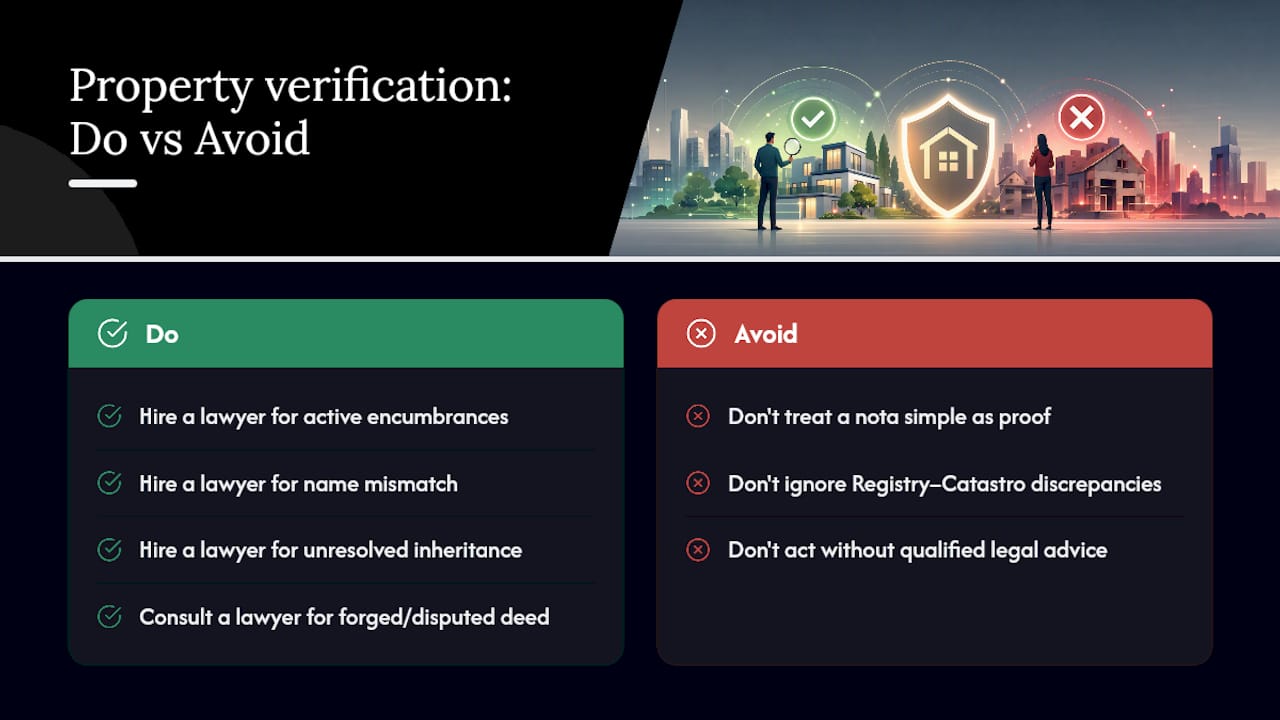
Pro Tip: Hire a notary or lawyer the moment you spot an active encumbrance, a name mismatch, or an inheritance that hasn’t been formally recorded. A €9 document tells you there’s a problem; a lawyer tells you how big it is.
What Identifiers Do You Need Before You Search?
Reliable searches start with the right identifier, not the address. Here’s the hierarchy:
- CRU/IDUFIR: the single most efficient identifier, since it points to exactly one finca with no ambiguity.
- Finca registral number, plus tomo/libro/folio if you have older records.
- Referencia catastral: useful for cross-checking against Catastro.
- Full address and owner name with NIF/NIE: workable, but can return multiple hits or miss entirely if the Registry’s address data is outdated.
You’ll usually find the CRU on a previous nota simple, the escritura pública, or a municipal tax receipt. Owner-name searches are the least reliable option and should be a last resort.
What Does It Cost and How Long Does It Take?
The official fee for a nota simple through the Colegio de Registradores is €9.02 plus VAT. Online requests generally return a PDF in under two hours; in-person requests run same day to one or two business days depending on the office’s workload. Certificaciones take longer and cost more, since a registrar has to review and sign them personally. Third-party portals sometimes add their own markup on top of the official fee, so going direct through sede.registradores.org keeps costs predictable.
What Red Flags Should Make You Pause?
A few patterns in a nota simple should stop you before you sign anything.
- Owner name doesn’t match the seller: the person selling isn’t the person on record, which can mean an unrecorded inheritance or an outright scam.
- Active mortgages or embargos: unpaid debts attached to the property can transfer liability to you as the new owner.
- Short or missing registration history: recently created entries or gaps can hide unresolved claims.
- Multiple claimants or repeated corrections: signs of an ongoing dispute or a messy title chain.
Any of these should trigger the same response: request a certificación registral, bring in a lawyer, and make the resolution a condition in the purchase contract before any deposit changes hands.
Your Pre-Signing Ownership Checklist
Before you sign or pay anything, work through this order:
- Obtain a current nota simple, not one that’s months old.
- Confirm the seller’s name and NIF/NIE match the registered owner exactly.
- Check the cargas section for mortgages, embargos, or restrictions.
- Compare the nota simple against the escritura pública for consistency.
- If anything is unclear, request a certificación registral before moving forward.
The decision rule is simple: any active encumbrance or any mismatch between documents means you pause and call a lawyer, not a real estate agent.
Why Early Verification Saves Buyers Money
Skipping the nota simple step to save €9 and twenty minutes is one of the more expensive mistakes a buyer can make. Hidden liens, unpaid community fees, and tax restrictions surface constantly in registry checks that would otherwise appear only after closing, when they’re far costlier to unwind.
Pro Tip: If you want an agency to run a pre-check before you commit to viewing a property, give them the address and, if you have it, the cadastral reference. That’s usually enough to start.
Costa Cambrils offers this kind of support alongside its property listings, without pressure to commit to anything beyond the check itself.
Let Costa Cambrils Handle the Registry Legwork for You
Chasing down a CRU, decoding a nota simple’s cargas section, or figuring out whether a seller’s NIF actually matches the registered owner takes time most buyers don’t have, especially from abroad. Costa Cambrils runs these checks as part of its property advisory service: document verification, direct liaison with the local Registro, and legal referral when a title needs a closer look.
If you’re actively looking at properties in the Costa Dorada area, the simplest next step is to browse luxury property types in Costa Dorada and flag any listing you want pre-checked. Ask for a Registry search before you view, not after you’ve fallen for the property.
Frequently Asked Questions
What is the fastest way to verify property ownership?
Request a nota simple online through sede.registradores.org using the CRU or finca number. It’s usually ready in under two hours.
Does a nota simple prove legal ownership?
No. It’s informative only. For legal proof that holds up in a dispute, you need a certificación registral or the escritura pública.
Can anyone request a nota simple on a property they don’t own?
Yes, provided you can show a legitimate interest, which covers buyers, lenders, and legal verifiers. Owner permission isn’t required.
What if the Registry entry and Catastro don’t match?
Discrepancies between the Registro de la Propiedad and Catastro happen and are worth investigating, since they can signal boundary disputes or outdated cadastral data.
When should I hire a lawyer instead of just checking the Registry myself?
Bring in a lawyer if you find active encumbrances, a name mismatch, an unresolved inheritance, or any sign of a forged or disputed deed.
This article is general information, not a substitute for advice from a qualified lawyer. Consult a qualified legal professional about your own circumstances before acting on anything here.
Sources
Recommended
- Property Legal Documents: What Every Buyer Must Check – Inmobiliaria Costa Cambrils
- Why Property Documentation Matters for Every Buyer – Inmobiliaria Costa Cambrils
- Property Buying Checklist: Steps for Smart Buyers in 2026 – Inmobiliaria Costa Cambrils
- Legal Aspects of Property Purchase: International Buyer’s Guide – Inmobiliaria Costa Cambrils