
TL;DR:
- The 2026 housing market features declining median prices but rising pending sales, indicating balanced demand. Local market conditions and demand drivers like demographic trends heavily influence prices and investment potential. Investors should focus on assets with strong cash flow, local data, and proximity to AI infrastructure amid high mortgage rates and persistent inflation.
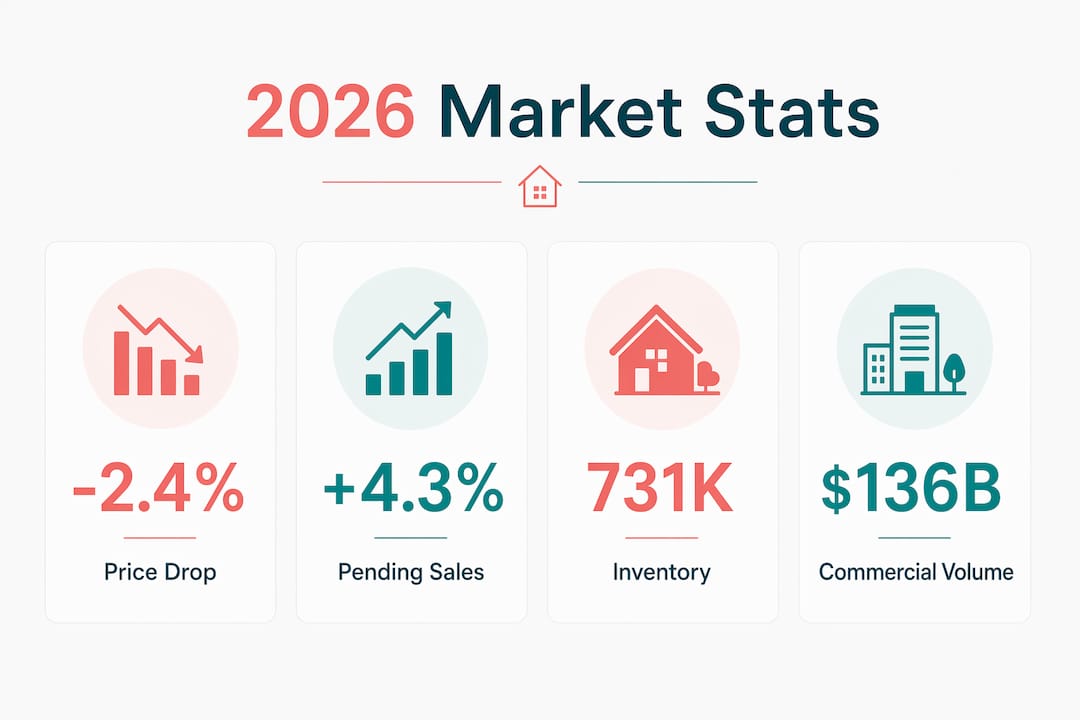
The 2026 housing market is defined by a rare combination: median list prices fell 2.4% year over year in may 2026, the steepest decline since 2017, while pending sales rose for six consecutive months. That split signal means buyers have more pricing power than at any point in nearly a decade, yet demand is clearly not collapsing. For real estate investors and homebuyers, understanding this divergence is the difference between a well-timed move and a costly miscalculation. The real estate trends 2026 picture rewards those who read local data carefully and act with conviction.
What are the key price and sales trends shaping the 2026 housing market?
The most important number in the 2026 housing market analysis is that pending sales rose 4.3% year over year even as list prices fell. Rising demand alongside falling prices is not a contradiction. It signals that affordability improvements are pulling sidelined buyers back into the market.
Sellers have fundamentally changed their behavior. Rather than listing high and cutting later, experienced sellers are pre-pricing homes closer to expected sale values. Only 17.5% of listings had price cuts in may 2026, fewer than in prior years. That figure reflects pre-listing price discipline, not a soft market.
New listings are also increasing, giving buyers more options without flooding the market. The result is a more balanced environment than the frenzied conditions of 2021 and 2022. Days on market stabilized for three consecutive weeks by mid-2026, confirming that absorption rates remain steady even as inventory grows.
Key pricing and sales signals for 2026:
- Median list prices dropped 2.4% year over year, the largest annual decline since 2017
- Pending sales increased 4.3% year over year, showing genuine buyer engagement
- Price cut frequency fell to 17.5% of listings as sellers price more accurately upfront
- Days on market held flat for three straight weeks, indicating stable demand absorption
- New listings rose, expanding buyer choice without overwhelming supply
Pro Tip: If you are a buyer, this is the moment to negotiate on price without expecting the market to collapse further. Sellers are motivated but not desperate, and well-priced homes still move quickly.
How are regional and local differences influencing real estate trends in 2026?
The single most important insight from the first half of 2026 is that the housing market is increasingly local. National headlines about price declines or rising inventory do not apply uniformly across every city or neighborhood. Investors who rely on national averages to make local decisions will consistently misread their target markets.
Cities like Hartford, Connecticut and Rochester, New York are outperforming pandemic-era winners. These markets feature tight inventory, shorter days on market, and strong absorption rates. Cleveland, Ohio shows similar resilience. What these cities share is a combination of relative affordability, stable employment bases, and housing stock that never experienced the speculative run-up seen in Sun Belt metros.
“Local housing markets can show sharply different absorption rates and pricing trends than national aggregates, highlighting the importance of hyper-local data and analysis.” — HousingWire, 2026
National inventory tells a partial story. Average inventory during H1 2026 reached about 731,000 homes, with months of supply averaging 2.44. That is above pandemic lows but still well below 2019 levels. The gap between national supply and local scarcity is where pricing power lives.
| Market | Key Strength | Market Condition |
|---|---|---|
| Hartford, CT | Low inventory, strong absorption | Seller-favored |
| Rochester, NY | Affordability, stable employment | Competitive |
| Cleveland, OH | Price resilience, workforce base | Balanced to seller |
| Sun Belt metros | Higher inventory post-pandemic | Buyer-favored |
| National average | 731,000 homes, 2.44 months supply | Transitional |
The practical takeaway is clear. Before making any investment or purchase decision, study the specific metro’s months of supply, days on market, and year-over-year price movement. National real estate forecasts for 2026 set the backdrop. Local data closes the deal.
What investment sectors and asset classes are favored in the 2026 real estate market?
Commercial real estate is recovering faster than most investors expected. Commercial transaction volume reached $136 billion in Q1 2026, a 27% increase year over year. That recovery is not evenly distributed across asset classes, and the winners are specific.

Senior housing stands out as the clearest opportunity. Senior housing transactions surged 194.2% year over year in Q1 2026. The demographic math is straightforward: the U.S. population aged 65 and older is growing rapidly, and purpose-built senior housing supply has not kept pace with that demand. Investors seeking durable cash flows rather than speculative price gains are moving into this sector decisively.
The top investment sectors gaining traction in 2026:
- Senior housing — Transaction volume up 194.2% year over year; demographic demand is structural, not cyclical
- AI-ready locations — Properties near skilled labor hubs and high-capacity power infrastructure attract institutional capital and command premium valuations
- Specialized residential assets — Build-to-rent communities and workforce housing offer stable occupancy in markets with constrained for-sale supply
- Debt-accessible commercial assets — Improved debt availability in Q1 2026 is reopening commercial deals that stalled during the rate shock of 2023 and 2024
The AI-driven location thesis deserves specific attention. Investors are prioritizing locations with high power capacity and access to skilled employment sectors. Data centers, advanced manufacturing facilities, and the residential markets surrounding them are benefiting from this capital flow. This is not a speculative trend. It reflects where long-term employment growth is concentrating.
Pro Tip: When evaluating a market for investment, check whether major technology or AI infrastructure projects are planned or under construction nearby. Proximity to these hubs is becoming a measurable driver of residential demand and property value trends in 2026.
For investors interested in luxury property investment strategies, the same principle applies: location quality and asset specificity matter far more than broad market timing in the current environment.
What practical strategies should investors and homebuyers apply in 2026?
The 2026 market rewards preparation and penalizes hesitation. Buyers who waited for prices to crash will find that the most desirable local markets never offered that opportunity. Investors who waited for rate cuts will find that no rate cuts are expected in 2026, making financing cost management a permanent constraint rather than a temporary one.
Practical steps for investors and homebuyers navigating 2026:
- Price to buy, not to hope. Sellers are pricing accurately upfront. Lowball offers on well-priced homes waste time and goodwill. Come in at market with clean terms.
- Use local absorption data. Months of supply below 2.0 in a specific zip code means you are in a seller’s market regardless of what national headlines say. Adjust your offer strategy accordingly.
- Evaluate financing before selecting assets. With mortgage rates elevated, your debt structure determines your return. Run scenarios at current rates, not projected future rates.
- Target markets with structural demand drivers. Workforce growth, university presence, healthcare employment, and AI infrastructure proximity all create durable rental demand.
- Consider 2026 investment opportunities in markets where inventory remains below pre-2020 norms. These markets offer price resilience even if national conditions soften further.
The sellers’ shift toward accurate pre-listing pricing also benefits buyers indirectly. Sellers adopting pricing-to-sell behavior reduces post-listing volatility and gives buyers cleaner price signals. You spend less time chasing overpriced listings and more time evaluating genuinely competitive options.
How do interest rates and inflation impact the 2026 real estate outlook?
The Federal Reserve is holding its restrictive stance through 2026. Core personal consumption expenditures inflation remains above 3% in mid-2026, which removes any near-term justification for rate cuts. That single fact reshapes every financial calculation in real estate.
What elevated rates and inflation mean for real estate in 2026:
- Mortgage costs stay high. Buyers must underwrite at current rates. Waiting for relief is not a strategy.
- Purchasing power erodes. Inflation above 3% reduces what a fixed income or salary can buy over time, making real assets more attractive as inflation hedges.
- Investors shift toward cash flow. With no broad price appreciation expected, assets that generate reliable income, such as senior housing and build-to-rent residential, outperform speculative plays.
- Commercial debt is available but selective. Lenders are active but disciplined. Well-located assets with strong occupancy attract financing. Marginal assets do not.
The inflation dynamic creates an interesting asymmetry for real estate investors. Real property tends to hold value during inflationary periods better than cash or bonds. That makes investing in real estate in 2026 a defensible position even without expecting significant price appreciation. The goal shifts from capital gain to capital preservation with income.
Key Takeaways
The 2026 housing market rewards investors and homebuyers who prioritize local data, accurate pricing, and cash-flow-focused assets over broad national narratives or rate-cut speculation.
| Point | Details |
|---|---|
| Prices fell, demand rose | Median list prices dropped 2.4% while pending sales increased 4.3%, creating a buyer-friendly window. |
| Markets are local, not national | Hartford, Rochester, and Cleveland outperform while Sun Belt metros face higher inventory pressure. |
| Senior housing leads investment | Senior housing transactions rose 194.2% year over year, driven by structural demographic demand. |
| No rate cuts expected | Core PCE inflation above 3% keeps the Fed restrictive through 2026; underwrite at current rates. |
| Sellers price accurately upfront | Only 17.5% of listings had price cuts, signaling cleaner market pricing and less post-listing volatility. |
What the 2026 market taught me about reading signals correctly
The instinct most investors fight in a market like this one is paralysis. Prices are falling slightly, rates are high, and the headlines alternate between “buyer’s market” and “affordability crisis.” I have watched investors sit on the sidelines waiting for perfect conditions that never arrive.
What the data actually shows in 2026 is a market in transition, not collapse. Pending sales rising for six straight months while list prices fall is a textbook signal of demand returning at a new price equilibrium. That is not a warning sign. That is an entry point.
The regional divergence story is the one I find most underreported. Investors who focus on Hartford or Rochester right now are operating in a completely different market than those looking at Phoenix or Austin. The mistake I see repeatedly is applying a national framework to a local decision. The 2026 real estate market guide for investors I recommend most is one built on zip-code-level data, not national averages.
My honest caution: do not let the senior housing surge tempt you into a sector you do not understand operationally. A 194.2% transaction increase attracts capital fast, and fast capital inflows compress yields quickly. If you are entering senior housing, do it with an operator partner who has existing relationships and a track record. The demographic tailwind is real. The execution risk is equally real.
— Oscar
Luxury real estate in Costa Dorada: a market built for 2026
The conditions shaping the 2026 housing market globally, including accurate pricing, selective inventory, and demand from quality-focused buyers, describe the Costa Dorada luxury market precisely. Costacambrils specializes in exclusive properties in Cambrils and the surrounding Costa Dorada region, where luxury real estate combines coastal lifestyle with genuine investment resilience.

Costacambrils offers a curated selection of villas, new-build developments, and premium apartments, backed by property valuation services, legal advisory, and full asset management. For buyers and investors who want a personal property buying service tailored to the 2026 market, the Costacambrils team provides end-to-end support from search to closing. The Costa Dorada is not a speculative bet. It is a market with constrained supply, international demand, and a quality of life that sustains long-term value.
FAQ
What are the main real estate trends in 2026?
Median list prices fell 2.4% year over year in may 2026 while pending sales rose 4.3%, signaling a market where buyers have more pricing power but demand remains active. Regional divergence is the defining feature, with Midwest and Northeast cities outperforming Sun Belt metros.
Will home prices drop further in 2026?
National list prices are down from 2025 levels, but local markets with constrained inventory, such as Hartford and Rochester, are holding prices steady. A broad national price collapse is not supported by current pending sales and absorption data.
Is 2026 a good time to invest in real estate?
Senior housing and AI-ready locations near skilled labor hubs are the strongest investment sectors in 2026. With no Fed rate cuts expected and inflation above 3%, investors should prioritize assets with durable cash flows over speculative appreciation plays.
How do mortgage rates affect the 2026 housing market?
Elevated mortgage rates reduce buyer purchasing power and increase the cost of investment financing. The Federal Reserve is not expected to cut rates in 2026 due to core PCE inflation remaining above 3%, so buyers and investors must underwrite deals at current rate levels.
What types of properties perform best in the 2026 market?
Senior housing, build-to-rent residential, and properties near AI and technology infrastructure hubs are outperforming in 2026. These asset classes benefit from structural demand drivers that persist regardless of short-term interest rate movements.