Most sellers in Spain pay a commission typically between low single digits and around 6% of the final sale price, with the market center closer to about 3% to 5%. The seller customarily foots the bill, not the buyer, and that commission usually carries VAT on top. The exact percentage, who pays it, and when it’s due all come down to one document: the contract you sign with the agency, so read it before you sign anything.
TL;DR:
- Commissions in Spain typically range from 3% to 5% for most properties, but coastal and luxury markets can demand up to 7% due to higher marketing costs.
- The buyer rarely pays the agency fee unless they sign a contract accepting responsibility, with most sellers being the default payers under contractual terms.
- Payment usually becomes due at the signing of the purchase deed, but agencies can demand commission earlier once the sale agreement is finalized, risking non-payment if the deal collapses.
- Standard services included in commission are property valuation, professional photos, viewings, negotiations, and sale coordination, with higher rates adding extras like international marketing or legal support.
- Sellers should negotiate based on net proceeds, demand clear written scopes and contractual clauses, and verify all costs, since high commissions can significantly reduce final profit.
Table of Contents
- What Are Typical Real Estate Commission Rates in Spain?
- Who Pays the Real Estate Agency: Buyer or Seller?
- When Does the Commission Become Payable?
- What Should the Commission Actually Cover?
- How Do You Negotiate Commission and Avoid Getting Burned?
- Real Numbers: What Commissions Cost in Euros
- How Costacambrils Approaches Commission and Contract Transparency
- How Much Do Agency Fees Really Cut Into Your Sale Profit?
- What I Tell Sellers About Commission Negotiations
- Selling in Costa Dorada? Here’s a Straightforward Alternative
- Where to Verify These Numbers Yourself
- Sources
What Are Typical Real Estate Commission Rates in Spain?
Real estate agencies in Spain don’t operate on a fixed national tariff. Rates are negotiated agency by agency, which is exactly why two sellers on the same street can pay wildly different amounts. Fotocasa’s guidance puts typical sale commissions around 3% to 5%, depending on location and the scope of services included. Coastal and luxury markets tend to sit higher, often 5% to 7%, because those listings demand more marketing spend, international outreach, and longer sales cycles.
A study by OCU that reviewed 60 agencies found commissions ranging from 2% to 6%, with many agencies failing to hand over a written contract model or a clear payment schedule at first contact. That gap is a legitimate consumer protection concern and a reminder to ask for numbers in writing early.
Flat-fee and online agency models exist too. Some charge a fixed sum from roughly €1,990 to €6,000 regardless of sale price, according to Inmolovers’s commission guide. These can save money on higher-value homes but often mean you handle more of the viewings and negotiation yourself. Minimum-fee clauses are common too, especially on lower-value properties, where a straight percentage would barely cover the agency’s marketing costs.
| Sale price range | Typical commission model | Approximate rate |
|---|---|---|
| — | Minimum flat fee common | Fixed fee often applies |
| — | Percentage-based | 3%–5% |
| — | Percentage-based, premium service | 5%–7% |
| Any price (online/flat-fee model) | Fixed fee | €1,990–€6,000 |
When you get a quote, ask three things: is that rate before or after 21% IVA, what’s actually included for that price, and is there a minimum fee that kicks in below a certain sale value. A “5%” quote that turns out to be 5% plus VAT, with photography and portal listings as extras, is a very different deal from an all-in 5%.
Who Pays the Real Estate Agency: Buyer or Seller?
In Spain, the party that signs the mediation contract pays the commission, which is almost always the seller. There is no national law enforcing this arrangement. Spain runs on freedom of contract, so the payer is whoever agrees to it in writing.
That said, a few situations flip the default:
- Buyer’s agents exist, particularly in international and coastal markets, where a buyer hires their own representative and pays that agent directly.
- Split commissions happen when both a listing agency and a buyer’s agent are involved and divide the fee between them.
- A buyer can become liable if they sign a document accepting the obligation, such as a parte de visitas or a specific clause in a contrato de arras. El País’s legal column confirms that liability turns entirely on what the buyer explicitly agreed to, not custom.
- In some regions with heavy foreign buyer activity, split arrangements are more common than in inland Spanish towns, where the seller pays outright almost every time.
If you’re a buyer, check what you’re signing at a viewing. Agencies sometimes present a “parte de visitas” as a routine sign-in sheet when it actually contains a commission acceptance clause. Read the fine print before you initial anything.
When Does the Commission Become Payable?
Timing matters as much as the rate, and it’s the part most sellers overlook until money is due. Three payment structures are common: full payment at the notary signing (escritura), a split between the arras deposit and the escritura, or a smaller advance at arras with the balance later.
The legal backdrop matters here. BusinessInsider reports that the Tribunal Supremo has confirmed the right to commission accrues once the purchase agreement is perfected, which is typically the signing of the contrato de arras, provided the agency’s involvement was the actual cause of the sale. In practice, that means an agency can legally demand payment before the deed is signed at the notary, not just afterward.
That creates real risk if the deal later collapses. Here’s how to protect yourself:
- Insist on a refund clause covering cases where the sale falls through for reasons unrelated to the agency’s work.
- Avoid paying the full commission at arras signing. A partial payment (commonly around 20%, with the balance due at escritura) is a more balanced structure.
- Ask the notary to retain the commission from sale proceeds at escrituración if you want a guaranteed, single-moment payment rather than staged installments.
This retention practice is common enough that Costacambrils covers it in its guide to how escrow works in a Spanish property sale.
Pro Tip: Avoid agreeing to pay the full commission before the notary appointment unless explicitly tied to a completed, causally-connected sale in the contract. If the deal collapses for reasons outside the agency’s control, you want your money back, and that only happens if the clause says so.
What Should the Commission Actually Cover?
A commission rate on its own tells you almost nothing about value. What matters is what’s included, and offers vary more than most sellers expect.
At minimum, expect these core services baked into any standard commission:
- Property valuation and pricing guidance
- Professional photography and a listing on major portals
- Coordinating and hosting viewings
- Negotiating with prospective buyers
- Managing paperwork through to sale coordination and invoicing
Higher percentages, particularly in the 5% to 7% range, should buy something beyond the basics: home staging, international marketing to overseas buyers, dedicated legal coordination, or post-sale support. If an agency is charging premium rates without offering any of that, push back or shop around.
Flat-fee packages often strip out the extras first. Open-house hosting, premium portal placement, and proactive marketing outreach are common casualties in a stripped-down online model.
Pro Tip: Before signing anything, request a written scope of work listing exactly what’s included, the exclusivity period, how the commission is calculated, whether VAT is included in the quoted number, and exactly when payment is due. If an agency won’t put this in writing, that’s your answer.
How Do You Negotiate Commission and Avoid Getting Burned?
Commission rates are negotiable more often than sellers realize, especially on higher-value properties where the agency’s absolute payout is larger even at a lower percentage.
Use these levers when negotiating:
- Offer a shorter exclusivity period in exchange for a lower rate, since agencies value certainty over unlimited runway.
- Ask for a defined marketing package (professional photos, portal placement, social promotion) tied to the fee you’re paying.
- Request a minimum guarantee or timeline expectation, especially if the agency claims it can sell fast.
- Consider accepting a higher commission when the property is genuinely difficult to sell, unusually priced, or in a niche luxury segment where broader reach matters more than the percentage saved.
Watch for these red flags before signing:
- Pressure to sign an exclusive mandate without first seeing a sample contract.
- Vague or verbal-only payment timing instead of a written clause.
- No documented scope of services, just a percentage and a handshake.
Put refund clauses, a marketing budget breakdown, and any performance expectations in writing before you commit. A verbal promise from an agent means nothing if the sale drags on for a year with no updates.
Real Numbers: What Commissions Cost in Euros
Percentages feel abstract until you see the euro figures.
That line item, often overlooked in contracts, can be one of the largest transaction costs after taxes.
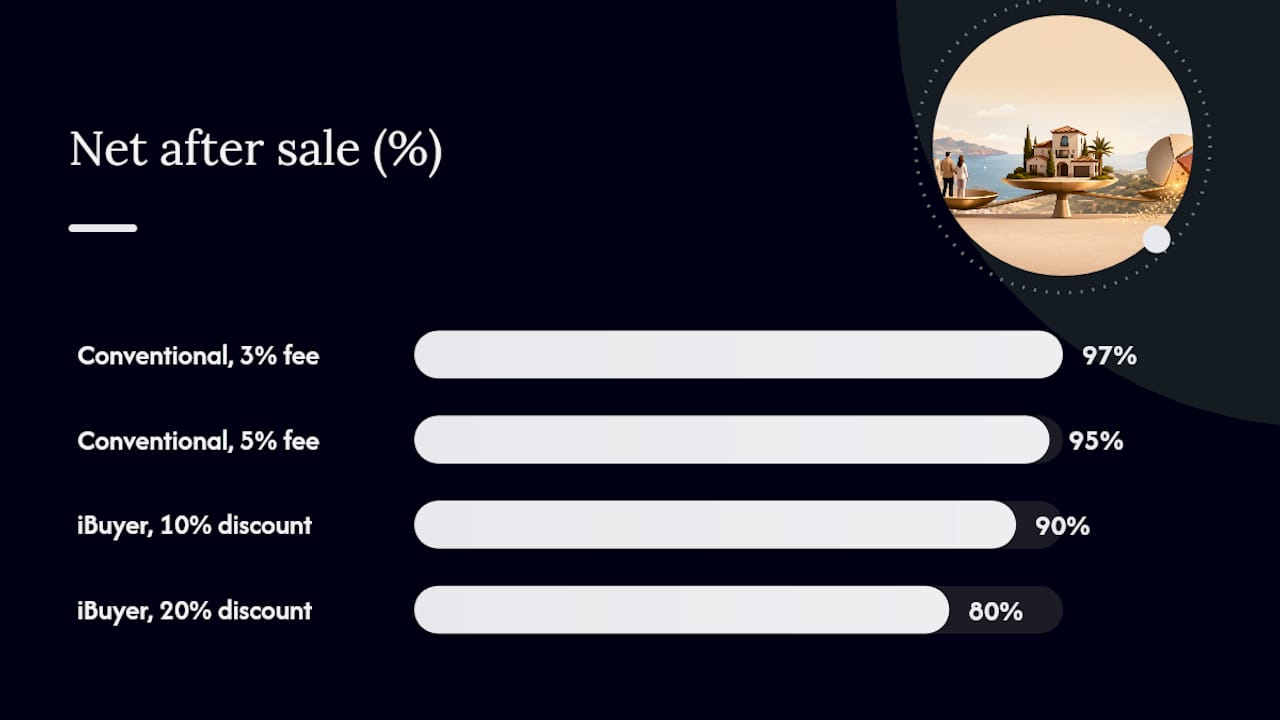
A quick-buy or iBuyer-style offer sidesteps the explicit commission line entirely, but typically at a discount of 10% to 20% below open-market value, according to Inmolovers. For most sellers, that trade only makes sense when speed matters more than maximizing sale price. Compare the two numbers side by side, not just the headline “no commission” pitch.
How Costacambrils Approaches Commission and Contract Transparency
Commission structures in the Costa Dorada market often reflect the work involved, such as property valuation, legal advisory support, and marketing coordination rather than a bare listing service. That scope is why commission levels in this segment tend to sit toward the higher end of the national range rather than the flat-fee minimum.
Sellers working with any agency, Costacambrils included, should expect and request specific contract terms: a defined scope of services, a stated exclusivity period with a clear end date, the exact commission calculation method, whether VAT is included in the quoted figure, and payment timing tied to a completed, causally-connected sale rather than an arbitrary date.
Before signing with anyone, ask for that breakdown in writing. If an agency won’t provide it, treat that hesitation as information.
How Much Do Agency Fees Really Cut Into Your Sale Profit?
Sellers who focus only on the sale price and forget the commission often get an unpleasant surprise at the notary when the final transfer amount lands lower than expected.
The math gets more complicated once you stack commission on top of other selling costs. Capital gains obligations, the 3% withholding that applies specifically to non-resident sellers, and any outstanding mortgage settlement all come out of the same pool before you see a euro. Commission is usually the second-largest line item after taxes, ahead of notary fees or registry costs.
Here’s the part that gets missed: a higher commission doesn’t automatically mean lower profit. The relevant number isn’t the percentage on the invoice. It’s the final sale price minus every cost, commission included.
That’s why comparing agencies purely on rate is the wrong exercise. Two agencies quoting different percentages can produce completely different net outcomes depending on their reach, negotiation skill, and how long the property sits on the market accumulating carrying costs.
What I Tell Sellers About Commission Negotiations
Focus on net proceeds, not the headline percentage. A lower rate from an agency with weak marketing reach or a slow sales cycle can cost you more than a higher rate from one that sells fast and negotiates hard. Read the contract before you sign it, and insist on a VAT-inclusive number in writing. Too many sellers discover the real cost only when the invoice lands.
Compare agencies on what they deliver: marketing reach, negotiation track record, and contract clarity, not just the number on the quote.
— Oscar
Selling in Costa Dorada? Here’s a Straightforward Alternative
If you’re weighing agencies on commission rate alone, you’re missing the bigger question: which one actually gets you a better net result. Some agencies work specifically in the Costa Dorada luxury segment, where property valuation, legal advisory coordination, and full marketing exposure to international buyers are built into the service rather than sold as add-ons.
For sellers with high-end properties in Cambrils and the surrounding coast, that combination matters more than shaving a point off the commission. Onboarding starts with a property valuation and a written scope of services, so you know exactly what’s included and how the commission is calculated before you sign anything.
If you’re ready to see what your property could fetch in today’s market, explore luxury amenities and positioning for elite listings in Spain and get a clear read on where your home fits before you commit to any agency.
Where to Verify These Numbers Yourself
For consumer complaints and fee transparency standards, OCU’s research on agency practices is the most credible independent source. For regional rate breakdowns, see Trustin’s commission guide. For the legal mechanics of who owes what and when, El País’s legal column walks through real contractual scenarios in plain language.
Sources
- OCU — notas de prensa: agencias inmobiliarias (2026)
- Fotocasa — Comisiones inmobiliarias: ¿quién paga en venta o alquiler?
- El País — consultorio: buyer liability for agency commissions (2026-07-23)
- BusinessInsider — Supreme Court confirms commission devengo and typical ranges