
TL;DR:
- Property purchase in Spain no longer automatically grants residency since the Golden Visa ended in April 2025. Buyers must now apply separately for visas like the Non-Lucrative or Digital Nomad Visa, regardless of property ownership. Proper planning involves obtaining an NIE, understanding tax and residency distinctions, and ensuring legal steps are followed with independent legal counsel.
Residency and property purchase in Spain are two separate legal processes that intersect in ways most buyers don’t anticipate until they’re already deep in the paperwork. Since the Golden Visa ended in April 2025, buying property no longer grants automatic residency rights. Families and individuals planning a move to coastal regions like Costa Dorada or Costa del Sol now need to understand two distinct tracks: the property purchase process itself, and the visa or residency pathway that runs alongside it. Key documents like the NIE (Foreigner Identification Number), the Contrato de Arras, and the Escritura Pública are non-negotiable steps in both tracks. Getting clarity on how they connect is the foundation of any smart relocation plan.
What are the residency requirements in Spain for property owners?
Legal residency in Spain is defined by physical presence, economic ties, and tax obligations. Spending 183 or more days per year in Spain triggers tax residency, which means declaring worldwide income and paying income tax (IRPF) at progressive rates between 19% and 47%. That distinction matters enormously for property owners because it changes your financing options, your tax bill, and your obligations to the Spanish tax authority.

Property ownership does not grant residency on its own. The two main visa routes for property owners are the Non-Lucrative Visa (NLV) and the Digital Nomad Visa. The NLV suits retirees and those with passive income. It requires proof of sufficient funds and, critically, proof of accommodation, which owning property satisfies more convincingly than a rental agreement. The Digital Nomad Visa targets remote workers earning income from outside Spain and requires proof of employment or client contracts.
Here is how property ownership fits into each visa application:
- Non-Lucrative Visa: Owned property serves as permanent proof of accommodation, removing the need to show a rental contract. Applicants still need to demonstrate passive income above roughly €2,400 per month.
- Digital Nomad Visa: Property ownership strengthens the application by showing long-term commitment to Spain, though it is not a formal requirement.
- Tax residency: Once you spend 183 or more days in Spain, you become a tax resident regardless of visa status. This triggers IRPF obligations on worldwide income.
- Legal residency vs. tax residency: Legal residency is a visa or permit status. Tax residency is determined by days spent in Spain or having your primary economic center there. You can hold one without the other, at least temporarily.
Pro Tip: Apply for your NIE before you begin property searches. Without it, you cannot sign any purchase contract, open a Spanish bank account, or submit a visa application. The NIE is the single document that unlocks every other step.
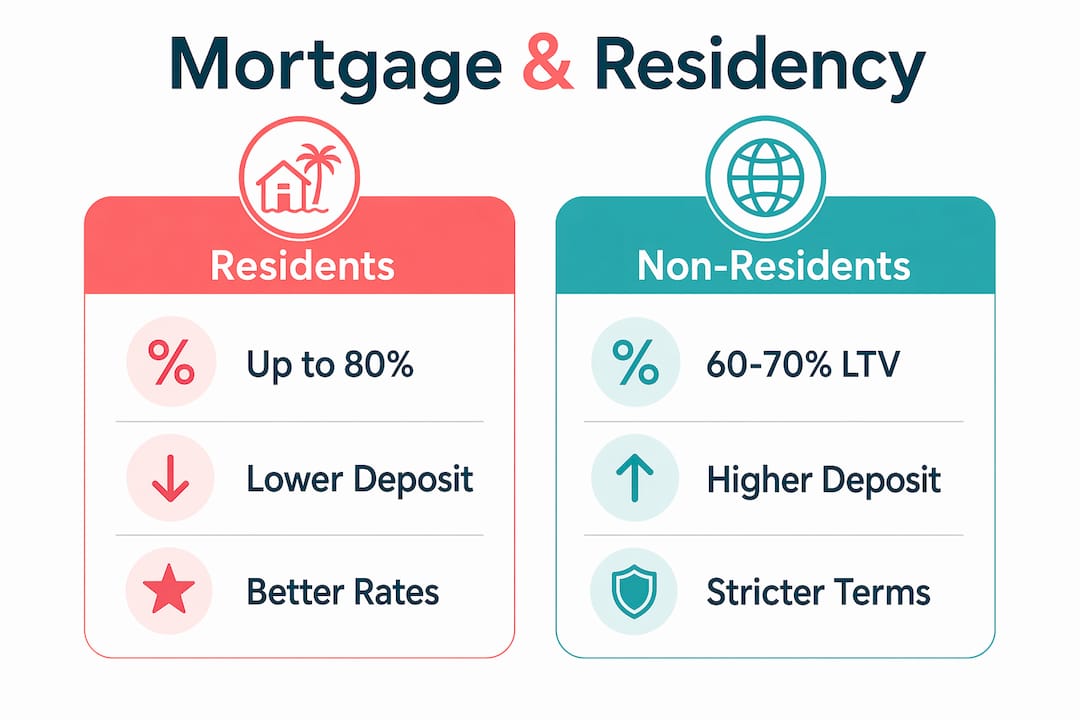
Tax residency also changes your financing terms significantly. Spanish tax residents access mortgage loan-to-value ratios up to 80%, compared to 60–70% for non-residents. That gap directly affects how much cash you need on hand at closing.
How does the Spanish property purchase process work?
The standard property purchase process in Spain follows a clear sequence, but each stage has legal weight that first-time buyers often underestimate.
- Obtain your NIE. This is the Foreigner Identification Number issued by Spanish authorities. No purchase can proceed without it.
- Open a Spanish bank account. Required for transferring purchase funds and paying taxes.
- Property search and due diligence. Verify the property’s legal status through the Land Registry (Registro de la Propiedad). Check for outstanding debts, liens, or planning violations.
- Sign the Contrato de Arras. This is a preliminary contract where the buyer pays a 10% deposit. If the buyer withdraws, the deposit is forfeited. If the seller withdraws, the seller refunds double the deposit. This contract is legally binding and treated seriously by both parties.
- Notary signing and Escritura Pública. The public deed is signed before a notary. The notary’s role is procedural: they verify the legality of the transaction and create the public record. They do not represent either party, so independent legal counsel is not optional. It is the only way to protect your interests.
- Land Registry registration. After signing, the property must be registered in your name.
- Pay purchase taxes. Deadlines are strict, typically within 30 working days of signing.
| Step | Residents | Non-residents |
|---|---|---|
| Mortgage LTV | Up to 80% | 60–70% |
| Deposit requirement | Lower | Higher |
| Mortgage approval time | 3–6 weeks | Longer, more documentation |
| Tax on rental income | IRPF (progressive) | Flat non-resident rate |
Before signing the public deed, obtain a certificate confirming no outstanding community debts on the property. Unpaid community fees or IBI (local property tax) arrears can transfer to the new owner. This is a step many buyers skip and later regret.
Pro Tip: Hire an independent Spanish property lawyer before signing the Arras contract, not after. By the time you reach the notary, your legal exposure is already locked in.
What are the investment opportunities in Spain’s coastal property market?
Spain’s coastal property market is one of the strongest in Southern Europe right now. Average home prices rose 8.9% year-on-year to €2,429 per square meter as of Q1 2026. That growth rate reflects sustained demand from both domestic buyers and international investors, particularly in regions like Costa Dorada and Costa del Sol.
Rental yields vary significantly depending on residency status and rental strategy. Long-term lets generate pre-tax yields between 4.0% and 6.4%, while net yields after non-resident taxes average 2.4%–3.5% in coastal areas. The gap between gross and net is where many investors get surprised. Residents benefit from a 60% reduction on long-term rental income tax, which makes the numbers look very different depending on your residency status.
Key considerations for coastal property investors:
- Seasonal demand: Coastal areas like Cambrils and Tarragona see peak rental demand from june through september. Long-term lets provide more stable income year-round.
- Legal checks before purchase: Verify planning permissions, especially for properties near the coastline where building restrictions apply.
- Inherited debts: Always request a certificate from the property’s community manager confirming zero arrears before signing any contract.
- Property type and tax: New builds attract VAT at 10% plus stamp duty. Resale properties attract Transfer Tax (ITP) instead.
Property ownership in coastal Spain also serves a strategic purpose beyond pure yield. It anchors housing costs and provides long-term family stability in a way that renting cannot. For families applying for the NLV, owning property removes one of the most complex requirements from the visa application entirely.
The advantages of Spanish real estate investing in 2026 extend beyond rental income. Capital appreciation in coastal zones, combined with favorable lifestyle factors, makes property a dual-purpose asset for families planning long-term residency.
What tax implications should buyers consider?
Tax obligations in Spain depend heavily on whether you are a resident or a non-resident, and on the type of property you are buying.
Acquisition taxes:
- Resale properties: Transfer Tax (ITP) ranges from 6% to 10% depending on the autonomous community. Catalonia, which covers Costa Dorada, applies a rate of 10%.
- New builds: VAT at 10% plus Stamp Duty (AJD), which varies by region.
- Payment deadline: Taxes must be paid within 30 working days of signing the public deed. Missing this deadline triggers penalties.
Annual and income taxes:
- Residents pay IRPF on worldwide income at progressive rates between 19% and 47%. They can deduct mortgage interest on a primary residence under certain conditions.
- Non-residents pay a flat Non-Resident Income Tax (IRNR) on Spanish-source income only, including rental income and imputed income on vacant properties.
- Residents who rent long-term benefit from a 60% tax reduction on net rental income, making buy-to-let significantly more profitable for those with legal residency.
- IBI (local property tax) is paid annually by all owners regardless of residency status.
Tax residency is the dividing line between these two regimes. Spending 183 or more days in Spain, or having your primary economic interests there, makes you a tax resident. That status changes your mortgage options, your rental income tax rate, and your obligation to declare assets held abroad under the Modelo 720 declaration.
Key Takeaways
Buying property in Spain and securing residency are separate legal processes, and understanding both tracks before you commit is the single most important step any buyer can take.
| Point | Details |
|---|---|
| Golden Visa is gone | Since April 2025, property purchase no longer grants residency; buyers must apply for an NLV or Digital Nomad Visa separately. |
| NIE is non-negotiable | You cannot sign contracts, open a bank account, or apply for a visa without a valid NIE number. |
| Residency changes your finances | Tax residents access up to 80% LTV mortgages and a 60% rental income tax reduction unavailable to non-residents. |
| Arras contract is binding | A 10% deposit locks both parties in; withdrawing costs the buyer the full deposit or doubles the refund if the seller exits. |
| Verify debts before signing | Always obtain a certificate confirming no community fee or IBI arrears before completing any purchase. |
What I’ve learned from watching buyers get this wrong
Most of the mistakes I see come from one misunderstanding: buyers treat property purchase and residency planning as a single process when they are two completely separate tracks that need to run in parallel. Someone falls in love with a villa in Cambrils, rushes through the Arras contract, and only then asks how to get a visa. By that point, they’ve committed €50,000 or more with no residency plan in place.
The other pattern I see constantly is underestimating the tax gap between resident and non-resident status. A buyer who plans to spend eight months a year in Spain but structures their purchase as a non-resident is leaving real money on the table. The 60% rental income tax reduction alone can shift the return on a coastal property by a full percentage point or more annually.
My honest advice: treat the visa application and the property search as two parallel workstreams that start on the same day. Get your NIE, consult a tax advisor about your residency intentions, and only then begin making offers. The legal requirements for buying in Spain are manageable when you approach them in the right order. They become expensive when you don’t.
One more thing worth saying plainly: the notary is not your lawyer. The notary confirms the transaction is legal and creates the public record. They will not flag a problematic clause in the Arras contract or warn you about a planning dispute on the property. Independent legal counsel is the only protection you have, and it costs a fraction of what a bad purchase costs to unwind.
— Oscar
How Costacambrils helps you buy and plan residency on the Costa Dorada
Costacambrils specializes in luxury property sales and rentals across Costa Dorada, with deep local knowledge of Cambrils, Tarragona, and the surrounding coastal areas. The team provides bilingual support for international buyers navigating the full purchase process, from NIE applications to notary signing and post-purchase registration.
Beyond property listings, Costacambrils offers legal advisory services, property valuations, and connections to tax specialists who understand both resident and non-resident obligations. Whether you are buying a coastal villa as a primary residence or a long-term investment, the team guides you through every stage. Explore the luxury real estate services Costacambrils offers in Cambrils, or browse current listings to find the right property for your residency and investment goals.
FAQ
Does buying property in Spain still grant residency?
No. Spain’s Golden Visa program ended in April 2025. Buying property no longer grants residency rights, and buyers must apply separately for a visa such as the Non-Lucrative Visa or Digital Nomad Visa.
What is the NIE and why do I need it?
The NIE is the Foreigner Identification Number required for all property transactions in Spain. Without it, you cannot sign a purchase contract, open a Spanish bank account, or submit a visa application.
What taxes do I pay when buying property in Spain?
Resale properties attract Transfer Tax (ITP) at 6%–10% depending on the region. New builds attract VAT at 10% plus Stamp Duty. All taxes must be paid within 30 working days of signing the public deed.
How does residency status affect my mortgage options?
Spanish tax residents can access mortgage loan-to-value ratios up to 80%, while non-residents are typically capped at 60%–70%. Residents also face fewer documentation requirements and shorter approval timelines of 3–6 weeks.
What is the Contrato de Arras?
The Contrato de Arras is a preliminary purchase contract where the buyer pays a 10% deposit. If the buyer withdraws, the deposit is forfeited. If the seller withdraws, the seller must return double the deposit amount.