Cambrils offers one of the most varied residential mixes on the Costa Dorada, and the types of housing styles in Cambrils reflect that directly. You’ll find medieval stone homes in the old town, compact apartments near the port, sprawling family chalets in residential neighborhoods, and contemporary luxury villas that blend natural stone with glass and black metal. The architecture here isn’t decorative for its own sake. It responds to the Mediterranean climate, the fishing town’s history, and a local planning culture that has consistently favored family living over mass tourism density.
The dominant styles at a glance:
- Chalets and single-family villas: Spacious, often two to four floors, common in urbanizations like Vilafortuny and Ardiaca
- Pisos (apartments): Concentrated near the seafront and port area, ranging from modest older units to modern builds
- Casas adosadas (townhouses): Semi-detached homes popular with families seeking outdoor space without full villa costs
- Historic center homes (la Vila): Narrow stone-facade properties with heritage protections and limited renovation scope
- Modern luxury villas: Contemporary builds featuring natural stone and glass, large terraces, and Mediterranean light optimization
1. What are the main housing styles found in Cambrils?
Cambrils’ residential character breaks into several distinct categories, each shaped by a different era or neighborhood logic.
- La Vila historic homes: The medieval center features narrow floor plans, stone facades, and heritage protections that limit what owners can change. These properties carry real architectural character but require patience with renovation permits.
- El Port fishing district: Homes here reflect practical coastal design, modest in scale, close to the waterfront, and built for working families rather than leisure buyers.
- Family chalets in Vilafortuny and Ardiaca: These residential urbanizations hold the bulk of Cambrils’ single-family housing stock. Plots are generous, gardens are common, and the architecture tends toward two-story builds with covered terraces.
- Modern luxury villas: Architects like White Houses Costa Dorada have built villas in Ardiaca that combine heavy natural stone walls with slatted wood, wide glass openings, and black metal frames. The result is a home that reads as contemporary from the street but feels grounded and calm inside.
- Casas adosadas: Townhouse rows appear throughout newer developments, offering three-bedroom layouts with private patios at a lower price point than detached villas.
- New-build apartment blocks: Projects like the 40-unit Fabregat development in Cambrils show how modern apartment design here still prioritizes generous balconies, communal gardens, and light-colored ceramic finishes rather than the dense, utilitarian blocks common in purely tourist-driven towns.
Pro Tip: If you’re drawn to la Vila’s historic character, check heritage protection status before making an offer. Renovation scope is often narrower than buyers expect.
2. How does Cambrils compare to Salou and Tarragona for housing?
The contrast is sharper than most buyers realize. Cambrils averages 97 m² per home, compared to 91 m² in Tarragona and just 75 m² in Salou. That gap reflects fundamentally different housing markets, not just different price levels.
- Salou: Dominated by small tourist apartments. Pisos account for more than 90% of transactions, and the typical buyer is an investor targeting short-term rental income rather than a family looking for a permanent home.
- Tarragona: Also piso-heavy at over 90% of sales, with a more urban character and less coastal premium.
- Cambrils: Houses (detached and semi-detached) represent 21.95% of transactions, versus 8.05% in Tarragona and 5.07% in Salou. New-build activity is also stronger here, at 14.31% of sales.
Cambrils’ urban planning has consistently favored low-density residential development. That policy choice is why you find spacious family homes here rather than the high-rise tourist blocks that define stretches of the neighboring coastline. For buyers seeking long-term stability rather than a speculative short-term rental play, that distinction matters in practical terms.
3. What materials and design elements define Cambrils homes?
The palette is consistent across styles, even when the architecture shifts from traditional to contemporary. Natural materials dominate, and the best Cambrils homes use them to manage light and temperature rather than just for aesthetics.
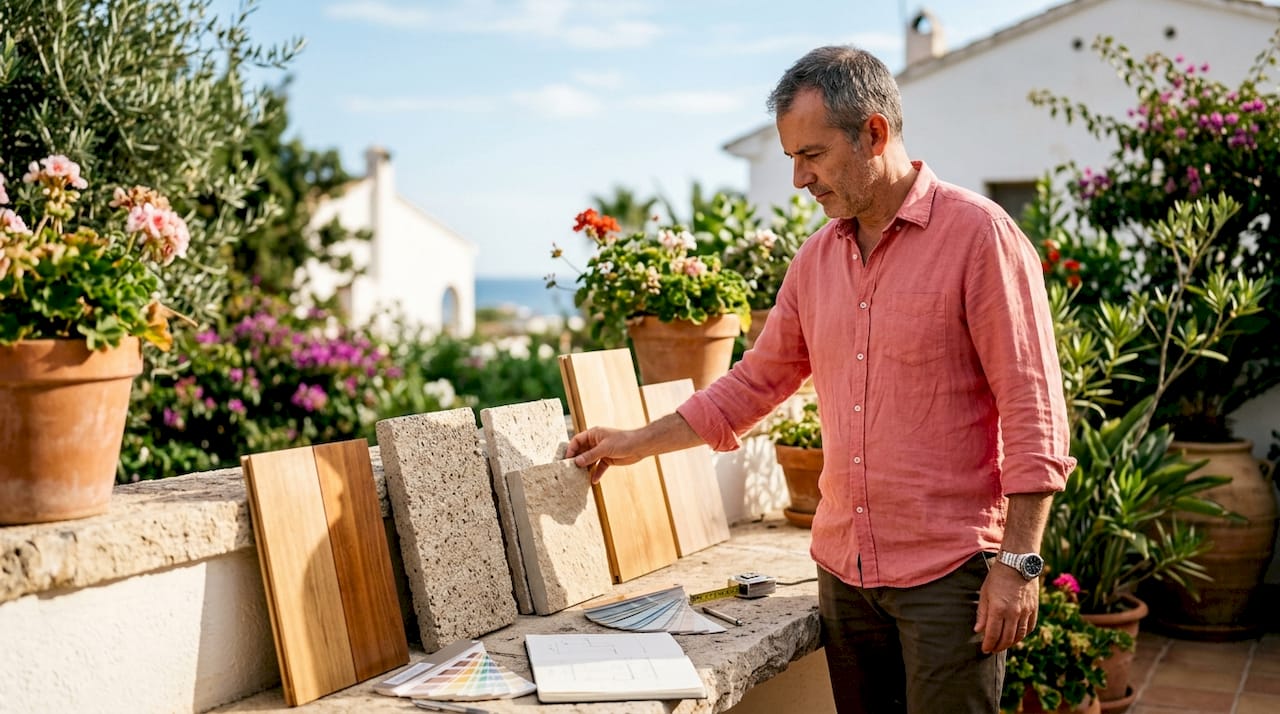
- Limestone and stone: Used for plinths, feature walls, and facades. Newer buildings reference the historic fabric of the old town through limestone detailing even when the overall design is modern.
- Oak wood: Appears as interior flooring, slatted screens, and door panels. In luxury villas, wooden slats serve a dual function: privacy screening and solar shading.
- Glass: Wide openings are standard in contemporary builds, pulling Mediterranean light deep into the floor plan. The Hotel Marina Cambrils project by Isern & Associats uses wicker-panel screens to filter that light, creating a softer, more textured effect than plain glass alone.
- Black metal frames: A signature detail in modern Cambrils villas. The contrast between black metalwork and white plaster surfaces gives these homes a clean, graphic quality without feeling cold.
- Ochre and earth tones: Warm yellows and terracotta accents appear in interiors and on facades, echoing Mediterranean hues that connect the built environment to the surrounding landscape.
- Natural wool and tactile textiles: In higher-end interiors, handwoven rugs and soft furnishings reinforce the sensory warmth that stone and wood establish structurally.
The dual-skin design approach seen in Ardiaca villas, where a heavy stone outer layer pairs with a lightweight wooden screen, is the clearest expression of how Cambrils architects think about climate. The stone holds thermal mass; the screen manages airflow and privacy.
4. Which neighborhoods best illustrate each style?
Cambrils’ geography makes the style differences easy to read on the ground.
La Vila is the medieval core, bounded by remnants of the old town walls and anchored by the Gothic-Catalan church of Santa María. The architecture here is compact and vertical, with stone construction, narrow street frontages, and balconies draped in plants. These are the oldest residential buildings in Cambrils, and their character is irreplaceable.
El Port sits at the waterfront and retains its fishing-village scale. Buildings are modest, streets run close to the water, and the residential mix includes older apartments and small family homes that predate the tourism boom.
Vilafortuny is where Cambrils’ family chalet culture is most visible. Detached homes with private pools, mature gardens, and two-car garages sit on generous plots. The architectural style here ranges from 1980s and 1990s Mediterranean vernacular to more recent contemporary builds.
Ardiaca has become the address for high-end contemporary villas. White Houses Costa Dorada’s Villa V&O, a 392 m² single-family home completed in 2018, is the clearest example of what the neighborhood produces: modern white and black lines, natural stone walls, and a design developed in collaboration with interior designer Susanna Cots.
5. What are the current trends shaping new residential architecture in Cambrils?
The most consistent trend is the move toward what architects here call a “dialogue” between materials rather than a single dominant style. New builds in Cambrils rarely commit fully to either traditional vernacular or pure minimalism. Instead, they layer the two.
Bioclimatic design has moved from a selling point to a baseline expectation. Large windows, cross-ventilation, shaded terraces, and south-facing orientations are standard in any new-build home in Cambrils that targets the upper-mid or luxury segment. Passive cooling through thermal mass, the same principle behind those thick stone walls in la Vila, is being reinterpreted in contemporary form.
There’s also a clear shift toward indoor-outdoor continuity. Ground-floor living spaces open directly onto terraces and gardens, with sliding glass walls replacing fixed openings. The boundary between inside and outside is deliberately blurred, which suits both the climate and the lifestyle buyers are seeking when they choose Cambrils over a city apartment.
Costacambrils knows this market from the inside out
If you’ve read this far, you already know that Cambrils’ housing market is more layered than a quick property search reveals. The difference between a heritage-protected la Vila apartment and a bioclimatic villa in Ardiaca isn’t just price. It’s planning rules, renovation potential, rental yield profile, and long-term livability.
Costacambrils specializes in exactly this market, covering chalets, pisos, casas adosadas, and luxury properties in Cambrils across every neighborhood discussed here. The team combines local architectural knowledge with legal and property management support, so you’re not piecing together advice from three different sources. Whether you’re buying a family home in Vilafortuny or evaluating a contemporary villa in Ardiaca, start with a property consultation at Costacambrils to match the right style to your actual needs.
Key Takeaways
Cambrils’ housing market is defined by its family-oriented, low-density residential character, with single-family homes representing 21.95% of transactions, far above neighboring towns.
| Point | Details |
|---|---|
| Dominant housing types | Chalets, pisos, casas adosadas, and modern luxury villas each serve distinct buyer profiles in Cambrils. |
| Size advantage over neighbors | Cambrils averages 97 m² per home, versus 75 m² in Salou, reflecting its family-residential focus. |
| Signature materials | Natural stone, oak wood, black metal, and ochre tones define both traditional and contemporary Cambrils homes. |
| Neighborhood variety | La Vila offers historic stone homes; Ardiaca and Vilafortuny hold the best contemporary and family villa stock. |
| Costacambrils expertise | Costacambrils covers all property types across Cambrils neighborhoods, with legal and management support included. |
Recommended
- Casas históricas versus modernas en Cambrils: guía 2026 – Inmobiliaria Costa Cambrils
- New build homes in Cambrils: luxury coastal living 2026 – Inmobiliaria Costa Cambrils
- Cómo alquilar vivienda en Cambrils: guía práctica paso a paso – Inmobiliaria Costa Cambrils
- Step-by-step home buying guide for luxury homes in Cambrils – Inmobiliaria Costa Cambrils