
TL;DR:
- A property reservation contract temporarily holds a property off the market in exchange for a fee, but it can be legally treated as a binding sale if it contains essential elements. Buyers should verify owner signature, financing conditions, fund protection, and clear language stating it is only a reservation before paying. Proper clauses and legal review are crucial to prevent the reservation from unintentionally becoming a sale.
A property reservation contract is a private agreement that temporarily removes a property from the market in exchange for a fee, giving the buyer a set window to complete due diligence, arrange financing, and move toward a formal sale. The core legal risk: if the document contains all the essential elements of a sale (a specific property, an agreed price, and mutual consent), a court can reinterpret it as a binding purchase regardless of what it is called.
Before you pay or sign anything, check these four things:
- Who signed it. If only an estate agency signed and not the property owner, the seller has not committed to anything.
- Whether a financing condition is included. Without one, losing your mortgage approval does not automatically entitle you to a refund.
- How your money is protected. For new builds, a bank guarantee (aval bancario) is non-negotiable. For resales, confirm who holds the funds and under what terms.
- Whether the document explicitly states it is only a reservation. Language that describes the document as a preliminary step, requiring a later formal contract to complete the sale, is the single most important drafting safeguard you have.
If any of these four items is missing or unclear, pause, do not pay, and request changes before proceeding.
Table of Contents
- Where does a reservation contract fit in the property sale process?
- What should a reservation contract include?
- Is a reservation contract legally binding?
- How does a reservation contract differ from an earnest-money agreement?
- Who drafts and signs a reservation contract, and when should you involve a lawyer?
- How much is the reservation fee, when is it paid, and how is it protected?
- What happens if the buyer or seller withdraws?
- Common red flags to watch for before you sign
- A lawyer-ready checklist before you sign or pay
- What to do next: your immediate action plan
- Key Takeaways
- The reservation contract trap most buyers walk into
- Useful sources and where to find local legal help
Where does a reservation contract fit in the property sale process?
The reservation sits at the very beginning of the transaction chain, before any legally binding commitment is made. A typical timeline runs: property listing → reservation agreement (short exclusivity period) → pre-contract checks and financing → earnest-money agreement (arras) or private sale contract → public deed at the notary.
The reservation’s job is narrow: it holds the property off the market for a defined period, usually a few weeks, while the buyer decides whether to proceed. It is most common in three situations: new-build or off-plan promotions where the developer needs early commitment; agency-mediated resales where the agent wants to lock in a buyer before the owner is available to sign a full contract; and early-stage offers where the buyer needs time to secure a mortgage before committing to arras.
During the reservation period, the buyer should be doing real work. That means requesting a title search at the Land Registry (Registro de la Propiedad) to check for debts or encumbrances, asking the agency to confirm the owner has ratified the reservation or holds a notarized power of attorney, submitting a mortgage application, and reviewing the legal requirements for buying in Spain that apply to your specific situation. The reservation period is not a pause button. It is a deadline.
What should a reservation contract include?
A reservation contract is an atypical private agreement not expressly regulated by the Civil Code, which means its legal force comes entirely from its clauses. There is no statutory fallback if the wording is vague. Every clause matters.
Standard clauses to check or insist on:
- Property identification. Full address, Land Registry reference, floor plan or square meters, and cadastral number. Vague descriptions (“a flat in building X”) create disputes.
- Reservation period and expiry date. A specific calendar date, not a relative period (“30 days from signing”), avoids ambiguity.
- Reservation fee amount and treatment. State the exact figure, whether it is deducted from the purchase price at closing, and what happens to it if the sale does not proceed.
- Parties and signatory authority. Names, ID numbers, and confirmation of whether the agency is signing with a notarized power of attorney from the owner.
- Financing condition (suspensive clause). Something like: “This reservation is conditional upon the buyer obtaining mortgage approval for no less than [amount] by 2026. If approval is not obtained, the reservation fee shall be returned in full within [X] days.”
- Exclusivity obligation. The seller/agency must confirm in writing that the property will be withdrawn from active marketing during the reservation period.
- Conversion clause. Specify what document follows (private sale contract or notarial deed) and by what date.
Sample refund and forfeiture wording to negotiate:
“If the buyer withdraws without cause, the reservation fee is forfeited. If the seller withdraws or fails to ratify this reservation within [X] days, the seller shall return double the reservation fee to the buyer.”
Pro Tip: Add one explicit sentence to the document: “This document constitutes a reservation only and does not perfect a sale. A separate formal contract signed by both the buyer and the property owner is required to create binding purchase obligations.” That single line, combined with a suspensive financing clause, materially reduces the risk that a court treats the document as a completed sale. Experts advise also citing the correct Civil Code articles when defining any arras-type deposit referenced in the text, to prevent courts from defaulting to the stricter confirmatory interpretation.
Is a reservation contract legally binding?
The short answer: it can be, and often is, even when neither party intended it that way.
Courts look at substance, not labels. If a document called a “reservation” specifies the property, states the full price, and records unconditional payment, a judge will likely treat it as a perfected purchase contract. The name on the document is irrelevant once those three elements are present.
The key judicial test: Does the document contain the three essential elements of a sale under the Civil Code — a specific object (the property), a defined price, and mutual consent? If yes, courts across Spain and much of Central Europe will treat it as a binding sale, not a preliminary step. The buyer can be compelled to complete the purchase, and the seller can be compelled to deliver the property. A notary practitioner has noted that in practice, “I have never seen a reservation contract — only sales contracts in which the parties have not yet fulfilled their obligations.”
Source: Notario Francisco Rosales
Two practical outcomes arise from this. First, if the reservation is treated as a perfected sale, the buyer cannot simply walk away by forfeiting the fee. The seller can demand forced completion or claim damages under Article 1124 of the Civil Code. Second, if the document is treated as genuinely preliminary (because it contains explicit conditional language and lacks an unconditional price commitment), only the deposit is at stake on breach.
The safest approach, recommended by notary practitioners, is to skip the reservation entirely and sign a private sale contract with a suspensive financing clause. If a reservation is unavoidable, insist on notary involvement for any significant deposit and require explicit conditional language throughout.
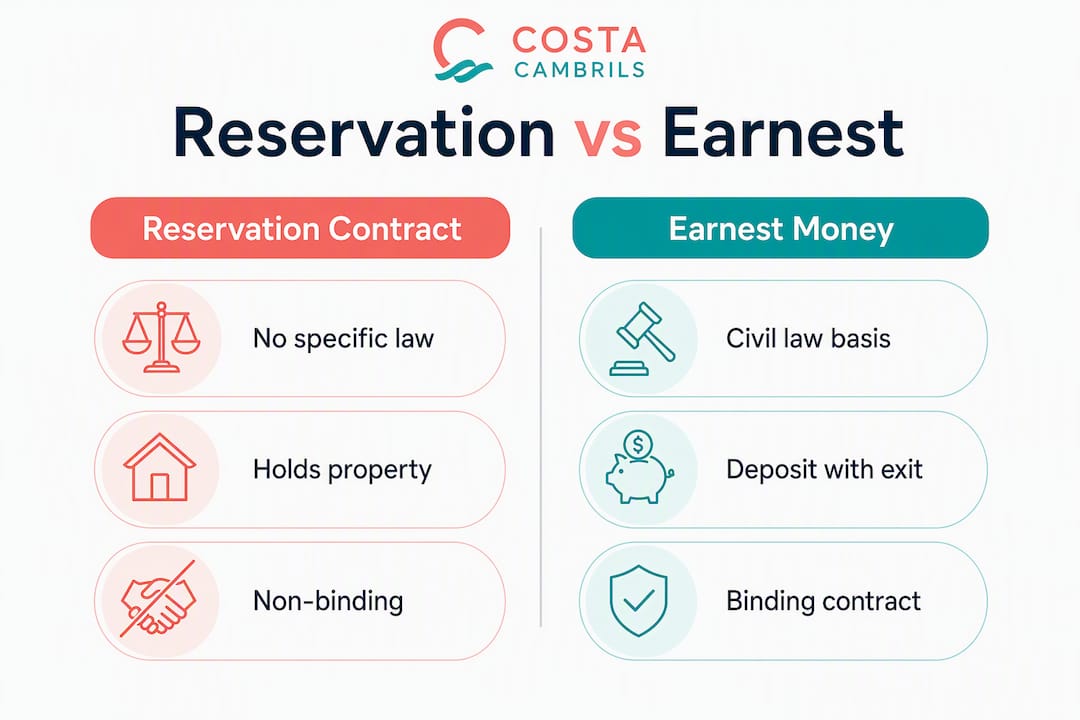
How does a reservation contract differ from an earnest-money agreement?
This is the distinction most buyers get wrong, and the confusion is expensive.
| Dimension | Reservation contract | Earnest-money (arras) |
|---|---|---|
| Legal basis | Atypical; no specific Civil Code article | Article 1454 of the Civil Code (penitential) |
| Party intent | Temporary exclusivity; no firm commitment to buy/sell | Firm mutual commitment to complete the sale |
| Who typically signs | Buyer and agency (owner often absent) | Buyer and property owner directly |
| Owner signature required | Not always; agency may sign alone | Yes, owner must sign |
| Remedy if buyer withdraws | Forfeiture of reservation fee (if so agreed) | Loss of the full arras deposit |
| Remedy if seller withdraws | Return of fee (if so agreed); damages possible | Return of double the arras deposit |
| Typical use case | Early-stage hold; off-plan; financing pending | Confirmed deal; both parties ready to close |
| Statutory framework | None; entirely clause-dependent | Defined by Civil Code; courts apply default rules |
The critical practical difference: arras penitenciales under Article 1454 give both parties a clean exit at a defined cost. The buyer loses the deposit; the seller pays double. A reservation has no such statutory safety net. Its consequences depend entirely on what the contract says, and if the contract is silent or ambiguous, a court may impose the stricter sale-completion remedy instead.
Country-specific note: while the arras framework is rooted in Spanish civil law, similar pre-contractual deposit instruments exist across Central European jurisdictions. The specific Civil Code articles and default remedies vary by country, so always verify which national law governs your contract and what the local default rules are for breach.
Who drafts and signs a reservation contract, and when should you involve a lawyer?
Reservation contracts are frequently drafted by estate agencies rather than independent legal advisers. That creates an obvious tension: the agency’s interest is in closing the sale and earning its commission, not in maximizing buyer protections. Agency-drafted forms often lack a financing condition, omit the owner’s signature, and contain forfeiture clauses that favor the agency’s position.
Typical drafters and signatories:
- Estate agency (most common for resales and new-build promotions)
- Property developer or promoter (for off-plan sales)
- Property owner directly (less common at reservation stage)
- Buyer’s lawyer (rare, but possible when the buyer insists)
When to escalate to a lawyer or notary:
- The deposit exceeds a few hundred euros
- The property is off-plan or under construction
- The agency cannot produce a notarized power of attorney from the owner
- You are a cross-border buyer unfamiliar with local law
- Any clause is ambiguous, especially around refunds or conversion to a full sale
Pro Tip: Before paying anything, send the agency a short written request: “Please confirm in writing that the property owner has authorized this reservation and provide either their signature on this document or a copy of the notarized power of attorney.” If the agency cannot or will not provide this, treat the reservation fee as unsecured money. An agency that signed without owner ratification leaves you with no enforceable claim against the seller, only a potential restitution claim against the agency.

How much is the reservation fee, when is it paid, and how is it protected?
Reservation fees are not fixed by law. For resale properties, common practice puts the fee between €500 and €3,000, depending on the property’s value and local market norms. For new-build or off-plan properties, staged deposits can run significantly higher, often representing a substantial portion of the purchase price across multiple payment installments.

Payment typically occurs at signing or within a short deadline stated in the contract. The fee is usually deducted from the purchase price at closing, but this must be stated explicitly. If the contract is silent, the fee may be treated as a separate charge rather than a price installment.
For new-build properties, buyers should verify a bank guarantee (aval bancario) covering all advance payments before handing over any money. Spanish law requires developers to protect advance payments for properties under construction, and checking that the developer has the required guarantees early prevents losses if the promoter defaults. For resale properties, request that funds be held in a client escrow account rather than paid directly to the agency. Understanding how escrow works in real estate before you sign can save you from a situation where your deposit disappears into an agency’s operating account with no protection.
Always get a written receipt that states the amount, the date, the property, and the conditions under which the fee is refundable.
What happens if the buyer or seller withdraws?
Outcomes depend almost entirely on what the contract says. Here are the most common scenarios:
Buyer withdraws during the reservation period with a clear withdrawal clause. The reservation fee is forfeited. The buyer has no further liability, and the property returns to market. This is the cleanest exit, but it requires the clause to be explicit.
Buyer withdraws without a withdrawal clause. The seller or agency may argue the document constitutes a binding sale and demand completion or damages. If the document contains price and property details, a court may agree.
Buyer’s financing falls through, with a suspensive financing clause. The reservation fee is returned in full within the timeframe stated in the clause. Without this clause, the buyer has no automatic right to a refund.
Seller withdraws while the reservation is in force. If the contract specifies a double-return remedy (mirroring arras logic), the seller returns twice the fee. If the contract is silent, the buyer’s remedy may be limited to restitution of the fee plus a damages claim, which requires litigation.
Agency signed without owner ratification, and the owner refuses to proceed. This is the most dangerous scenario. The buyer may have no enforceable claim against the owner at all. The only recourse is against the agency for the return of funds, and only if the contract provides for it. A critical risk in agency-mediated reservations is precisely this: the owner never ratified, the deal collapses, and the buyer’s money is tied up in a dispute with the agency rather than secured against the property.
Sample remedy clause to negotiate:
“If the seller fails to ratify this reservation within [10] business days of signing, or if the property owner withdraws from the transaction at any point during the reservation period, the buyer shall be entitled to the immediate return of the full reservation fee plus [X]% interest per annum from the date of payment.”
Common red flags to watch for before you sign
Most reservation problems are visible before signing. Here is what to look for:
- No property identifiers. A contract that describes the property only by address, without a Land Registry reference or cadastral number, cannot be enforced precisely and may not match the title.
- Agency as sole signatory, no power of attorney. If the owner has not signed and the agency cannot produce a notarized authorization, your money is not secured against the property.
- No financing condition. Absence of a suspensive clause means a failed mortgage does not trigger a refund. This is the most common and costly omission in agency-drafted forms.
- Ambiguous refund language. Phrases like “the fee may be returned at the discretion of the seller” are not refund clauses. Insist on specific triggers and timeframes.
- No bank guarantee for new-build deposits. Paying a developer without a verified aval bancario is an unsecured loan to a construction company.
- Automatic conversion language. Clauses that state the reservation “automatically converts” to a sale contract on a set date, without requiring a new signature, can bind you without a second decision point.
- Inconsistent dates. Mismatched signing dates, expiry dates, and payment deadlines create ambiguity about when obligations start and end.
If you spot any of these, pause payment immediately. Ask for owner ratification in writing, require escrow or a bank guarantee, and have a lawyer add a suspensive financing clause before you proceed. Real disputes over reservation contracts frequently trace back to one of these seven issues, often the missing financing condition or the unsigned-by-owner problem.
A lawyer-ready checklist before you sign or pay
Follow these steps in order. Do not skip to step 5 because the agent is pressing you.
- Request the owner’s ID and proof of title. Ask for a recent Land Registry extract (nota simple) showing the owner’s name and any encumbrances. This takes minutes to obtain and confirms you are dealing with the right person.
- Confirm signatory authority. If the agency is signing, request the notarized power of attorney. If the owner is not present, do not pay until this document is in your hands.
- Add a financing suspensive clause. If the contract does not include one, add it before signing. This is non-negotiable if your purchase depends on a mortgage.
- Add an explicit “reservation only” statement. One sentence confirming that the document does not perfect a sale and that a separate formal contract is required.
- Confirm fee treatment and refund triggers. The contract must state whether the fee is deducted from the price, what triggers a refund, and the timeframe for return.
- Request escrow or bank guarantee. For new builds, verify the developer’s aval bancario before paying. For resales, ask that funds be held in a client account, not the agency’s operating account.
- Set a ratification deadline. If the owner has not signed, add a clause: “This reservation is conditional upon written ratification by the property owner within [10] business days. Failure to ratify entitles the buyer to a full refund.”
- Have a lawyer review the final draft. A one-hour legal review costs far less than recovering a lost deposit through litigation.
Sample email to send to the agent before paying:
“Before I proceed, please provide: (1) a current Land Registry extract for the property; (2) written confirmation that [owner name] has authorized this reservation, or a copy of the notarized power of attorney; (3) confirmation that the reservation fee will be held in a client escrow account; and (4) a draft contract including a financing suspensive clause and an explicit statement that this document does not constitute a sale. I am ready to proceed once these items are confirmed.”
Pro Tip: Keep the reservation fee as low as possible until the owner has ratified. Offer a modest holding amount (say, €500) with the balance payable only after owner ratification and receipt of the bank guarantee. Agents will push back, but a reasonable seller will accept it. Anyone who refuses to provide owner ratification before taking a large deposit is telling you something important about the transaction.
What to do next: your immediate action plan
If you have not yet signed:
- Run through the checklist above before any payment
- Confirm owner ratification and signatory authority
- Add the financing clause and “reservation only” statement
- Decide whether the fee is protected (escrow or bank guarantee)
If you are negotiating terms:
- Request a lower initial fee until owner ratification is confirmed
- Tie the refund explicitly to financing failure and seller withdrawal
- Ask for a ratification deadline in the contract
- Get a lawyer to review before you sign
If you are ready to sign and terms are acceptable:
- Keep a signed copy of the contract and the payment receipt
- Note the reservation expiry date and set a calendar reminder one week before
- Begin your title search, mortgage application, and due diligence immediately
- Do not treat the reservation period as downtime
When to walk away: If the agency cannot produce owner ratification, refuses to add a financing clause, or insists on a large fee with no escrow protection, those are not negotiating positions. They are structural problems with the transaction. Walking away costs you nothing at this stage.
Key Takeaways
A property reservation contract can be legally binding as a completed sale if it contains a specific property, a defined price, and mutual consent, regardless of what the document is called.
| Point | Details |
|---|---|
| Core definition | A reservation holds a property off the market for a set period in exchange for a fee; it is not regulated by the Civil Code. |
| Binding risk | Courts can treat a reservation as a perfected sale if it contains the essential elements: property, price, and consent. |
| Top red flags | No financing clause, no owner signature, no bank guarantee for new builds, and ambiguous refund wording. |
| What protects you | An explicit “reservation only” statement, a suspensive financing clause, owner ratification, and escrow or bank guarantee for the fee. |
| Immediate next step | Do not pay until you have owner ratification in writing and a financing condition in the contract; get a lawyer to review before signing. |
The reservation contract trap most buyers walk into
The most consistent mistake seen in property transactions is treating the reservation as a formality. Buyers sign quickly because the agent says it is “just a holding document,” pay a fee without checking who signed, and discover weeks later that the owner never ratified the agreement, or worse, that the document they signed is legally a sale.
Agency-drafted reservation forms are written to close deals, not to protect buyers. That is not a criticism; it is just the reality of how agencies operate. Their incentive is to get both parties committed before anyone changes their mind. The clauses that protect a buyer (financing conditions, explicit reservation-only language, owner ratification requirements) are exactly the clauses that give a buyer an exit, and exits are not in the agency’s interest.
The practical answer is simple: treat every reservation as a potential sale contract, because a court might. Add the protective clauses, confirm the owner signed or authorized the agency, and keep the fee small until those conditions are met. For buyers navigating a new-build purchase in Costa Dorada, Costacambrils works with legal partners who review reservation documents before any money changes hands. That review is the difference between a clean transaction and a dispute that takes years to resolve.
Useful sources and where to find local legal help
These are the primary references used in this guide, along with notes on what each contains:
- Notario Francisco Rosales — A notary practitioner’s detailed commentary on why reservation contracts frequently function as sales in practice, with guidance on when to skip the reservation and go directly to a private sale contract with a suspensive clause. Highly recommended reading before signing anything.
- Agave Abogados — Clear legal explanation of the differences between reservation, arras, and full sale contracts, with analysis of how courts determine which instrument applies. Useful for understanding the judicial risk.
- BBS Abogados — Focused on buyer protections for new-build reservations, including the bank guarantee requirement and what happens when a developer defaults.
- Tu Abogado Inmobiliario — Practical overview of reservation contract contents, agency drafting risks, and the importance of precise clause wording.
- Thomson Reuters Practical Law — English-language reference on reservation agreements, useful for international buyers who need a common-law framing before engaging with Spanish civil law concepts.
To find a local property lawyer or notary: Contact the local bar association (Colegio de Abogados) in Tarragona or the nearest notary office. Bring the reservation contract draft, a copy of your ID, the Land Registry extract for the property, and proof of funds. A lawyer can review the document and add protective clauses in a single session. For buyers purchasing in Costa Dorada, the local legal requirements and procedural steps specific to the region are a practical starting point before that first legal appointment.
This article is general information, not legal advice. Property law and contract interpretation vary by jurisdiction. Confirm the rules that apply to your specific transaction with a qualified local lawyer or notary before signing or paying.
Recommended
- What Are Property Filters? A 2026 Buyer’s Guide – Inmobiliaria Costa Cambrils
- What Is a Rental Contract? A Guide for Renters and Investors – Inmobiliaria Costa Cambrils
- What Is Property Registry? A Real Estate Guide – Inmobiliaria Costa Cambrils
- What Is Property Title Insurance? A Buyer’s Guide – Inmobiliaria Costa Cambrils