TL;DR:
- Escrow in real estate involves a neutral party holding funds until all sale conditions are satisfied, protecting both buyer and seller. In Spain, no regulated escrow system exists; instead, lawyers’ client accounts and bank guarantees ensure deposit security. Buyers should verify these protections and include suspensive conditions to prevent losing their deposit if financing or permits fall through.
Escrow in real estate is defined as a neutral third party holding a buyer’s funds until all conditions of the property sale are satisfied. That arrangement protects both the buyer and the seller from default, fraud, or failed financing. For homebuyers and investors purchasing property in Spain, understanding the role of escrow in property deals is especially critical, because the Spanish system differs sharply from the U.S. model most international buyers expect. This guide explains how the process works, where Spain diverges, and how to protect your money at every stage.
What is escrow in real estate and how does it work?
Escrow is a financial arrangement where a neutral agent holds funds, documents, or assets on behalf of two parties until specific contractual conditions are met. The escrow agent releases the funds only when both sides fulfill their obligations. That neutrality is the core value: neither buyer nor seller can access the money unilaterally.
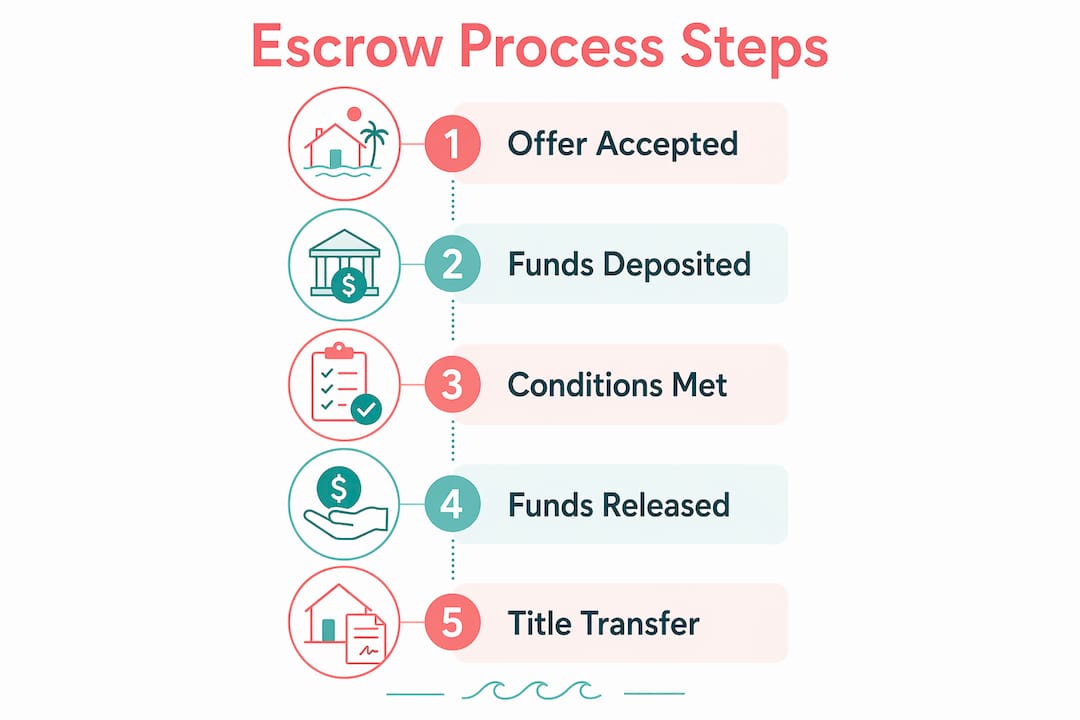
The standard escrow process in a U.S. real estate transaction follows a clear sequence:
- Earnest money deposit: The buyer deposits funds with the escrow agent shortly after signing the purchase agreement, typically 1%–3% of the purchase price.
- Condition period: The escrow agent holds funds while inspections, appraisals, and mortgage approvals are completed.
- Contingency clearance: Each condition is cleared in writing before the agent moves to the next step.
- Closing: The agent disburses the purchase price to the seller, pays closing costs, and records the deed simultaneously.
That simultaneous disbursement is the defining feature of U.S. escrow. No money moves until every condition is satisfied. The buyer cannot lose funds to a seller who backs out, and the seller cannot lose the property to a buyer who never had financing.
Pro Tip: Always confirm in writing which conditions must be cleared before your escrow agent releases funds. Verbal agreements do not bind escrow instructions.

The role of escrow accounts extends beyond the purchase itself. Mortgage lenders in the U.S. also use escrow accounts to collect monthly property tax and insurance payments, holding them until the annual bills come due. That ongoing role makes escrow a permanent fixture in American homeownership, not just a closing mechanism.
How does Spanish real estate differ from U.S. escrow?
Spain has no standardized national escrow system. Security depends entirely on private contractual arrangements and the quality of legal counsel the buyer retains. That single fact changes everything for international buyers who assume a regulated escrow officer will manage their funds.
The Spanish Notary plays a central role in property transactions, but that role is not equivalent to a U.S. escrow officer. The Notary prepares and authorizes the public deed of sale but does not hold buyer funds in a segregated account. Funds typically move at signing via bank check or wire transfer, authorized in the Notary’s presence. The Notary witnesses the payment; the Notary does not control it.
| Feature | U.S. escrow system | Spanish property system |
|---|---|---|
| Neutral fund holder | Licensed escrow officer | No regulated equivalent |
| Fund timing | Held until all conditions met | Transferred at signing |
| Regulatory oversight | State-regulated escrow law | Private contract terms |
| Buyer protection | Statutory escrow rules | Lawyer’s client account or contract clauses |
| Dispute resolution | Escrow instructions govern | Civil Code and contract terms |
Foreign buyers frequently confuse the Notary’s role with U.S. escrow. That confusion leads to the most common and costly mistake in Spanish property purchases: wiring a deposit directly to a seller or estate agent without legal protection in place.
The practical solution is to use a lawyer’s client account as a de facto escrow arrangement. Lawyers commonly hold deposit funds in client accounts to provide segregated, secure holding until all agreed conditions are met. That account sits outside the seller’s reach and outside the agent’s control. For international buyers, this is the closest functional equivalent to U.S. escrow available in Spain.
Pro Tip: Custom escrow agreements, known in Spain as contratos de depósito en garantía, are legally valid and increasingly used by non-residents. Ask your lawyer to draft one before any money changes hands.
You can learn more about how the Spanish Notary’s legal role fits into the broader transaction process through Costacambrils’ dedicated guide on the subject.
How are buyer funds protected in off-plan and new development purchases?
Off-plan purchases carry the highest financial risk in Spanish real estate because buyers pay before the property exists. Spanish law addresses this directly through a mandatory special account system under the Spanish Building Law, known as the Ley de Ordenación de la Edificación (LOE).
Advance payments from off-plan buyers must be deposited into a special account that is legally segregated from the developer’s general operating funds. The developer cannot use those funds for any purpose other than construction of the specific development. That segregation functions as a state-backed escrow equivalent for new builds.
The law also requires developers to back those special accounts with either a bank guarantee or surety insurance. Penalties for developer non-compliance can reach 25% of the guaranteed amount. That penalty structure gives developers a strong financial incentive to comply.
Before making any payment on an off-plan property, buyers must verify two things:
- The special account exists and is registered with a licensed bank.
- A valid bank guarantee or surety insurance policy covers the full amount of advance payments.
Buyers must confirm the existence of a bank guarantee or insurance as legal protection before transferring any funds. Requesting documentary proof of both the special account and the guarantee is not optional. It is the minimum standard of due diligence for any off-plan purchase in Spain.
Staged payment schedules add another layer of protection. Paying in installments tied to verified construction milestones limits the amount at risk at any single point. A lawyer reviewing each stage certificate before authorizing payment is the most reliable way to manage that risk.
What contract terms protect your deposit in a Spanish property deal?
The Spanish deposit system operates in two stages, and understanding both is the foundation of deposit protection. The first stage is a reservation fee, typically €3,000–€10,000, paid to take the property off the market. The second stage is the main deposit, equal to 10% of the purchase price, paid upon signing the private purchase contract known as the contrato de arras.
The contrato de arras penitenciales is the most common form of private purchase contract in Spain. Under Article 1454 of the Civil Code, the consequences of withdrawal are clear and binding:
- If the buyer withdraws, the buyer loses the full 10% deposit.
- If the seller withdraws, the seller must return double the deposit amount to the buyer.
- Neither party can force the other to complete the sale under this contract type.
- The penalty is the exclusive remedy; no additional damages apply unless the contract states otherwise.
- The contract must specify which type of arras applies, because different types carry different legal consequences.
That double-penalty rule for seller withdrawal is a meaningful protection. It makes backing out financially painful for sellers, which reduces the risk of a seller accepting a higher offer after your deposit is paid.
Suspensive conditions are the second critical protection. Including a mortgage approval clause in the arras contract means your deposit is returned in full if your bank denies the loan. Without that clause, a failed mortgage application costs you the entire deposit. Military permit conditions apply to certain properties near restricted zones and carry the same logic: if the permit is denied, the deposit returns.
Pro Tip: Never sign an arras contract without a lawyer reviewing the suspensive conditions first. A missing clause costs the same as a lost deposit.
Experts consistently stress that suspensive conditions prevent deposit loss over financing or permit failures. That advice applies equally to first-time buyers and experienced investors. The legal requirements for buying in Spain include specific rules on how these conditions must be drafted to be enforceable.
Key Takeaways
Escrow in real estate protects buyers and sellers by placing funds with a neutral party until all transaction conditions are met, and in Spain, lawyers and special accounts serve that function in the absence of a regulated escrow system.
| Point | Details |
|---|---|
| Escrow definition | A neutral third party holds funds until all sale conditions are satisfied before release. |
| Spain has no standard escrow | Security depends on lawyer’s client accounts, contract terms, and bank guarantees. |
| Notary is not an escrow officer | Spanish Notaries authorize deeds but do not hold or control buyer funds. |
| Off-plan legal protection | LOE mandates special accounts and bank guarantees; verify both before any payment. |
| Arras contract terms | Buyer loses 10% if they withdraw; seller pays double if they withdraw, per Article 1454. |
Why I think most international buyers get Spain’s escrow question completely wrong
Most buyers arriving from the U.S., the U.K., or Northern Europe ask the same question: “Who holds the escrow?” The honest answer is that nobody holds it the way they expect. That gap between expectation and reality is where most costly mistakes happen.
What I have seen repeatedly is buyers who assume the Notary fills the escrow role. They wire a deposit to a seller’s account, attend the Notary signing, and feel protected because a legal official was present. The Notary’s presence does not protect your deposit. It witnesses the transaction. Those are completely different things.
The buyers who navigate Spain well treat their lawyer’s client account as non-negotiable. They refuse to pay any deposit until a lawyer confirms the account is segregated and the conditions for release are written into the contract. That single habit eliminates the majority of deposit-loss risk.
The other mistake I see is skipping suspensive conditions to appear like a serious buyer. Sellers and agents sometimes pressure buyers to sign a “clean” arras without mortgage contingencies. Accepting that pressure is a gamble. If your financing falls through, you lose the deposit. No exception. The right response is to negotiate the clause in, not remove it to look committed.
Spain’s system is not broken. It is just different. Once you understand that security comes from contract terms and qualified legal counsel rather than a regulated escrow officer, you can navigate it confidently.
— Oscar
Buying property in the Costa Dorada with confidence
Costacambrils specializes in luxury property sales and rentals across Cambrils and the Costa Dorada, with a team that guides international buyers through every financial and legal step of the transaction.

From verifying developer special accounts on new development properties to reviewing arras contract terms and deposit structures, Costacambrils connects buyers with the legal and advisory resources they need before any money moves. Whether you are evaluating a luxury villa or a new-build apartment, the team helps you confirm guarantees, structure staged payments, and protect your deposit at every milestone. For buyers ready to assess specific opportunities, the luxury property evaluation guide for Cambrils is a practical starting point.
FAQ
What is the escrow definition in real estate?
Escrow in real estate is a financial arrangement where a neutral third party holds a buyer’s funds until all conditions of the property sale are met. The agent releases funds only when both buyer and seller fulfill their contractual obligations.
Does Spain have a regulated escrow system?
Spain has no standardized national escrow system. Fund security relies on private contract terms, lawyer’s client accounts, and bank guarantees rather than a state-regulated escrow officer.
What happens to my deposit if the seller backs out in Spain?
Under the arras penitenciales contract, governed by Article 1454 of the Civil Code, the seller must return double the deposit amount to the buyer if the seller withdraws from the sale.
How are off-plan buyer payments protected in Spain?
Spanish Building Law requires developers to deposit advance payments into a special segregated account backed by a bank guarantee or surety insurance. Buyers must verify both exist before transferring any funds.
What is a suspensive condition and why does it matter?
A suspensive condition is a contract clause that voids the purchase and returns the deposit if a specific event, such as mortgage denial or permit refusal, occurs. Without it, a failed loan application results in the full loss of the deposit.
Recommended
- Checklist for Buying New Homes 2026: Full Guide – Inmobiliaria Costa Cambrils
- Legal Aspects of Property Purchase: International Buyer’s Guide – Inmobiliaria Costa Cambrils
- How to Screen Property Agents: A 2026 Buyer’s Guide – Inmobiliaria Costa Cambrils
- Why Consider Off-Plan Properties: A 2026 Buyer’s Guide – Inmobiliaria Costa Cambrils