
TL;DR:
- A property registry is an official government record that documents land ownership, location, and encumbrances, providing a legal foundation for transactions. Its contents—including geographic details, ownership, and registered interests—are critical for due diligence, with official copies holding legal weight. Timely filing and understanding regional registry differences are essential for protecting property rights and avoiding disputes.
A property registry is an official, government-maintained record that documents detailed information about land and buildings, including geographic location, ownership, and encumbrances. Known formally as a land registry in many jurisdictions, this public record replaces fragmented private documents with a single authoritative source of legal truth. Systems like HM Land Registry in England and Wales, ACRIS in New York City, and Registers of Scotland each serve the same core function: giving buyers, sellers, lenders, and legal professionals a reliable foundation for every property transaction. Understanding how this system works is not optional for anyone serious about real estate.
What is property registry and what does it record?
A land registry formally records rights and interests in land, including ownership and encumbrances, in an official state-maintained register. That definition matters because it tells you exactly what you are looking at when you pull a registry record: not an opinion, not a summary, but a legal document backed by state authority.
Most property registries contain three core categories of information:
- Geographic location and extent. The property register provides geographic allocation and extent used in property records, often tied to cadastral mapping that defines precise boundaries.
- Registered ownership and title details. This identifies who legally holds the property, under what tenure (freehold or leasehold), and when that ownership was registered.
- Encumbrances. These include mortgages, easements, restrictive covenants, and leases that affect the property’s use or transferability.
One distinction that trips up many buyers is the difference between a free online summary and an official copy. HM Land Registry’s free service shows details like address, tenure type, and restrictive covenants, but official copies require a formal request and carry legal weight. A free summary is useful for a quick check. An official copy is what your solicitor needs to complete a transaction.
Pro Tip: Always order official copies before signing any purchase contract. A free online summary will not protect you in a legal dispute.

How do property registries vary across regions?
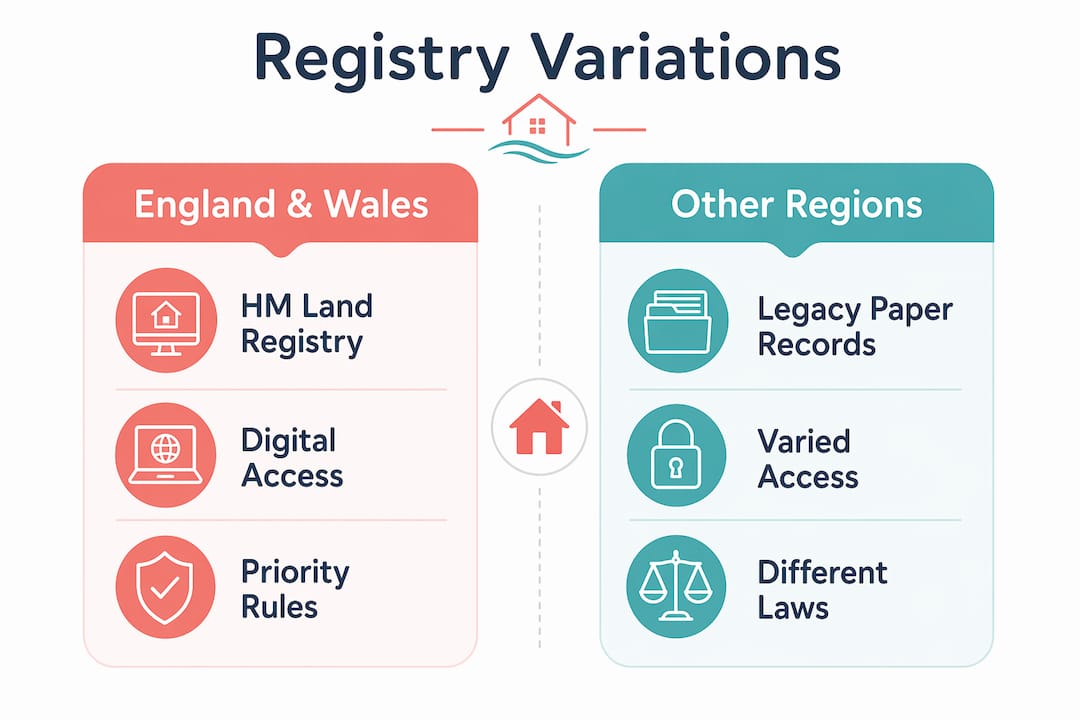
No two countries run identical registry systems, and those differences carry real consequences for buyers and professionals working across borders. The table below captures the key distinctions between three widely used systems.
| Registry system | Jurisdiction | Access method | Coverage |
|---|---|---|---|
| HM Land Registry | England and Wales | Online portal and official copy requests | Registered land only; unregistered land not shown |
| ACRIS | New York City | Free public online search | All recorded documents by borough and block |
| ScotLIS (Registers of Scotland) | Scotland | Search by postcode or title number | Land Register and Sasine Register |
| Nova Scotia E-Land Registry | Nova Scotia, Canada | Digital records converted from legacy paper books | Electronic records defined as primary |
The registered versus unregistered land distinction is particularly important. HM Land Registry notes that unregistered land ownership may not appear online at all, meaning a buyer relying solely on a digital search could miss critical ownership history. Scotland’s ScotLIS system allows searching by postcode or title number, giving professionals a fast route to ownership data and purchase documents. New York’s ACRIS is notable for being entirely free and publicly accessible, covering recorded documents across all five boroughs.
Digital conversion is reshaping every system on this list. Nova Scotia’s e-land registry program involves scanning legacy record books and legally defining when electronic records become the primary source of truth. This transition is not cosmetic. It changes which document controls in a dispute, and professionals need to know which format their jurisdiction treats as authoritative.
What is the property registration process for buyers and sellers?
The property registration process follows a logical sequence, but the timing of each step carries legal consequences that most buyers underestimate. Registry-based conveyancing involves official search, ownership review, and contract structuring based on registry information. Here is how that plays out in practice.
- Conduct an official registry search. Before any contract is drafted, the buyer’s legal representative pulls the current title register and title plan. This confirms who owns the property, what encumbrances exist, and whether any pending applications are already lodged.
- Review ownership and encumbrance records. Every mortgage, easement, and restrictive covenant must be identified at this stage. An official registry search informs contract conditions, including the discharge of registered encumbrances before completion.
- Check for pending applications. Registry entries support priority based on the date and time they are entered in the day list. If another buyer has already lodged an application on the same property, that application takes precedence. This is one of the most overlooked risks in competitive markets.
- Structure the contract around registry findings. Any encumbrance that must be discharged before completion should be written into the contract as a condition. Do not assume a seller will clear a mortgage without a contractual obligation to do so.
- Lodge the registration application promptly after completion. The moment a transaction completes, the buyer’s solicitor should file the registration application. Delay creates a window where a competing claim could take priority.
- Obtain official copies for your records. Once registration is confirmed, official copies from land registries are required for formal legal proof and differ from online summaries geared for general checks.
Pro Tip: In Spain, the Registro de la Propiedad operates on the same priority-by-date principle. If you are buying in Costa Dorada, confirm with your notary that the registration application will be filed the same day as the deed signing. Review the legal requirements for buying property in the region before you sign anything.
How professionals and individuals use registries effectively
Property registries provide centralized, public notice of land rights, reducing disputes and building market confidence. That is the theory. In practice, the professionals who get the most value from registries use them proactively, not reactively.
Here are the most impactful applications:
- Fraud prevention. Verifying ownership through the registry before any money changes hands is the single most effective defense against title fraud. Fraudsters rely on buyers skipping this step.
- Due diligence for purchases and lending. Lenders require a clear title search before approving a mortgage. Buyers who run their own search independently, before the lender orders one, catch problems earlier and negotiate from a stronger position.
- Secured lending clarity. A registered mortgage appears on the title register, giving lenders confidence that their security interest is publicly recorded and legally protected.
- Reducing reliance on private documents. Registration systems provide public visibility of rights, reducing reliance on incomplete private documents. A seller’s bundle of old deeds is no substitute for a clean registry entry.
- Investment and planning research. Investors use registry data to identify ownership patterns, assess encumbrances on target properties, and map out acquisition strategies before approaching sellers.
- Legal dispute resolution. When ownership is contested, the registry entry is the starting point for any court proceeding. A registered right is far easier to defend than an unregistered claim backed only by private paperwork.
Digital public access to registry data improves due diligence and empowers buyers and lenders to make faster, better-informed decisions. Systems like ScotLIS demonstrate that public accessibility does not compromise legal integrity. It strengthens it by making the information harder to dispute.
For anyone evaluating property in Spain, understanding how the Registro de la Propiedad interacts with the notarial process is non-negotiable. Costacambrils recommends reviewing the role of notaries in Spanish property transactions alongside any registry research, since the two systems work in tandem to protect buyers.
Key takeaways
A property registry is the legal backbone of every real estate transaction, and understanding its priority rules, coverage limits, and document types is what separates informed buyers from exposed ones.
| Point | Details |
|---|---|
| Registry definition | A government-maintained record of ownership, location, and encumbrances for land and buildings. |
| Official copies matter | Free online summaries are for general checks; official copies carry legal weight in disputes and transactions. |
| Priority is time-sensitive | Registry applications take priority by date and time of lodgement, making prompt filing after completion critical. |
| Coverage gaps exist | Unregistered land may not appear in online searches, requiring additional due diligence beyond the digital record. |
| Digital access improves outcomes | Public online registries like ScotLIS and ACRIS reduce fraud risk and accelerate due diligence for buyers and lenders. |
Why registry timing is the detail most buyers get wrong
Most buyers treat the property registry as a formality, something their solicitor handles in the background. That mindset is the source of most avoidable transaction problems I have seen over the years.
The priority-by-date rule is the one that catches people off guard. Two buyers can be in contract on the same property simultaneously, and the one whose solicitor files the registration application first wins. That is not a technicality. That is the law, and it applies whether you paid full price or not.
I have also watched buyers over-rely on free online summaries. They see a name on a screen and assume the transaction is safe. It is not. Unregistered land, pending applications, and overriding interests do not always appear in a basic search. The official copy is the only document that gives you a complete picture at a specific point in time.
The other misconception worth addressing: a property registry does not guarantee that the registered owner has the right to sell. It records what has been submitted and accepted. Fraud, forgery, and administrative errors do occur. The registry reduces risk dramatically, but it does not eliminate the need for a competent legal professional reviewing the full picture.
My advice for anyone buying property, whether in Costa Dorada or anywhere else, is to treat the registry search as the starting point of due diligence, not the end of it. Pair it with a property title search, a review of planning records, and a conversation with a local notary or solicitor who knows the jurisdiction.
— Oscar
Find your next property with Costacambrils

Costacambrils specializes in luxury property sales and rentals across Costa Dorada, with particular depth in Cambrils and the surrounding Tarragona region. The team provides full transaction support, including guidance on registry verification, encumbrance review, and coordination with local notaries to protect every buyer’s legal position. Whether you are purchasing a seafront villa or a new-build apartment, Costacambrils handles the due diligence so you can focus on the decision. Explore the luxury real estate services available in Costa Dorada and connect with an advisor who understands both the local market and the legal framework behind every transaction.
FAQ
What is a property registry in simple terms?
A property registry is an official government record that lists who owns a piece of land or building, where it is located, and what rights or debts are attached to it. It replaces private ownership documents with a single, publicly accessible legal record.
What is the difference between a land registry and a property registry?
The two terms refer to the same concept. “Land registry” is the standard industry term used in most jurisdictions, while “property registry” is a broader descriptive phrase. Both describe the official state-maintained system for recording ownership and encumbrances.
Why does the timing of property registration matter?
Registry entries support priority based on the date and time they are lodged, meaning a later application on the same property can lose out to an earlier one even if the transaction completed first.
Can I search a property registry for free?
Many jurisdictions offer free online searches for general information. HM Land Registry and ScotLIS both provide public access, though official copies require a formal request and a fee for legal-grade documents.
What happens if a property is not registered?
Unregistered land ownership may not appear in online registry searches, which creates gaps in due diligence and increases the risk of title disputes. Most jurisdictions now require registration upon sale, but older properties in some areas remain outside the digital record.