
For most landlords in Spain, the safest combination is a DGSFP-registered rental non-payment insurance policy paired with strict tenant pre-screening, not one or the other alone. Guarantee platforms pay faster in some cases, but insurance carries stronger regulatory backing. Before signing anything, confirm the provider’s DGSFP registration and request the full policy wording, not just a summary sheet.
TL;DR:
- A DGSFP-registered rental non-payment insurance policy offers longer rent indemnity coverage, typically between 6 and 12 months, with regulatory backing.
- Insurance premiums range from about 3% to 5% of annual rent, costing roughly €360 to €600 per year for €12,000 annual rent, depending on coverage length and risk factors.
- Insurers require thorough tenant financial and credit checks, including recent pay slips, rental agreements, and tax returns, before issuing coverage.
- Payout delays can occur due to waiting periods, legal procedures, and documentation requirements, making prompt legal notices and record-keeping crucial.
- Layering tenant pre-screening with both insurance and quick-pay guarantee platforms provides optimal protection, especially in higher-risk rental situations.
Table of Contents
- What Does Seguro Impago Alquiler España Actually Cover?
- How Much Does Rental Non-Payment Insurance Cost in Spain?
- What Documents Do You Need to Qualify for Coverage?
- How Long Does It Take to Get Paid After a Tenant Stops Paying?
- Insurance or Fast-Pay Guarantee: Which Fits Your Property?
- What Should You Ask a Provider Before Signing?
- A Practical Workflow for Costa Dorada Landlords
- An Agent’s View on Screening Versus Insurance
- How Costacambrils Supports Landlords Beyond the Policy
- Sources
What Does Seguro Impago Alquiler España Actually Cover?
A seguro impago alquiler españa policy is built around a few core promises, and reading the fine print on each one matters more than the marketing page ever will. The centerpiece is rent indemnity: the insurer pays you a set number of months of unpaid rent, commonly between 6 and 12 months according to legal guides on the subject, Legia’s landlord guide notes. That figure isn’t unlimited capital.
Beyond rent itself, most policies bundle in a handful of other protections:
- Defensa jurídica (legal defense), covering court costs and attorney fees tied to the eviction claim
- Damage to contents or structure caused by the tenant, usually capped around €3,000 as noted by several industry sources, according to reporting from El País
- Unpaid utility supplies (water, electricity, community fees) the tenant left behind
- A separate, smaller sub-limit for locksmith or lock-change costs, often around €250
Exclusions cluster in predictable places: squatting situations (okupación) that started before the policy existed, willful non-payment that began before the contract with the insurer, and any arrears that were already accruing when you signed up. Read those exclusion clauses twice. They’re where insurers quietly draw the line between what sounds covered and what actually gets paid.
How Much Does Rental Non-Payment Insurance Cost in Spain?
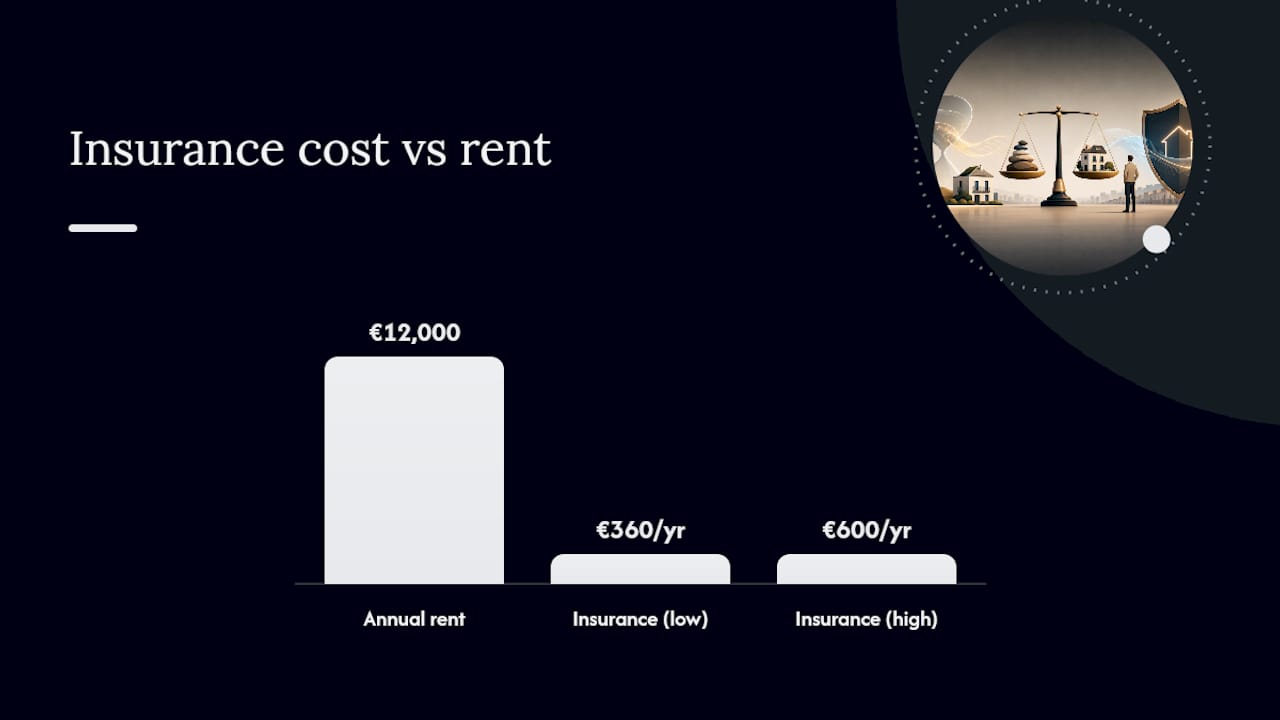
On a property renting for €1,000 a month, that annual rent is €12,000. At 3% to 5%, you’re looking at roughly €360 to €600 a year, or €30 to €50 a month folded into your operating costs. That’s a modest number against a single missed month of rent, let alone six.
What pushes the price up or down:
- Coverage length, since 12 months of protection costs more than 6
- Tenant risk profile, including income stability and credit history
- Property location, with higher-demand areas sometimes pricing differently
- Added extras like damage cover or unpaid supplies bundled in
- Payment frequency, since annual payment sometimes beats monthly installments
When comparing quotes, put them side by side on identical terms: same number of months covered, same franchise (deductible) amount, same damage cap. A quote that looks 20% cheaper often just cuts one of those three, and you won’t notice until you file a claim.
What Documents Do You Need to Qualify for Coverage?
Insurers won’t cover a tenant blind. They run a solvency check before issuing the policy, and that check is really doing double duty: it’s protecting the insurer, but it’s also giving you a professional-grade background check on someone about to live in your property, a point El País makes well.
- Gather the tenant’s pay slips (nóminas) covering the last three months, plus their signed rental contract and, where available, their latest IRPF tax return.
- Submit the file to the insurer, who typically returns a decision in 24 to 72 hours when the paperwork is complete.
- Expect an income ratio check: most insurers want the rent to sit no higher than about 30% to 40% of the tenant’s net monthly income.
- A credit history check against ASNEF or similar registries happens automatically as part of underwriting.
If your tenant doesn’t clear those bars, you’re not out of options. A solvent avalista (guarantor) can back the file, an increased security deposit sometimes satisfies the insurer, or you pivot to an alternative guarantee product built for higher-risk tenant profiles. Don’t skip this step to close the lease faster. It’s the cheapest risk filter you’ll ever run.
How Long Does It Take to Get Paid After a Tenant Stops Paying?
Payout speed is where insurance and guarantee products genuinely diverge, and it’s worth understanding before you’re relying on either one.
Nearly every insurance policy carries a carencia, a waiting period before default coverage kicks in, typically 1 to 3 months from the policy start date. Buy the policy the same week you sign a shaky lease, and you may not be covered yet if that tenant stops paying in week three. On top of the carencia, most policies apply a franchise (a deductible period, often one month) before indemnity payments begin, and require you to formally initiate legal reclamation: such as a burofax demand, a claim form, or sometimes a court filing.
That legal step isn’t optional paperwork. Legia’s guide is explicit that insurers often require the landlord to start documented legal action within precise windows, and missing that window is a common reason a legitimate claim may be delayed or denied.
Realistic timelines: fast guarantee platforms have advertised payment within 5 business days in some cases, while traditional insurance claims, once legal proceedings are underway, commonly take months rather than just weeks.

Pro Tip: Keep every notice, burofax receipt, and email from day one of a missed payment. Insurers deny more claims over missing documentation than over the actual non-payment event.
Insurance or Fast-Pay Guarantee: Which Fits Your Property?
Both products solve the same problem from different directions, and the right pick depends on what you value more: legal muscle or speed.
A traditional insurer is a regulated financial product, supervised by the Dirección General de Seguros y Fondos de Pensiones (DGSFP), with judicial claim backing behind every payout. A guarantee platform often moves faster because it’s paying from its own commercial balance rather than running a claim through insurance machinery, but that speed can come with a narrower coverage ceiling and, depending on the provider, less regulatory oversight than a licensed insurer.
- Long-term, buy-and-hold landlords who can absorb a short wait generally do better with regulated insurance and its stronger legal backing.
- Landlords who need cash flow certainty, such as those relying on rental income to cover a mortgage payment each month, may value a guarantee platform’s faster turnaround more than the extra legal protections.
- Properties in higher-risk rental segments benefit from whichever product offers a lower franchise and shorter carencia, regardless of label.
Neither option replaces the tenant screening step. Both work better layered on top of it, not instead of it.
What Should You Ask a Provider Before Signing?
Run through this before you commit to any policy or guarantee product:
- How many months of rent does the policy actually cover, and is that number a hard cap?
- What is the carencia period, and does it start on the policy date or the tenant move-in date?
- What franchise (deductible) applies before payments begin?
- Are legal costs (defensa jurídica) included, or billed separately above a threshold?
- What is the damage cap, and is there a separate, smaller sub-limit for things like lock changes?
- Is payout conditional on a judicial resolution, or can the insurer pay before a court ruling?
Verify the provider’s DGSFP registration directly. OCU’s own comparative analysis flags this as the single most important check before signing anything, since unregulated “guarantee” products may not carry the same legal recourse if a payout dispute arises. Ask for a sample claim timeline from a past case, not a hypothetical one.
Pro Tip: A price that looks 30% below the market range for full coverage is a signal to check the fine print, not a reason to celebrate. Cheap premiums usually mean a thinner policy, not a better deal.
Red flags worth walking away from: no verifiable DGSFP registration, vague language around what “guarantee” actually means contractually, and refusal to send full policy wording before you pay.
A Practical Workflow for Costa Dorada Landlords
If you own a rental property in Cambrils or along the Costa Dorada, the sequence that keeps you protected looks like this:
- Pre-screen every applicant with income documentation and a credit check before you discuss insurance at all.
- Request DGSFP proof from any insurer or guarantee provider you’re considering, in writing.
- Choose your product, insurance, guarantee, or both layered together, based on your cash flow needs and risk tolerance.
- Save your claim contacts and documentation templates now, before you ever need them, so a missed-payment month doesn’t turn into a missed-deadline month.
Costacambrils works alongside owners on the tenant verification and legal referral side of this process, which matters most when a claim actually needs to move. If you’re setting up a new rental, our guide to the rental process in Spain walks through the paperwork stage by stage.
An Agent’s View on Screening Versus Insurance
Insurance is a backstop, not a substitute for knowing who you’re renting to. I’ve seen landlords buy a policy and skip the pre-screening step, assuming the insurer’s check covers them; it often does, but only after the carencia clears and only within the cap. Combine both. Before your next lease, get the tenant file reviewed and get your policy wording in hand.
— Oscar
How Costacambrils Supports Landlords Beyond the Policy
A rental non-payment policy handles the financial fallout. It doesn’t handle finding the right tenant in the first place, negotiating a lease that protects you, or coordinating what happens the moment a payment goes missing. That’s the gap Costacambrils fills for owners across Cambrils and the Costa Dorada.

A rental agency can help landlords with tenant verification, lease structuring, and coordinating with legal contacts if a claim needs to move quickly. If you manage a property remotely or simply prefer not to chase paperwork yourself, a local property manager closes that gap in a way a policy alone can’t. This matters most for owners who split time between countries and can’t respond to a missed-payment notice within days.
If you’re weighing whether to self-manage or bring in local support for your rental, explore the property management and ownership services Costacambrils offers across the region and get a sense of what fits your property.
Sources
- Seguro de impago de alquiler: precio, requisitos y coberturas — Tuio blog
- Comparativa seguros impago rentes — OCU
- Seguro de impago de alquiler: guía para el propietario — Legia