TL;DR:
- The Spanish Land Registry records legal ownership, encumbrances, and restrictions for each property to ensure security. Verifying registration status is essential, as it protects buyers against hidden claims and disputes. Proper due diligence, including checking the registry and paying taxes on time, helps secure legal ownership in Spain.
The Spanish Land Registry, known officially as the Registro de la Propiedad, is a government-supervised public register that records legal ownership and rights related to real estate in Spain. Governed by the Public Law Corporation of Land and Mercantile Registrars, it serves as the definitive legal record for every property transaction in the country. Understanding what is land registry Spain means is not optional for buyers or investors. It is the foundation of legal security in every Spanish property deal, and skipping it exposes you to risks that no amount of goodwill from a seller can fix.
What does the Spanish Land Registry contain?
The Registro de la Propiedad records five core categories of information for each property. Registry data categories include ownership, encumbrances, property description, restrictive notes, and fiscal charges. Each entry gives you a complete legal picture of who owns a property and what obligations are attached to it.

Every property in Spain carries a unique registration number, sometimes called the CRU (Código Registral Único), which links all registry entries to that specific asset. The registry is organized territorially, with individual land registries serving specific municipalities. Some regions, like the Canary Islands, have special administrative arrangements, but the underlying legal framework is uniform across Spain.
| Registry Data Category | What It Tells You |
|---|---|
| Ownership | Current titleholder and chain of title |
| Encumbrances | Active mortgages, liens, and easements |
| Property description | Surface area, boundaries, and building details |
| Restrictive notes | Legal limitations on use or transfer |
| Fiscal charges | Outstanding municipal or tax-related charges |
One distinction every buyer must understand is the difference between the Land Registry and the Catastro. The Land Registry is not responsible for the physical description of a property. That is the Catastro’s role, which serves a fiscal and administrative purpose. The Land Registry advertises legal rights. The Catastro records physical facts. Both matter, but they serve different functions, and mismatches between them can delay or block a registration.
How to request a Nota Simple and other registry documents
The Nota Simple is the most widely used document derived from the Land Registry. It is an informative summary of a property’s registration status, including ownership, encumbrances, and any restrictions. Buyers, lawyers, and banks all rely on it as a first-line check before any transaction moves forward.
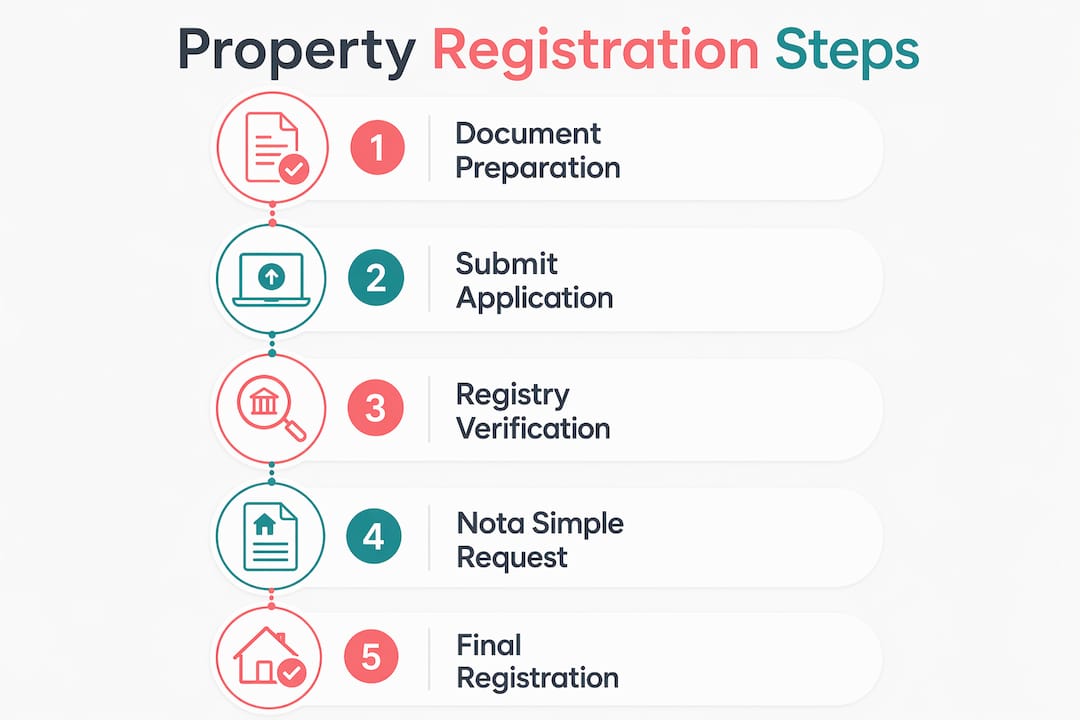
The official cost of a Nota Simple is €9.02 plus taxes, and it is typically delivered electronically within 2–24 hours through the official online portal. That price point makes it one of the most affordable pieces of due diligence available in any real estate market.
Here is how to request one:
- Visit the official Sede Electrónica del Registro de la Propiedad portal.
- Identify the correct land registry for the property’s municipality.
- Enter the property’s registration number or address.
- Select your reason for the request. Accurate request reasons help the system process applications faster, often delivering results in under 2 hours.
- Pay the fee online and receive the document by email.
You can also request a Nota Simple in person at the relevant local registry office, though the online route is faster for most buyers.
The Nota Simple differs from a Certificación Registral. The Certificación has full legal probative value and is signed by the registrar. Courts and notaries require it for formal legal proceedings. The Nota Simple is informative only. It tells you what the registry shows at that moment, but it does not carry the same evidentiary weight in a dispute.
Pro Tip: Request your Nota Simple at least two weeks before signing any purchase agreement. Registry data can change, and having an up-to-date copy gives your lawyer time to flag issues before you are legally committed.
What is the property registration process in Spain?
Spain property registration follows a defined sequence after a sale is agreed. Understanding each step prevents costly delays and protects your ownership rights from day one.
The process works as follows:
- Sign the public deed (escritura pública) before a notary. The notary verifies identities, confirms the transaction, and produces the official deed. Learn more about the notary’s role in Spanish property transfers.
- Pay the applicable taxes. Buyers of resale properties pay the Property Transfer Tax (ITP). New builds attract VAT (IVA) and Stamp Duty (AJD). Buyers have 30 working days from signing the deed to pay taxes at the regional treasury. Missing this deadline blocks registration entirely.
- Present the deed at the Land Registry. Once taxes are paid and stamped, the deed goes to the relevant registry office.
- Registrar qualification period. The registrar has 15 working days to review the deed and complete the inscription if everything is in order. This period exists to catch legal defects before they become permanent problems.
Registration is not legally mandatory for ownership to transfer in Spain. Ownership passes through the public deed and physical handover. However, inscription in the land registry is critical for legal protection against third parties under Article 34 of the Mortgage Law. That article means a registered buyer is protected even if a previous owner had competing claims. Without registration, you own the property but you cannot enforce that ownership against a third party who later registers a competing right.
One common pitfall catches buyers off guard: unpaid but formally uncanceled mortgages. A paid-off mortgage that has not been formally canceled in the registry still appears as an active charge. Sellers must complete the cancellation inscription before the sale closes, or buyers inherit a registered encumbrance that takes time and money to remove.
How does the Spanish Land Registry protect buyers and investors?
The Land Registry is the primary legal safeguard for anyone buying property in Spain. The registry protects purchasers against hidden liens and multiple sales by a single owner. That protection is not theoretical. It is the legal mechanism that prevents a dishonest seller from selling the same property to two different buyers and leaving both without recourse.
Verifying registration status before purchase is non-negotiable. A thorough due diligence review covers:
- Confirming the seller is the registered owner
- Checking for active mortgages, liens, or easements
- Reviewing any restrictive notes that limit use or transfer
- Identifying fiscal charges linked to the property
- Confirming the property’s registered description matches the physical reality
The registry also connects to fiscal authorities. Municipal charges, such as the IBI (property tax), and certain community debts can appear as registered charges. Buyers who skip this check sometimes inherit tax arrears from a previous owner.
The Land Registry is the pillar of legal security in Spain. It acts as legal insurance for property rights, shielding buyers from hidden claims that would otherwise be invisible until after the sale closes.
Priority of inscription is another protection worth understanding. When two competing claims exist for the same property, the one registered first takes legal precedence. This rule makes early registration after signing the deed a practical priority, not just a formality. For investors buying property in Spain, this principle directly affects the security of their investment.
Common misconceptions about the Spanish Land Registry
The most persistent confusion in Spain property registration is treating the Land Registry and the Catastro as the same thing. They are not. Many buyers confuse the Catastro with the Property Registry. A modern property deed must correspond to both, and mismatches between the two can delay registration by weeks or months.
Other frequent misunderstandings include:
- Overestimating the Nota Simple’s legal weight. The Nota Simple is an informative snapshot, not a legal certificate. It should not replace a full legal expert review for complex transactions.
- Assuming a paid mortgage disappears automatically. Buyers must insist on formal mortgage cancellation at the registry before closing. Payment alone does not remove the registered charge.
- Ignoring the tax payment deadline. Missing the 30-working-day window for tax payment means the deed cannot be registered until taxes are settled, plus potential penalties.
- Submitting incomplete documentation. Missing signatures, incorrect property descriptions, or unresolved discrepancies between the deed and the Catastro all trigger a registrar’s objection, extending the 15-working-day qualification period.
Pro Tip: Before signing any purchase agreement, ask your lawyer to cross-check the Land Registry entry against the Catastro record. Any surface area or boundary discrepancy needs resolving before the deed is signed, not after.
Key Takeaways
The Registro de la Propiedad is Spain’s definitive legal record for property ownership, and registration under Article 34 of the Mortgage Law is the only reliable protection against third-party claims.
| Point | Details |
|---|---|
| Registry vs. Catastro | The Land Registry records legal rights; the Catastro records physical facts. Both must match. |
| Nota Simple cost and speed | A Nota Simple costs €9.02 plus taxes and arrives within 2–24 hours online. |
| Tax payment deadline | Buyers have 30 working days from deed signing to pay ITP, IVA, or AJD taxes. |
| Registrar qualification period | The registrar has 15 working days to review and complete the inscription after deed presentation. |
| Mortgage cancellation | A paid mortgage must be formally canceled in the registry or it remains a registered charge. |
What I’ve learned from watching buyers skip the registry check
After years of working with property buyers on the Costa Dorada, one pattern stands out: the buyers who run into serious problems are almost never the ones who did too much due diligence. They are the ones who assumed the seller’s word was enough, or who treated the Nota Simple as a formality rather than a diagnostic tool.
The registry check is the moment where hidden problems surface. I have seen transactions where a seller genuinely did not know their paid-off mortgage was still showing as an active charge. That is not fraud. It is a paperwork gap that becomes the buyer’s problem the moment the deed is signed without resolving it. Catching it early costs almost nothing. Fixing it after closing costs time, legal fees, and stress.
My practical advice is simple. Get the Nota Simple the day you make a serious offer, not the day before signing. Give your lawyer the full Spain real estate documentation package, including the Catastro reference, and ask them to flag any discrepancy in writing. If the seller cannot produce a clean registry entry before closing, that is a negotiating point, not an obstacle to walk away from.
The registry is not bureaucracy for its own sake. It is the legal infrastructure that makes property ownership in Spain enforceable. Treat it that way.
— Oscar
How Costacambrils supports your property registration process
Buying property in Spain involves more legal steps than most buyers expect, and the land registry process is one of the most consequential. Costacambrils provides expert guidance through every stage of a Costa Dorada property transaction, from initial due diligence to deed signing and registration support.
The Costacambrils team works with buyers and investors who want clean, legally secure transactions in Cambrils and the surrounding Costa Dorada region. Whether you are purchasing a luxury villa or a new-build apartment, the team coordinates legal reviews, registry checks, and documentation to protect your investment. Explore the benefits of investing in 2026 with a team that understands both the local market and the legal framework behind every transaction.
FAQ
What is the Registro de la Propiedad in Spain?
The Registro de la Propiedad is Spain’s official public land registry that records legal ownership, encumbrances, and rights related to real estate. It is governed by the Public Law Corporation of Land and Mercantile Registrars and provides legal protection for property owners and buyers.
Is property registration mandatory when buying in Spain?
Registration is not legally mandatory for ownership to transfer, but it is the only way to obtain third-party legal protection under Article 34 of the Mortgage Law. Without registration, a buyer’s ownership cannot be enforced against competing claims from third parties.
How much does a Nota Simple cost in Spain?
A Nota Simple costs €9.02 plus taxes through the official online portal and is typically delivered within 2–24 hours. It provides an informative summary of a property’s ownership and encumbrances but does not carry the same legal weight as a formal Certificación Registral.
What is the difference between the Land Registry and the Catastro?
The Land Registry records legal rights such as ownership and mortgages, while the Catastro records physical property data for fiscal and administrative purposes. Discrepancies between the two can delay or block property registration.
How long does the land registry process take in Spain?
After presenting the public deed, the registrar has 15 working days to complete the qualification and inscription. Buyers must also pay applicable taxes within 30 working days of signing the deed before the deed can be submitted for registration.
Recommended
- Legal Requirements for Buying in Spain: 2026 Guide – Inmobiliaria Costa Cambrils
- Checklist for Buying Villas: 2026 Buyer’s Guide – Inmobiliaria Costa Cambrils
- What Is Property Registry? A Real Estate Guide – Inmobiliaria Costa Cambrils
- Spanish Real Estate Laws: A Guide for International Buyers – Inmobiliaria Costa Cambrils