TL;DR:
- A turnkey property is a fully finished and immediately livable real estate asset that requires no extra renovation work. It offers time savings and certainty for investors but often comes with higher costs and limited material control. Success depends on matching the finishing tier and location to your investment goals while thoroughly reviewing contract scope and market expectations.
A turnkey property is a fully finished, immediately livable or rentable real estate asset that requires no additional renovation work before occupancy. The term “turnkey” comes from the idea of simply turning a key and moving in. For real estate investors and homebuyers, this model eliminates the time, stress, and financial uncertainty of managing a renovation project. Turnkey rental properties have grown in popularity as wealth-holders increasingly treat time as a scarce resource. Understanding the turnkey property definition is the first step toward deciding whether this investment model fits your goals.
What is turnkey property finishing, and what does it include?
Turnkey finishing covers every element a property needs to be move-in ready. That includes flooring, interior painting, bathroom sanitary fittings, kitchen cabinetry and countertops, electrical outlets, lighting fixtures, and door hardware. The result is a property where a tenant or owner can arrive with personal belongings and nothing else.

Finishing packages typically fall into three tiers. Standard finishing uses entry-level materials and basic fixtures. Mid-range finishing adds better flooring, upgraded kitchen fronts, and higher-quality bathroom fittings. Premium finishing uses designer materials, custom cabinetry, and high-end appliances throughout. Each tier carries a meaningfully different price point, and finishing costs vary widely depending on market and material choices.
| Finishing tier | Typical cost per sq m | Key characteristics |
|---|---|---|
| Standard | 2,500–3,200 PLN | Basic materials, functional fixtures |
| Mid-range | 3,200–4,500 PLN | Upgraded flooring, better kitchen fittings |
| Premium | 5,000+ PLN | Designer materials, custom cabinetry |
Labor accounts for nearly 50% of total finishing cost. That constraint limits material choices unless investors specifically request and pay for upgrades. Most standard turnkey packages offer a fixed catalog of materials, so buyers who want custom finishes need to negotiate those terms before signing.
One detail many investors miss: mobile furniture is usually excluded from turnkey contracts unless explicitly stated. A property can be fully finished and still arrive without a sofa, bed frame, or dining table. Turnkey contracts vary widely in scope, and the term has no statutory legal definition in most markets. Always read the contract line by line.
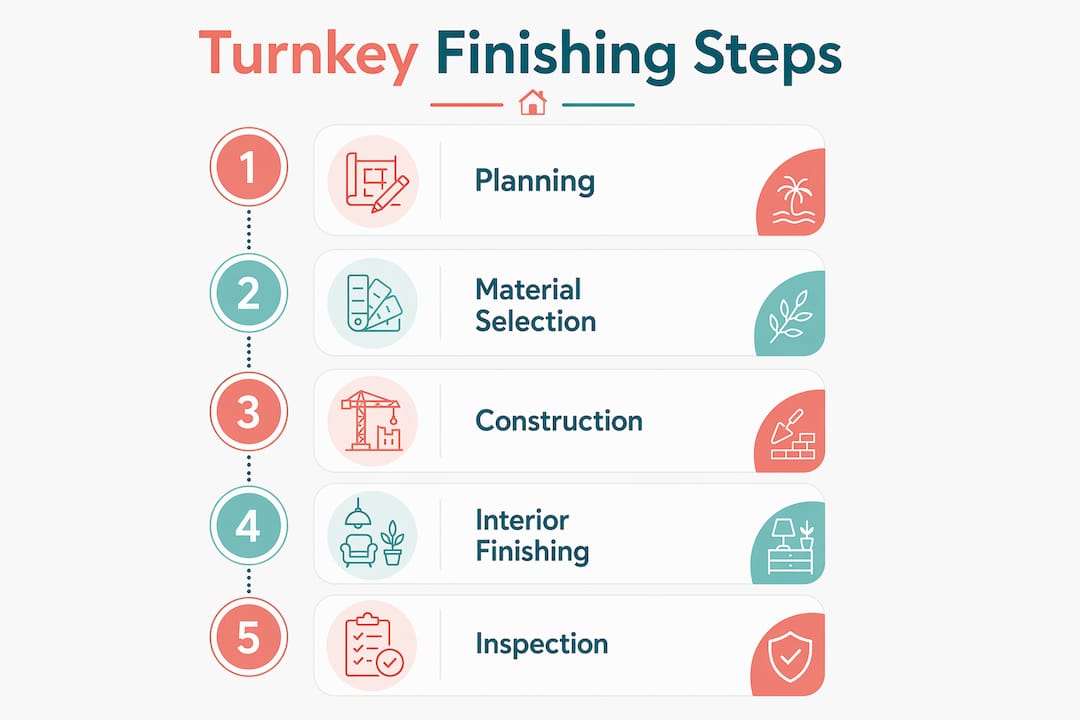
The typical finishing timeline runs 6–12 weeks from project start to ready-to-occupy status. That window covers trades coordination, material delivery, and final inspections.
Pro Tip: Request a written schedule of inclusions from your developer or contractor before signing. Ask specifically whether furniture, appliances, and window coverings are included. Ambiguity in this list costs money.
What are the benefits and drawbacks of turnkey property investment?
Turnkey properties offer a clear set of advantages for investors who prioritize speed and certainty over cost control.
Key benefits:
- Immediate rental income. The property is ready to rent from day one. Turnkey eliminates renovation supervision and secures cash flow faster than a self-managed renovation.
- Single contractor warranty. One party is responsible for the entire finish. Disputes about defects go to one address, not five subcontractors.
- Time savings. Investors avoid weeks of site visits, contractor coordination, and material sourcing. This matters most for buyers who live far from the property or manage multiple assets.
- Predictable upfront cost. The finishing price is agreed in advance, reducing budget overrun risk.
- Reduced decision fatigue. Developers handle material selection, which suits investors who lack interior design experience.
Potential drawbacks:
- Premium pricing. Turnkey finishing costs more than managing the same work independently. That premium compresses the initial return on investment.
- Limited material control. Standard packages use catalog materials. Investors who want specific finishes pay extra or accept what is offered.
- Rent ceiling risk. Premium finishing does not always increase rent proportionally. In cost-sensitive rental markets, tenants will not pay more simply because the kitchen is high-end.
- Hidden delays. The turnkey label does not guarantee instant income. Furnishing gaps and final inspections can push the rental start date back by weeks.
The financial impact is real. A 40 square meter apartment with full turnkey finishing can cost over 100,000 PLN in finishing alone. Combined with 80% bank financing, that level of upfront cost frequently produces negative cash flow in the first years of ownership. Investors need to model this scenario before committing.
Pro Tip: Match your finishing tier to your tenant profile. A student rental market does not reward premium finishes. A corporate relocation market does. Spend where your tenants will actually pay for it.
How does turnkey investment fit into broader real estate strategies?
Turnkey properties sit within what analysts call the “investment-ready product” category. The idea is simple: buy an asset that generates income immediately, without a construction or renovation phase eating into returns. This approach suits passive income investors, overseas buyers, and anyone with limited time to manage a project.
- Assess your capital structure first. High upfront finishing costs affect your loan-to-value ratio and monthly debt service. Model your cash flow at 80% financing before assuming the property will be profitable from month one.
- Factor in the time value of money. Every month a property sits vacant during renovation is a month of lost rent. Turnkey removes that gap, which has real financial value even if the sticker price is higher.
- Evaluate the local rental market before choosing a tier. A premium finish in a market with low rental demand does not recover its cost through higher rent. Real estate trends in 2026 show growing demand for turnkey solutions, but market conditions vary sharply by location.
- Account for hidden delays. Delays after technical handover are common. Furnishing delivery, final punch-list items, and utility connections can push your rental start date back by four to eight weeks. Build that buffer into your financial model.
- Treat turnkey as a convenience premium, not a guarantee. Wealth-holders increasingly choose turnkey because time functions as a luxury good in their investment calculus. That logic is sound. But convenience does not substitute for due diligence on location, tenant demand, and exit value.
The strongest turnkey investments combine a well-located property, a realistic finishing tier matched to local demand, and a financial model that accounts for the full cost of the ready-to-rent package. Investors who skip that analysis often discover the convenience premium was not worth the compressed yield.
How do you evaluate and select the right turnkey property?
Selecting the right turnkey property requires a structured approach. Aesthetics matter less than contract clarity, location fundamentals, and financial math.
Start with the contract. Verify every inclusion in writing. Confirm whether appliances, furniture, window coverings, and outdoor fixtures are part of the package. Contract scope ambiguity is the most common source of investor disappointment in turnkey deals.
Check finishing quality against local market expectations. A mid-range finish in a premium rental market leaves money on the table. A premium finish in a budget rental market destroys yield. Visit comparable rental listings in the area and assess what tenants actually pay for.
Analyze the numbers before you fall in love with the property. Calculate your expected gross rental yield, subtract financing costs, maintenance reserves, and vacancy allowance. If the result is negative in year one, decide whether the long-term appreciation case justifies the short-term loss.
Assess the developer or service provider’s track record. Ask for references from previous turnkey clients. Visit a completed project if possible. A developer who delivers on time and on spec is worth a modest price premium over an unknown contractor.
Consider location and vacancy risk. A turnkey property in a low-demand area is still a low-demand property. Turnkey finishing does not create rental demand where none exists.
| Evaluation factor | What to check |
|---|---|
| Contract inclusions | Full written list of fixtures, appliances, and furniture |
| Finishing tier vs. market | Compare to local rental listings for comparable units |
| Financial model | Gross yield minus financing, maintenance, and vacancy |
| Developer reputation | References, completed projects, warranty terms |
| Location demand | Vacancy rates, tenant profiles, transport links |
Pro Tip: Integrate your turnkey evaluation into your broader portfolio strategy. If you already hold high-yield assets, a lower-yield turnkey property in a stable location can balance risk. If this is your first investment, prioritize location and cash flow over finishing quality.
Key Takeaways
A turnkey property delivers immediate occupancy or rental income, but its financial value depends entirely on matching the finishing tier, location, and contract terms to your specific investment goals.
| Point | Details |
|---|---|
| Turnkey definition | A fully finished property ready for immediate occupancy or rental, requiring no further renovation work. |
| Finishing costs vary | Standard to mid-range finishing runs 2,500–4,500 PLN per sq m; premium exceeds 5,000 PLN per sq m. |
| Labor drives cost | Labor comprises nearly 50% of finishing cost, limiting material choices in standard packages. |
| Contract clarity is critical | Turnkey has no statutory definition; always verify inclusions for furniture, appliances, and fixtures in writing. |
| Premium finish ≠ higher rent | In cost-sensitive markets, premium finishing does not produce proportional rental income growth. |
The real cost of convenience in turnkey investing
Turnkey properties are genuinely useful tools for time-pressed investors. I have seen buyers save months of project management stress by choosing a finished property over a raw developer shell. That time saving is real, and for investors managing multiple assets or living abroad, it often justifies the price premium.
What concerns me is the assumption that turnkey equals effortless profit. The investors I have watched struggle with turnkey deals share one pattern: they bought the convenience without doing the underlying financial work. They assumed the premium finish would command premium rent. In many markets, it does not. Tenants in mid-range rental segments do not pay extra for designer tiles.
The other risk is the hidden delay problem. A property labeled turnkey can still sit empty for six to eight weeks after handover while furniture is delivered, utilities are connected, and minor defects are fixed. That gap matters when your mortgage clock is already running.
My honest recommendation: treat the turnkey premium as a line item in your investment model, not a feature. If the numbers work after accounting for higher upfront cost, financing charges, and a realistic vacancy buffer, then turnkey is a strong choice. If the numbers only work when you ignore those factors, the convenience is costing you more than it is worth. Use the property investment tips available for 2026 to stress-test your assumptions before you commit.
— Oscar
Luxury turnkey properties on the Costa Dorada
Costacambrils specializes in luxury real estate on the Costa Dorada, with a curated portfolio of new-build villas, apartments, and townhouses in Cambrils and the surrounding area. Many of these properties are delivered at premium finishing levels, ready for immediate occupancy or rental income. The team at Costacambrils provides full legal advisory, property valuation, and asset management services alongside each transaction. For investors seeking a luxury real estate agency with deep local market knowledge, Costacambrils offers the expertise to match the right property to your financial goals. Contact the team directly for a personalized property selection tailored to your investment profile.
FAQ
What is the turnkey property definition in real estate?
A turnkey property is a fully finished home or apartment ready for immediate occupancy or rental without any additional renovation. The buyer or investor simply moves in or places a tenant from day one.
How long does turnkey finishing typically take?
Turnkey finishing typically takes 6–12 weeks from project start to ready-to-occupy status. Hidden delays from furnishing delivery or utility connections can extend this window further.
Does turnkey finishing always include furniture?
No. Mobile furniture is excluded from most turnkey contracts unless explicitly stated. Always request a written list of inclusions before signing any agreement.
What are the main benefits of turnkey rental properties?
The main benefits are immediate rental income, a single contractor warranty, predictable upfront costs, and no need for personal renovation supervision. These advantages suit investors who prioritize speed and certainty over maximum cost control.
Is premium turnkey finishing worth the extra cost?
Premium finishing is worth the cost only when the local rental market supports higher rents. In cost-sensitive markets, premium finishes rarely increase rent proportionally, which compresses your return on investment.