
TL;DR:
- Property ownership structures determine who holds legal title and benefits financially from real estate. Understanding the distinction between legal estate and beneficial interest is crucial for protecting investments across jurisdictions. Choosing the appropriate ownership model before purchasing prevents inheritance, tax, and creditor risks later.
Property ownership structures are defined as the legal frameworks that determine who holds title to real estate, who benefits financially, and how rights transfer upon sale, death, or dispute. Every international investor and homeowner needs to understand this distinction before signing any deed. The core split is between legal estate, which is the name recorded on a public title register, and beneficial interest, which is who actually profits from or occupies the property. These two layers can be held separately, creating rights and obligations that no standard property search will reveal. Explaining property ownership structures clearly is the first step toward protecting your investment across any jurisdiction.
What are the main types of property ownership structures?
The five primary property ownership types recognized across common law countries are sole ownership, joint tenancy, tenancy in common, tenancy by the entirety, and community property. Each model assigns rights, responsibilities, and inheritance outcomes differently. Choosing the wrong one at the time of purchase can cost you far more than any legal fee.
Sole ownership
Sole ownership means one individual holds the complete legal title. Under fee simple absolute, the dominant form in common law countries, that person controls, enjoys, and disposes of the property without restriction. This structure suits single investors who want total control and no co-owner complications.

Joint tenancy vs. tenancy in common
These two co-ownership models look similar on the surface but produce very different outcomes.
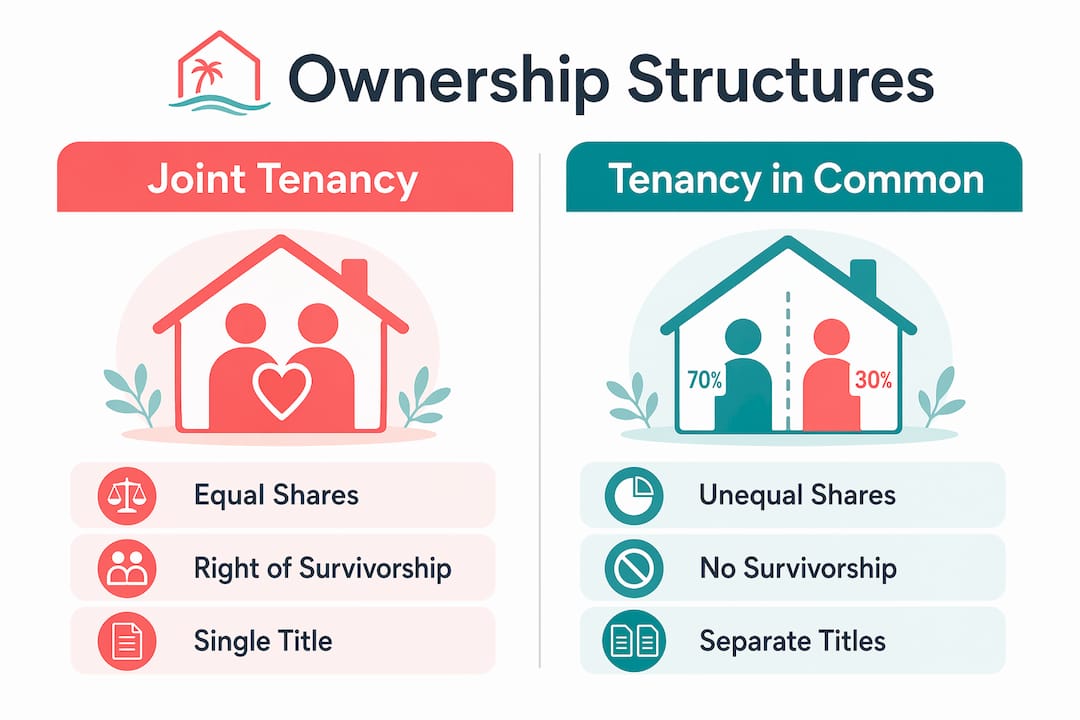
| Feature | Joint tenancy | Tenancy in common |
|---|---|---|
| Share size | Equal shares required | Unequal shares allowed (e.g., 70/30) |
| Survivorship | Automatic right of survivorship | No survivorship; share passes by will |
| Probate | Bypasses probate | Goes through probate |
| Creditor exposure | Creditors can reach the share | Same exposure unless protected by structure |
| Best for | Spouses or equal partners | Investors with different capital contributions |
Tenancy in common allows ownership percentages like 70/30, making it the preferred structure for investors who contribute unequal capital. Joint tenancy requires equal ownership and triggers automatic survivorship, which bypasses a deceased owner’s will entirely.
Tenancy by the entirety and community property
Tenancy by the entirety is available only to married couples in certain U.S. states. It provides a meaningful creditor protection: one spouse’s individual creditors generally cannot force a sale of the jointly held property. Community property is a separate system recognized in states like California, Texas, and Arizona, where assets acquired during marriage are owned equally by both spouses by default. International investors buying in the United States need to know which system applies in their target state before structuring any purchase.
Pro Tip: If you are buying with a business partner rather than a spouse, tenancy in common almost always serves you better than joint tenancy. It lets you specify ownership percentages in writing and direct your share to your own heirs.
How do legal estate and beneficial interest differ?
Legal title does not guarantee financial benefit. The legal estate is what appears on public registers such as HM Land Registry in the United Kingdom or county deed records in the United States. The beneficial interest is who actually profits from the property, whether through rental income, appreciation, or occupation rights. These two layers are often held by different parties through trust documents or private agreements.
This separation creates real risk for investors who do not look beyond the title register. Consider a scenario where a developer transfers legal title to a holding company but retains beneficial interest through a side agreement. A buyer who only checks the public register misses that claim entirely. Viewing ownership as a bundle of rights helps investors understand that any of those rights, including the right to occupy, to receive income, or to sell, can be divided, pledged, or sold separately.
The practical risks of this separation include:
- Hidden beneficial claims: A prior occupant or family member may hold an undocumented beneficial interest that survives a sale.
- Trust complications: Legal owners may hold property on trust for beneficial owners, creating fiduciary duties that bind them even if the trust is not publicly recorded.
- Cross-border conflicts: An investor managing property across Spain, the United Kingdom, and the United States faces three different legal systems, each treating the legal/beneficial split differently.
- Financing obstacles: Lenders often require clarity on both layers before approving a mortgage, and undisclosed beneficial interests can block or delay funding.
Pro Tip: Always request a full title search and a written declaration of trust when buying property with any co-owner. A declaration of trust records each party’s beneficial interest in writing and prevents disputes if the relationship breaks down.
What are the legal and financial implications of ownership structures?
The ownership model you choose at closing shapes your tax position, your estate plan, and your exposure to creditors for the entire life of the investment. Getting this right at the start costs a few hundred dollars in legal fees. Getting it wrong can cost you the asset.
Survivorship and wills: The right of survivorship in joint tenancy bypasses probate and can unintentionally disinherit heirs. If you hold a property as a joint tenant and want your share to pass to your children rather than your co-owner, joint tenancy actively works against you.
Inheritance flexibility: Tenancy in common allows each co-owner to direct their share through a will. This is the structure of choice for investors who want to pass specific percentages to specific heirs.
Creditor protection: Tenancy by the entirety shields the marital property from one spouse’s individual creditors in states that recognize it. Community property states offer a different but related set of protections that vary by jurisdiction.
Tax consequences: Different ownership models trigger different capital gains treatments, gift tax rules, and estate tax calculations. In Spain, for example, the transfer of a property share between co-owners can generate a taxable event even without a cash payment.
Title defects: Holding a deed does not guarantee clean ownership if the title chain has defects. Practitioners verify title through comprehensive searches and title insurance, not through the deed alone.
“Choosing between joint tenancy and tenancy in common can dramatically affect estate and creditor outcomes.” — LegalClarity
Pro Tip: Never select a vesting method without consulting an estate planning attorney first. Many investors make costly errors by treating ownership structure as a formality rather than a strategic decision.
How can international investors choose the right ownership model?
Choosing the right property title structure requires matching your legal environment, your investment goals, and your relationship with any co-owners. No single model works for every situation, and the correct answer often differs between countries.
Key considerations before you commit to any structure:
- Jurisdictional rules: Spain, the United Kingdom, and the United States each treat co-ownership, beneficial interest, and survivorship differently. Confirm which rules apply in your target market before structuring the purchase.
- Estate planning goals: If passing the asset to specific heirs matters to you, tenancy in common with a clear will is almost always the right choice. Joint tenancy can override your will without warning.
- Investor relationships: Business partners with unequal capital contributions need a structure that reflects those percentages. A property co-ownership agreement should document shares, decision rights, and exit terms in writing.
- LLC or corporate holding: Many international investors hold property through a limited liability company or a Spanish Sociedad Limitada. This separates personal liability from the asset, simplifies ownership transfers, and can offer tax advantages. The trade-off is added administrative cost and potential loss of certain personal tax exemptions.
- Title insurance: Title insurance protects against defects missed during title searches, including hidden beneficial interest claims. Treat it as mandatory, not optional.
Common pitfalls to avoid:
- Assuming the deed equals full ownership without verifying the title chain.
- Failing to record a declaration of trust when co-owners hold unequal beneficial interests.
- Ignoring local inheritance law, which in Spain can override a foreign will under certain conditions.
- Skipping a smart buyer checklist that covers title verification, beneficial interest disclosure, and ownership structure review.
Pro Tip: When buying luxury property in Spain as a non-resident, always confirm whether your home country’s tax treaty with Spain affects how your ownership structure is taxed on rental income and capital gains. The answer changes your optimal structure.
Key takeaways
The most effective approach to property ownership is choosing your legal structure before you sign, not after, because every ownership model carries distinct inheritance, tax, and creditor consequences that are difficult to reverse.
| Point | Details |
|---|---|
| Legal estate vs. beneficial interest | These two layers can be held separately; always verify both through title searches and trust documents. |
| Joint tenancy risk | Right of survivorship bypasses your will and can disinherit intended heirs without any court involvement. |
| Tenancy in common flexibility | Unequal shares and direct inheritance make this the preferred model for most investment partners. |
| Title insurance is mandatory | Public registers omit beneficial interest details; title insurance covers defects that searches miss. |
| Get legal advice before vesting | Selecting an ownership structure without an attorney is the most common and costly investor mistake. |
Why I think most investors underestimate ownership structure decisions
After working with international buyers across the Costa Dorada for years, I keep seeing the same pattern. Buyers spend weeks comparing floor plans and negotiating price, then spend about ten minutes deciding how to hold the title. That imbalance is where most legal problems are born.
The uncomfortable truth is that ownership structure is not a paperwork formality. It is the legal foundation of your entire investment. I have seen joint tenancy arrangements unintentionally cut children out of an inheritance because the surviving co-owner took the whole asset through survivorship. I have seen undisclosed beneficial interests surface after closing and tie a property up in litigation for years. Both situations were entirely preventable.
What actually works is treating the ownership decision with the same rigor you apply to due diligence on the property itself. That means a written declaration of trust for any co-ownership, a title insurance policy, and a conversation with an estate planning attorney who knows both your home jurisdiction and the country where you are buying. The cost of that advice is trivial compared to the cost of unwinding the wrong structure after a death or dispute.
The legal landscape around beneficial interests is also evolving. Spain, the United Kingdom, and the United States are all tightening disclosure requirements for property held through corporate entities. Investors who set up structures five years ago may find those structures no longer offer the protections they expected. An annual review of your ownership model is not excessive. It is basic risk management.
— Oscar
How Costacambrils supports international investors on ownership decisions
International buyers in the Costa Dorada face a specific challenge: Spanish property law, local tax rules, and cross-border estate planning all intersect at the moment of purchase. Getting that intersection right requires more than a standard real estate transaction.
Costacambrils works directly with international investors to clarify ownership options before any offer is made. The team covers legal title structures, beneficial interest documentation, and the tax implications of holding luxury property in Cambrils and the surrounding Costa Dorada region. Whether you are buying as an individual, through a co-ownership arrangement, or via a corporate entity, Costacambrils connects you with the right legal and fiscal advisors. Explore the full range of luxury real estate services available to international clients, or speak directly with the team about structuring your next acquisition correctly from day one.
FAQ
What is the difference between legal title and beneficial interest?
Legal title is the ownership recorded on a public register such as a land registry or county deed. Beneficial interest is the right to profit from or occupy the property, which can be held by a different person through a trust or private agreement.
Which ownership structure is best for international co-investors?
Tenancy in common is generally the best fit for international co-investors because it allows unequal ownership shares and lets each party direct their interest to their own heirs through a will.
Does joint tenancy override a will?
Yes. The right of survivorship in joint tenancy transfers the deceased owner’s share directly to the surviving co-owner, bypassing the will and probate entirely.
Is title insurance necessary when buying abroad?
Title insurance is necessary because public registers often omit beneficial interest details and hidden encumbrances. It protects buyers against defects that even thorough title searches can miss.
Can a corporate entity hold property instead of an individual?
Yes. Holding property through an LLC or a Spanish Sociedad Limitada separates personal liability from the asset and can simplify ownership transfers, though it adds administrative costs and may affect personal tax exemptions.