
TL;DR:
- The fastest way to transfer property in Central Europe is to choose the correct method, then follow the sequence of notarization, tax clearance, and land registry inscription. Properly completing these steps ensures the transfer is legally valid and protected against third-party claims, while skipping or reversing steps risks complications.
The fastest safe way to transfer property ownership in Central Europe is to choose the right method (sale, deed transfer, gift, joint survivorship, or beneficiary registration), then complete notarization, tax clearance, and land-registry inscription in that exact order. Skip or reverse any of those steps and you risk a transfer that is legally incomplete, unenforceable against third parties, or blocked at the registry.
Here is what you can do today:
- Pull a current land-registry extract (nota simple or equivalent) to confirm who the legal owner is and whether any mortgages, embargoes, or liens are attached.
- Check for encumbrances. If a mortgage exists, contact the lender before drafting anything.
- Gather your title deed (escritura) and any prior transfer documents.
- Book a notary appointment. Most notaries can advise on the correct deed type before you commit to a method.
- Consult a tax advisor about local exemptions before signing. Regional rates and family-status exemptions vary widely and can save you thousands.
One warning: if the title is disputed, the property has unknown encumbrances, or ownership crosses borders, stop and hire a property lawyer before taking any other step.
Table of Contents
- What legal methods can you use to transfer property?
- How do you transfer property during your lifetime, step by step?
- How does property transfer after the owner dies?
- What costs and taxes should you budget for?
- What documents do you need to complete a transfer?
- How long does a property transfer usually take?
- How can you simplify or avoid probate?
- What are the red flags to watch for in any property transfer?
- When do you need a notary or property lawyer, and what should you ask?
- How do you coordinate notary, land registry, cadastre, and municipal offices?
- Key Takeaways
- What practitioners know that the statutes do not say
- Where to find authoritative rules, registries, and local tax rates
What legal methods can you use to transfer property?
The method you choose shapes every document, tax, and timeline that follows. Central European systems generally recognize five main routes.
Sale (paid transfer). The most common path. Buyer and seller agree on a price, sign a purchase deed before a notary, and the buyer pays the applicable transfer tax before presenting the deed to the land registry. Ownership passes legally once the registry inscribes the deed, not merely when the notary signs it.
Deed transfer or assignment. A transfer of title without a full sale transaction, often used between related parties or to restructure ownership within a company. The mechanics mirror a sale but the consideration (price) may be nominal or absent.
Lifetime gift or donation. The owner transfers the property to a recipient for free. Donations typically require notarization and immediate tax filing. Some regions impose a one-month window to submit donation tax forms, so timing matters. The recipient takes on the property’s tax history, and the donor may trigger a capital gains event even though no money changed hands.
Joint ownership with survivorship rights. Two or more people hold title together, and when one dies, the survivor automatically inherits the deceased’s share without a formal probate process. The catch: neither owner can sell or mortgage without the other’s consent while both are alive.
Beneficiary registration or transfer-on-death. Not universally available across Central Europe, but where it exists, an owner designates a beneficiary who receives the property on death outside the probate estate. It avoids succession formalities but does not protect against the owner’s creditors during their lifetime.
A note on non-warranty transfers: the U.S. quitclaim deed has a rough equivalent in some Central European systems, a limited transfer that removes seller guarantees. It moves the interest quickly, but without registry protection the buyer is exposed to title risks the registrar would otherwise catch. Use it only when you fully understand what you are giving up.
Why does registration matter so much? Because the registrar’s calificación checks for hidden defects, liens, and formal errors before inscription, and that inscription is what gives the new owner legal protection against third-party claims. A notarized deed alone does not achieve that. Land-registry systems across Central Europe differ in their exact procedures, but the core principle holds: registration is what “blinds” the title.
How do you transfer property during your lifetime, step by step?
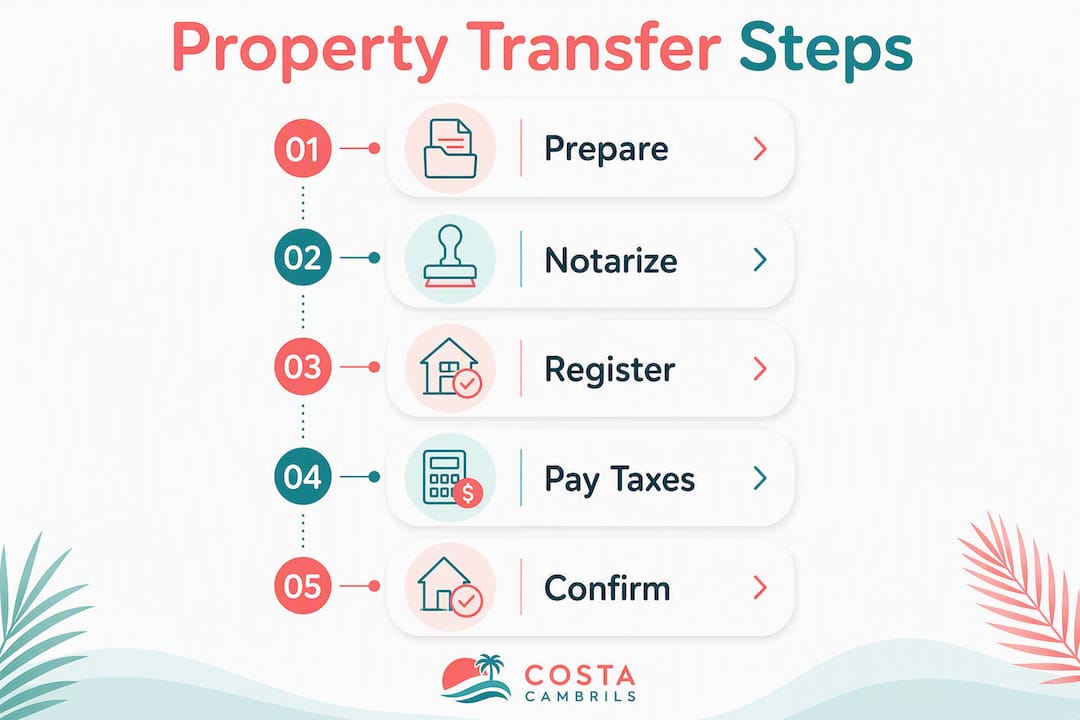
This is the sequence for a standard lifetime transfer, whether a sale, deed assignment, or gift. Each step has a clear owner.
Confirm title and order a current registry extract. Request an up-to-date nota simple or equivalent from the land registry. It shows the current registered owner, the cadastral reference, and any encumbrances. Do this before any negotiation concludes.
Clear or notify the mortgagee. If a mortgage is registered, either cancel it (with the lender’s certificate of cancellation) or obtain the lender’s written consent to the transfer. A registry will not inscribe a transfer over an active mortgage without proper documentation.
Draft the deed or donation agreement. For a sale, this is the escritura de compraventa. For a gift, it is the escritura de donación. Both require a notary to formalize them as a public instrument. Private contracts are insufficient for registry purposes in most Central European jurisdictions.
Sign before the notary. All parties (or their authorized representatives via certified power of attorney) must appear. The notary verifies identities, reads the deed aloud, and certifies the signatures. For the notary’s full role in this process, including fee structures and what to expect on signing day, Costacambrils has a detailed breakdown.
Pay transfer taxes and fees. Depending on the transfer type, this means ITP (Impuesto de Transmisiones Patrimoniales) for resale properties, VAT plus AJD (Actos Jurídicos Documentados) for new builds, or donation tax for gifts. Tax receipts must accompany the deed when you present it to the registry. Missing tax clearance receipts can block inscription.
Submit the deed and tax receipts to the land registry. The registrar performs the calificación, a formal legal review that typically takes several working days from presentation, though actual times vary by registry. Once approved, the deed is inscribed and the new owner appears on the register.
Update the cadastre and municipal records. After registry inscription, notify the cadastre of the ownership change. Then update utility contracts and, where required, notify the municipal tax office so future property tax (IBI) bills go to the correct owner.
Documents to have ready at each stage: current registry extract, national IDs for all parties, original title deed, mortgage cancellation certificate or lender consent, proof of tax payment, cadastral reference, and any power of attorney if a representative is signing.
Pro Tip: Ask your notary to handle the registry submission directly and to bundle the tax payment receipts with the filing packet. Notaries in Spain and much of Central Europe can submit electronically, which cuts days off the process and reduces the risk of a missing document rejection.
How does property transfer after the owner dies?
Whether probate or a simplified succession procedure applies depends on how the property is titled and the local rules of the jurisdiction. The first thing heirs should do is obtain the death certificate, secure the property physically, and pull a current land-registry extract to confirm what is registered and in whose name.
Here is the typical sequence for a death-time transfer:
Obtain the death certificate and will (if one exists). In Spain and much of Central Europe, the will is registered in a national notarial registry. Request a certificate of last will (certificado de últimas voluntades) to confirm whether a will exists and which notary holds it.
Open the estate. The executor named in the will (or an administrator appointed by the court in intestacy) inventories the assets, including real property, and notifies creditors.
Validate the will or establish intestacy rights. If there is a will, the executor presents it to the notary for acceptance. If there is no will, the heirs must establish their rights through a declaration of intestate heirs (declaración de herederos), which requires a notary or court proceeding depending on the jurisdiction.
Complete the formal succession or probate procedure. In Spain, most uncontested successions are handled by a notary rather than a court. Contested estates or those involving minors typically require judicial intervention. Deadlines matter: heirs generally have six months from the date of death to file and pay inheritance tax, with extensions possible but not automatic.
Pay inheritance tax and any municipal levies. Inheritance tax rates and exemptions vary dramatically by autonomous community in Spain. Some regions offer near-full exemptions for direct descendants; others do not. Pay before presenting documents to the registry.
Register the new owners at the land registry. Present the notarized deed of acceptance of inheritance (escritura de aceptación de herencia), the inheritance tax receipt, and the death certificate. The registrar performs calificación and inscribes the new owners.
Update the cadastre and municipal records. Same final steps as a lifetime transfer: notify the cadastre, update IBI billing, and change utility accounts.
For the legal requirements specific to buying or inheriting in Spain, Costacambrils has a dedicated guide covering documentation and regional tax checks.
What costs and taxes should you budget for?
Tax planning is where most people leave money on the table. Using an outdated regional rate or missing a family-status exemption can cost sellers or heirs thousands, and the error is often discovered only after signing.
Here are the main cost categories to account for:
- Transfer tax (ITP). Applies to resale property sales. Rates vary by autonomous community and are calculated as a percentage of the declared transfer price or the tax authority’s reference value, whichever is higher.
- VAT and AJD. New-build purchases attract VAT (10% for residential properties in Spain) plus AJD. AJD also applies to certain mortgage deeds.
- Notary fees. Set by a regulated fee schedule (arancel notarial) based on the declared value of the transaction. Typically paid by the buyer in a sale, but negotiable in other transfer types.
- Land-registry fees. Also regulated by arancel, scaled to the transaction value.
- Municipal levy (plusvalía). A local tax on the increase in urban land value since the last transfer. Paid by the seller in a sale, by the heir in a succession. The calculation method changed after a 2021 Constitutional Court ruling in Spain, so verify the current local formula with your municipality.
- Capital gains tax. The transferor may owe tax on the gain between the original acquisition cost and the current transfer value. Exemptions exist for primary residences under certain conditions.
- Donation tax. For gifts, the recipient pays donation tax. Rates and exemptions depend on the autonomous community and the family relationship between donor and recipient.
- Professional fees. Lawyer and real estate agent fees are not regulated in the same way as notary or registry fees. Get a written quote before engaging.
Regional transfer tax exemptions for age, disability, large families, and first-home purchases exist in many autonomous communities. Check with the relevant regional tax authority before signing anything. Also confirm that regional and municipal taxes are fully liquidated before presenting the deed to the registry, because unpaid receipts block inscription.
This article provides general information, not professional tax or legal advice. Verify current rates and exemptions with the relevant tax authority or a qualified advisor before signing.
What documents do you need to complete a transfer?
Arriving at the notary without a complete document set is the single most common cause of a delayed closing. Here is the full checklist:
For all transfers:
- Valid national ID or passport for all parties (and NIE for foreign nationals in Spain)
- Up-to-date land-registry extract (nota simple), ordered within the last 30 days
- Original title deed (escritura) or certified copy
- Cadastral reference number and cadastral certificate
- Proof of payment of IBI (annual property tax) for the current year
- Mortgage statement and lender’s cancellation certificate or written consent (if mortgaged)
- Proof of payment of community fees (if the property is in a homeowners’ community)
- Tax clearance receipts for all applicable transfer taxes
Additional documents for transfers after death:
- Death certificate
- Certificate of last will (certificado de últimas voluntades)
- Notarized deed of acceptance of inheritance
- Inheritance tax payment receipt
- Court or notarial declaration of intestate heirs (if no will)
Additional documents for gifts:
- Donation tax forms and payment receipt
- Donor’s proof of ownership and tax clearance
Additional documents for corporate owners:
- Company registration documents and articles of association
- Board resolution authorizing the transfer
- Authorized signatory’s ID and proof of authority
If using a representative:
- Certified power of attorney (poder notarial), apostilled if issued abroad
Pro Tip: Ask the notary for a municipality-specific document checklist at your first consultation. Requirements can differ between autonomous communities and even between local registries. One call saves multiple trips.

How long does a property transfer usually take?
| Stage | Typical duration | Notes |
|---|---|---|
| Negotiation and agreement | 1–4 weeks | Longer if financing is involved |
| Notarization | several working days from draft to signing | Faster if documents are complete |
| Tax clearance (ITP/AJD/donation tax) | several working days | Depends on regional tax office load |
| Registry submission and calificación | several working days from presentation | Can extend during peak periods |
| Cadastral update | a few weeks after registry inscription | Often handled automatically by the registry |
| Municipal formalities (plusvalía, IBI update) | a few weeks | Varies by municipality |
| Probate/succession (uncontested) | several months from death | Longer if contested or judicial |
The most common causes of delay are missing documents at the registry, outstanding mortgages or liens that were not cleared before submission, unpaid municipal taxes, and mismatches between the cadastral description and the registry record. A discrepancy as small as a wrong surface area can trigger a calificación defect notice and send the file back to the notary.
To move faster: pre-request the registry extract and cadastral certificate at least two weeks before the planned signing date, pay taxes as soon as the deed is drafted (not after signing), and ask the notary to submit the deed to the registry electronically on the day of signing. For a detailed look at the real estate legal process workflow, Costacambrils has a practitioner-level breakdown of each stage.
How can you simplify or avoid probate?
Probate and formal succession procedures take time and cost money. Several planning tools can reduce or eliminate them, but each comes with trade-offs.
| Method | Who keeps control | Tax event | Probate impact |
|---|---|---|---|
| Joint tenancy with survivorship | Both owners jointly; neither can act alone | Possible capital gains on survivor’s acquisition | Survivor inherits automatically; no probate for that share |
| Lifetime gift | Recipient (donor loses control); Donation tax for recipient; possible capital gains for donor | Property leaves estate entirely | |
| Beneficiary registration (where available) | Owner retains full control until death | Inheritance tax for beneficiary on death | Bypasses probate for that asset |
| Trust (where permitted) | Trustee manages; beneficiaries benefit | Depends on trust structure and jurisdiction | Can remove assets from probate estate |
Joint tenancy is the most widely used tool in Central Europe for couples and family co-owners. The survivor takes the deceased’s share without a succession procedure, which is fast and cheap. The downside: neither owner can sell, mortgage, or gift their share without the other’s written consent. That constraint can become a serious problem if the relationship breaks down.
Lifetime gifting removes the property from the estate entirely, which eliminates probate for that asset. But the donor loses control immediately, the recipient pays donation tax (sometimes at rates higher than inheritance tax, depending on the region and family relationship), and the donor may face a capital gains event. Gifts made close to death can also be challenged by forced heirs (legitimarios) under Spanish and many Central European succession laws.
Beneficiary registration is the cleanest probate-avoidance tool where it exists, because the owner keeps full control during their lifetime. The property passes on death without entering the probate estate, though the beneficiary still owes inheritance tax.
One caution that applies to all of these: creditors of a joint owner or a donor can sometimes reach the transferred property. Get legal advice before using any of these tools for a high-value asset or a complicated family situation.
What are the red flags to watch for in any property transfer?
Most transfers go smoothly. The ones that do not usually show warning signs early. Stop and investigate if you encounter any of the following:
Missing or inconsistent registry records. If the seller cannot produce a current registry extract, or if the extract does not match the property description in the deed, do not proceed until the discrepancy is resolved.
Undisclosed mortgages or encumbrances. A current nota simple reveals mortgages, embargoes, prohibitions to dispose, and judicial liens. Order one within 30 days of signing, not months before.
Unpaid municipal taxes or community fees. Unpaid IBI, plusvalía from a prior transfer, or community fee arrears attach to the property, not the person. You can inherit someone else’s debt without knowing it.
Absent seller consent where required. In a marriage or registered partnership, both spouses may need to consent to a transfer of the family home, regardless of whose name is on the title. Missing consent can void the transaction.
Discrepancies between cadastral and registry descriptions. Surface area, plot boundaries, or building descriptions that differ between the two records signal an unresolved regularization issue. Resolving it after purchase is expensive and slow.
Forged signatures or identity fraud. For high-value transfers, insist on in-person notarization. If a party cannot appear, require an apostilled power of attorney from a notary in their country of residence. Never accept a scanned or unverified signature on a transfer deed.
If you spot any of these, stop the transaction, order a fresh registry extract, request the seller’s proof of tax clearance, and consult a property lawyer before proceeding.
When do you need a notary or property lawyer, and what should you ask?
A notary is required for most formal property transfers in Central Europe. A property lawyer is optional but worth the cost in specific situations.
Hire a lawyer when:
- The title is disputed or the ownership history is unclear
- The property has multiple co-owners with conflicting interests
- The transfer involves assets in more than one country
- The estate includes forced heirs (legitimarios) who may challenge the transfer
- A mortgage needs to be cancelled or restructured as part of the deal
- The tax exposure is significant and the regional rules are complex
For why legal advice matters specifically in Costa Dorada real estate deals, Costacambrils has a practical guide covering when to engage and what to expect.
Questions to ask your notary or lawyer at the first meeting:
- What is the expected timeline from today to registry inscription?
- Will you handle the registry submission, or do I need to do that separately?
- Do I need a tax advisor, or can you advise on applicable exemptions?
- What is your fee structure, and what does it include?
- Are there any conflict-of-interest issues I should know about?
- Who pays for registry fees, tax payments, and any third-party costs?
- Can you provide a written engagement letter listing all deliverables and fees?
That last point is not optional. A written engagement letter protects both sides and prevents disputes over what was agreed. Any professional who resists putting the scope in writing is a red flag in itself.
How do you coordinate notary, land registry, cadastre, and municipal offices?
The four institutions involved in a property transfer do not operate as a single system. They exchange information, but the coordination is not automatic, and gaps between them are where transfers stall.
Here is the typical flow:
Notary formalizes the deed. The notary verifies identities, drafts and reads the deed, and certifies signatures. In Spain, the notary also has access to the registry and cadastre systems and can pre-check for discrepancies before signing day.
Deed is submitted to the land registry. The notary can do this electronically on the day of signing, or the parties can submit manually. Either way, the deed must be accompanied by proof that all applicable taxes have been paid or presented (presentación fiscal).
Registrar performs calificación. The registrar reviews the deed for legal defects, checks for encumbrances, and verifies that the cadastral reference matches the registry record. If everything is in order, the deed is inscribed. If not, a defect notice (nota de calificación) is issued and the file goes back to the notary for correction.
Registry communicates with the cadastre. After inscription, the registry notifies the cadastre of the ownership change. This is largely automated in Spain, but the cadastral record may take additional weeks to update.
Municipal formalities. The plusvalía (municipal land value increment tax) must be paid to the local municipality, not the regional tax authority. This step is separate and must be completed within the statutory deadline (typically 30 days from the transfer date for sales, six months for inheritances). Unpaid plusvalía does not block registry inscription in all cases, but it can create a lien on the property.
Pro Tip: Ask your notary to pre-validate registry requirements and confirm the cadastral reference matches the registry description before the signing appointment. Bundling the tax payment receipts into the closing packet and submitting everything electronically on signing day is the single most effective way to cut weeks off the total timeline.
Mismatches between the cadastral reference and the registry plot description are the most common source of calificación defects. If the surface area in the registry differs from the cadastre by more than a small tolerance, the registrar will flag it. Resolving that discrepancy requires a separate geodetic survey and a rectification procedure, which can add months. Catch it before signing, not after.

Key Takeaways
Transferring property ownership in Central Europe requires choosing the right method, completing notarization and tax clearance, and registering at the land registry in that exact sequence to achieve full legal protection against third parties.
| Point | Details |
|---|---|
| Choose the right method first | Sale, gift, joint survivorship, and beneficiary registration each trigger different taxes, timelines, and formalities. |
| Registry inscription is the finish line | A notarized deed alone does not protect against third-party claims; only land-registry inscription does. |
| Order a nota simple before anything | A current registry extract reveals mortgages, liens, and encumbrances that could block or void the transfer. |
| Pay taxes before submitting to the registry | Regional transfer taxes and municipal levies must be liquidated and presented with the deed; missing receipts block inscription. |
| Get professional help for complex cases | Disputed titles, cross-border assets, forced heirs, or high tax exposure all require a property lawyer, not just a notary. |
What practitioners know that the statutes do not say
The formal legal sequence for a property transfer is well documented. What is less obvious is where the process actually breaks down in practice.
The most consistent pattern: clients arrive at the notary with an outdated registry extract, sometimes months old, and discover an encumbrance that was registered after they started negotiating. A nota simple ordered the week before signing would have caught it. That single habit, ordering a fresh extract close to signing day, prevents more failed transactions than any other precaution.
The second pattern is tax timing. Many buyers and heirs treat tax payment as something to handle after the deed is signed, at their convenience. It is not. Regional tax offices have statutory deadlines, and some municipalities have very short windows for plusvalía filings. Miss the deadline and you face surcharges that eat directly into the deal’s economics. The smarter move is to calculate the tax liability during the drafting phase, prepare the payment, and submit it the same day as the deed signing.
The third pattern is the cadastre-registry mismatch. Properties in older urban areas often have surface areas in the registry that predate modern geodetic surveys. The cadastre may show a different figure. Neither authority will automatically fix the other’s record. If you are buying or inheriting a property with this discrepancy, budget for a regularization procedure and factor the time into your closing timeline.
Bring the checklist in this article to your first meeting with a notary or lawyer. It will save time, signal that you are prepared, and give the professional a clear starting point for identifying what is missing in your specific case. Costacambrils works with buyers and sellers across the Costa Dorada on exactly these coordination challenges. If you are transferring a luxury property in Cambrils or the surrounding area and want a professional valuation alongside the legal coordination, that is a natural first step.
Where to find authoritative rules, registries, and local tax rates
| Authority | What it provides | Where to access |
|---|---|---|
| Registro de la Propiedad | Land-registry inscription, nota simple requests, calificación procedures | Ministry of Justice portal; individual registry offices by municipality |
| Catastro (Spanish Cadastre) | Cadastral certificates, reference numbers, surface area data, ownership update procedures | Online portal; free cadastral certificate downloads |
| Regional tax authority (Agencia Tributaria autonómica) | ITP, AJD, donation tax, and inheritance tax rates, forms, and exemptions | Each autonomous community’s tax agency website |
| Municipal tax office (Ayuntamiento) | Plusvalía calculation and payment, IBI billing updates, local levy deadlines | Local municipality website or in-person office |
| Consejo General del Notariado | Notary locator, fee schedule (arancel notarial), and guidance on deed types | notariado.org |
| Spanish Tax Agency (AEAT) | Capital gains tax, non-resident income tax (IRNR), and international tax treaties | aeat.es; also relevant for cross-border owners |
For the nota simple specifically: you can request one online through the Colegio de Registradores portal (registradores.org) or in person at the registry office where the property is located. The online version is delivered within one to three working days and is sufficient for most pre-signing checks.
Always verify the local municipality’s deadline for municipal levies before signing. Deadlines differ between autonomous communities and between transfer types (sale versus inheritance versus gift). The municipal tax office website is the authoritative source; do not rely on general guides that may reflect outdated rules.
Recommended
- Property Inspection Explained: What Every Buyer Should Know – Inmobiliaria Costa Cambrils
- Property Buying Checklist: Steps for Smart Buyers in 2026 – Inmobiliaria Costa Cambrils
- Defining Luxury Home Amenities: A 2026 Central Europe Guide – Inmobiliaria Costa Cambrils
- Explaining Property Ownership Structures: Investor’s Guide – Inmobiliaria Costa Cambrils