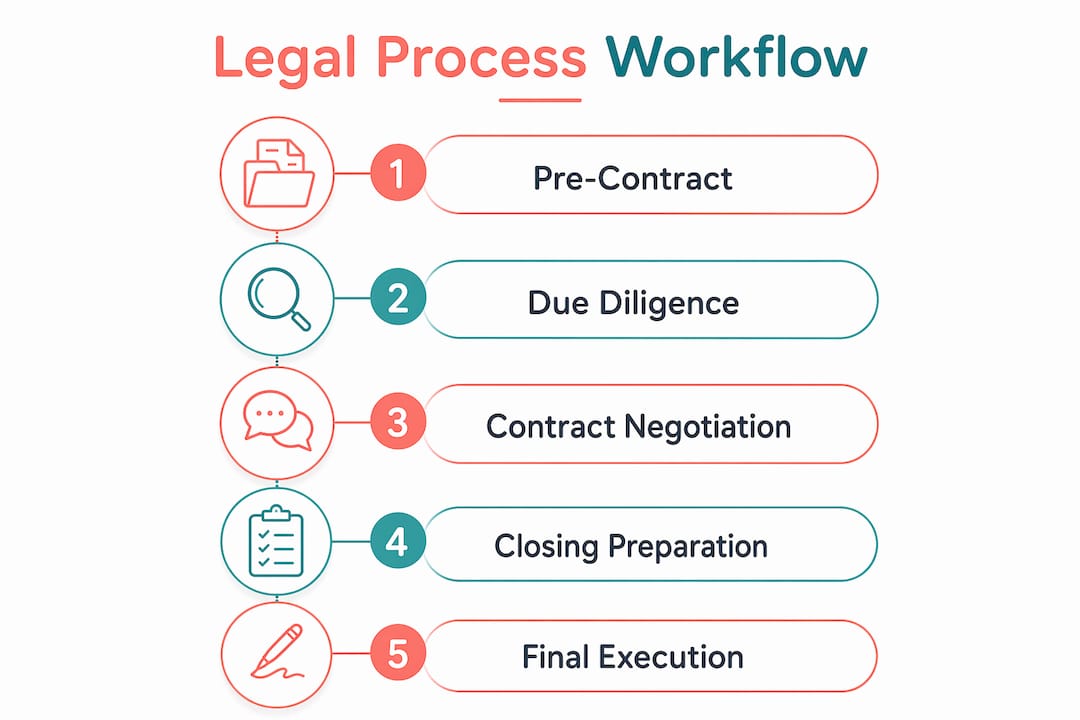
A well-run real estate legal process workflow in Spain moves through five distinct stages: pre-contract intake, due diligence, contract negotiation, closing, and post-closing compliance. Each stage has defined deliverables, responsible parties, and legal checkpoints that, when followed in sequence, protect all parties and keep transactions on track. The full process, from accepted offer to keys, typically spans 6–12 weeks for cash purchases and 8–16 weeks where mortgage financing is involved, as of Q2 2026.
Here is how the core workflow maps out:
- Pre-contract intake: Client onboarding, identity verification, NIE coordination for foreign buyers, power of attorney setup, and file opening
- Due diligence: Nota Simple extraction, Catastro cross-check, municipal planning review, community debt certification, and tax modeling (ITP, VAT, AJD, plusvalía)
- Contract negotiation: Reservation agreement review, Contrato de Arras drafting with suspensive conditions, and vendor warranty negotiation
- Closing: Escritura Pública preparation, notarial appointment coordination, funds transfer, tax payment filing, and Land Registry submission
- Post-closing: Registration confirmation, Catastro ownership update, utility transfers, and ongoing tax compliance setup
Key documents at each stage: reservation agreement (señal or reserva), private purchase contract (Contrato de Arras), public deed (Escritura Pública), Nota Simple from the Land Registry, Catastro certificate, community debt certificate, and tax settlement forms.
Parties involved: buyer’s independent lawyer (primary risk manager), seller’s lawyer, notary (identity and formality verification only), estate agent, mortgage bank representative where financing applies, and the Land Registry.

Why standardizing your legal workflow reduces risk and speeds up closings
Ad hoc transaction management is where deals fall apart. The Spanish real estate legal framework is layered across the Mortgage Law (Ley Hipotecaria), the Urban Land Law (Ley del Suelo, Royal Legislative Decree 7/2015), the Urban Leases Law (Ley de Arrendamientos Urbanos), and a regional tax regime that varies by autonomous community. Without a standardized workflow, practitioners routinely miss jurisdiction-specific checkpoints.
Common challenges without standardization:
- Jurisdictional complexity: Catalonia, for example, has its own civil law provisions that can override general Spanish rules on certain transactions
- Document variability: rural properties, new builds, and resale apartments each require different due diligence checklists
- Communication gaps between buyer’s counsel, notary, mortgage bank, and Land Registry cause avoidable delays
- Tax surprises when ITP, VAT, AJD, and plusvalía implications are not modeled before the Contrato de Arras is signed
Benefits of a standardized process:
- Consistent file quality across all matters, regardless of which team member handles intake
- Reduced errors at closing, since every checkpoint has been verified before the notarial appointment
- Faster completions because document requests are batched and sequenced correctly
- Compliance assurance across regional regulatory variations
The single most common bottleneck is signing a private purchase contract before due diligence is complete. Under Article 1454 of the Civil Code, an arras penitenciales contract binds the buyer immediately: walking away means losing the deposit, which is generally a portion of the purchase price agreed by the parties. A standardized workflow prevents this by making due diligence sign-off a mandatory gate before any binding contract is executed.
Pro Tip: Build a workflow review cycle into your practice calendar, at minimum quarterly. Digital document management tools like Clio, Notion, or a purpose-built legal practice management system let you track stage completion, flag overdue tasks, and maintain audit trails without relying on email threads.
1. Pre-contract intake: how to open a real estate matter correctly
The quality of a transaction is often determined in the first 48 hours. A thorough intake process prevents downstream problems and sets clear expectations for both client and counsel.
Client information and verification:
- Full identity documents (passport, national ID) for all buyers and sellers
- Proof of address and source of funds documentation for anti-money laundering compliance
- Marital status and ownership regime confirmation, since Spanish law treats jointly owned assets differently depending on the matrimonial property regime
Documents required before proceeding:
- NIE (Número de Identificación de Extranjeros) for all foreign buyers. NIE is mandatory for any real estate transaction in Spain; without it, the process stalls at the notarial stage
- Power of attorney (poder notarial) if the buyer cannot be present in Spain. This document must be signed before a Spanish notary, or before a foreign notary with a Hague Apostille
- Spanish bank account details, since payment at closing requires a certified bank draft (cheque bancario) drawn on a Spanish account
File opening best practices:
- Assign a dedicated matter number and responsible lawyer at intake
- Create a transaction checklist template specific to the property type (resale, new build, rural, commercial)
- Set milestone dates for due diligence completion, contract signing, and notarial closing
- Confirm the scope of representation in writing, including whether post-closing tax filings are included
Foreign buyers who cannot travel to Spain can grant their lawyer a power of attorney to handle every step, from NIE application through to signing the Escritura Pública. This is standard practice and does not slow the transaction when the power is drafted correctly and apostilled in advance.
2. Due diligence: the systematic checks that protect buyers and sellers
Legal due diligence in a Spanish real estate transaction covers four areas: registry and cadastral verification, urban planning compliance, tax and financial review, and technical inspection. Standard due diligence takes several working days for a straightforward resale property; rural properties or those with modification history may take longer.
Registry and cadastral checks:
- Extract the Nota Simple from the Land Registry (Registro de la Propiedad). This document confirms legal ownership, existing mortgages, liens, easements, and any preventive annotations from ongoing litigation
- Cross-reference the Nota Simple against the Catastro (the tax authority’s physical property database). Discrepancies between these two registers, such as built area differences or boundary mismatches, are a red flag for undeclared construction
- Verify the public deed (Escritura Pública) aligns with both registers. All three sources must be consistent before proceeding
Urban planning and licensing:
- Confirm the building license (Licencia de Obra) and first occupation license (Licencia de Primera Ocupación) are in order
- Check for outstanding planning violations or sanctioning procedures at the municipal level
- For properties with visible modifications, commission a qualified Spanish architect to verify that built structures match approved plans
- Verbal confirmations from local authorities carry no legal weight. Written documentation from the Town Hall is the only acceptable evidence of planning compliance
Tax and financial review:
- Request IBI (Impuesto sobre Bienes Inmuebles) receipts for the last four years. Unpaid IBI transfers to the new owner on purchase
- Obtain a community debt certificate from the building administrator. Under Article 9.1.e) of the Ley de Propiedad Horizontal, the buyer assumes liability for community debts from the year of acquisition and the three prior calendar years
- Model the full tax cost early: ITP, VAT, AJD, and plusvalía vary significantly by region and property type. A transaction that looks viable at headline price can become unworkable once regional tax rates are applied
| Due diligence item | Source | Responsible party | Typical turnaround |
|---|---|---|---|
| Nota Simple (Land Registry) | Registro de la Propiedad | Buyer’s lawyer | 24–48 hours |
| Catastro certificate | Catastro (tax authority) | Buyer’s lawyer | 24–48 hours |
| Planning status check | Municipal planning office | Buyer’s lawyer | 3–7 working days |
| Community debt certificate | Building administrator | Seller (presented at notary) | 3–5 working days |
| IBI receipts (4 years) | Seller / municipal authority | Seller | At intake |
| Building and occupation licenses | Town Hall | Buyer’s lawyer | 3–7 working days |
| Tax modeling (ITP/VAT/AJD/plusvalía) | Regional tax authority | Buyer’s lawyer | Concurrent |
One point practitioners frequently underestimate: Spanish notaries certify identities and oversee formal execution of the deed, but they do not investigate planning compliance, structural status, or encumbrances. That responsibility sits entirely with the buyer’s independent counsel. Treating the notary’s involvement as a substitute for legal due diligence is one of the most expensive mistakes a buyer can make.

For practitioners advising on legal requirements in Spain, the due diligence stage is also where rental compliance checks belong. In regions with active rent price regulations, verifying existing lease terms and tenant rights before acquisition has become a standard part of the workflow, not an afterthought.
3. Contract negotiation: structuring the Contrato de Arras correctly
The Contrato de Arras is the binding commitment in a Spanish transaction. Under the most common form, arras penitenciales (Article 1454, Civil Code), the buyer forfeits the deposit if they withdraw, and the seller must return double if they pull out. The deposit is generally a significant proportion of the purchase price as agreed by the parties.
What the contract must include:
- Full identification of buyer, seller, and property (with cadastral reference)
- Agreed purchase price and deposit amount with payment confirmation
- Completion date or deadline for Escritura Pública signing
- Distribution of transaction costs between parties
- Inventory of what is included in the sale (fixtures, parking, storage)
- Penalty clauses for non-performance by either party
Protective clauses that practitioners often omit:
- Suspensive conditions allowing deposit recovery if due diligence reveals material defects. Without these, a buyer who discovers a planning violation after signing has no contractual route to recover their deposit
- Mortgage approval conditions where financing is involved, with a defined approval deadline
- Specific representations from the seller on the absence of undisclosed charges, ongoing litigation, or community disputes
Independent legal review before signing is not optional. Contract law in Spain heavily favors what is written. Verbal assurances from agents or sellers have no standing once the contract is executed. The Contrato de Arras should never be signed before due diligence is complete, or at minimum, before suspensive conditions are embedded to protect the deposit.
For commercial transactions, the acquisition is typically structured through a Spanish special purpose vehicle (SPV), and the choice of acquisition vehicle (individual, Spanish company, SOCIMI, or real estate fund) affects both the contract structure and the applicable tax regime. This structuring decision should be made before the Contrato de Arras is signed, not after.
4. Closing preparation and execution: the Escritura Pública workflow
The closing stage is where all prior work either holds or fails. A well-prepared closing runs in a single day at the notary; a poorly prepared one generates last-minute registry searches, delayed tax filings, and post-signing disputes.
Pre-closing preparation:
- Obtain an updated Nota Simple 24–48 hours before the notarial appointment to confirm no new charges or annotations have been registered since due diligence
- Prepare the Escritura Pública draft in coordination with the notary. The deed must accurately reflect the agreed price, property description, and payment method
- Arrange the certified bank draft (cheque bancario) for the remaining balance. Personal checks are not accepted at Spanish notarial closings
- Where the seller is a non-resident, prepare Form 211 for the 3% withholding obligation on the purchase price, which the buyer must file and pay to the tax authority
At the notarial signing:
- The notary reads the full deed aloud in Spanish. If the buyer does not speak Spanish, a sworn translator (traductor jurado) must attend
- Both parties sign; the buyer hands over the bank draft and the seller hands over the keys
- Where financing is involved, the bank’s representative attends simultaneously to execute the mortgage deed
- The notary’s role covers identity verification, capacity confirmation, and formal execution. Legal risk assessment remains with the buyer’s counsel
Tax payments and Land Registry filing:
- ITP (resale) or VAT plus AJD (new build) must be paid within 30 business days of signing
- The buyer’s lawyer submits the Escritura Pública to the Land Registry for registration. This takes 2–8 weeks depending on the registry’s workload
- Land Registry registration is technically voluntary, but it is the primary mechanism of legal protection for ownership rights in Spain. Registration grants enforceable title against third-party claims and hidden charges. Every practitioner should treat it as mandatory
Post-signing tasks:
- Transfer utility contracts (electricity, water, gas, internet) to the buyer’s name
- Notify the community of owners (comunidad de propietarios) of the change of ownership
- Set up direct debits for IBI, community fees, and utilities on the buyer’s Spanish bank account
- Arrange home insurance, which is mandatory if a mortgage is in place
5. Getting started: how to build standardized workflows into your practice
Most practitioners know what a good real estate transaction looks like. The gap is between knowing the steps and having a system that executes them consistently, regardless of deal complexity or team member.
Assess your current process first:
- Map every active transaction against a standard checklist and identify where steps are being skipped or completed out of sequence
- Track where delays actually occur. In most practices, the bottleneck is not legal complexity but document collection, specifically waiting for IBI receipts, community certificates, or NIE confirmations
Build templates and checklists:
- Create separate checklists for resale residential, new build, rural, and commercial transactions. A single generic checklist misses property-type-specific risks
- Include compliance checkpoints for Catalonia’s civil law provisions, which can affect inheritance, ownership regimes, and certain contract terms differently from general Spanish law
- Template your Contrato de Arras with standard suspensive conditions already drafted. Lawyers who start from a blank contract on every deal introduce unnecessary variation and risk
Train your team on workflow execution:
- Assign clear ownership for each stage. Due diligence should not be a shared responsibility with no named lead
- Run a post-closing review on every completed transaction. What was missed? What took longer than expected? Feed those answers back into the checklist
Use technology where it adds real value:
- Legal practice management platforms let you set milestone deadlines, attach documents to specific workflow stages, and generate status reports for clients
- Automated calendar reminders for the 30-day tax payment window after closing prevent the most avoidable compliance failures
- For practitioners managing property investment workflows across multiple transactions, a centralized matter management system is the difference between a scalable practice and a reactive one
Build in continuous feedback:
- After each transaction, ask: did the workflow catch every risk before it became a problem? If not, update the checklist before the next file is opened
- Review regional regulatory changes at least annually. Spanish autonomous communities update planning rules, tax rates, and rental regulations regularly, and a checklist that was accurate in 2024 may have gaps by 2026
Costacambrils: legal support for Costa Dorada property transactions
Practitioners advising clients on luxury property investment along the Costa Dorada, particularly in Cambrils and the Tarragona region, benefit from working with a local specialist who understands the specific planning, tax, and registry nuances of this market. Costacambrils combines deep local market knowledge with end-to-end transaction support, from property search and legal coordination through to post-closing management. Whether your client is acquiring a beachfront villa or a new-build apartment, the legal process workflow is the same, but the local details matter.
Key Takeaways
A complete real estate legal process workflow in Spain requires five sequential stages, each with defined checkpoints, and skipping any one of them creates legal or financial exposure that cannot always be remedied after signing.
| Point | Details |
|---|---|
| Due diligence before any contract | Complete registry, Catastro, planning, and tax checks before signing the Contrato de Arras to protect the deposit. |
| NIE is a hard prerequisite | Foreign buyers must obtain their NIE before the transaction can proceed; without it, the process stalls and cannot advance to notarial closing. |
| Notaries do not replace lawyers | Notaries verify identity and formalities only; legal risk assessment is the buyer’s independent counsel’s responsibility. |
| Land Registry registration protects title | Registration is technically voluntary but provides enforceable ownership protection against third-party claims and hidden charges. |
| Tax modeling belongs at due diligence | ITP, VAT, AJD, and plusvalía vary by region and property type; model the full cost before the Contrato de Arras is signed. |