TL;DR:
- Buying property on Spain’s Costa Dorada requires understanding legal and financial terms to avoid costly mistakes. International buyers must verify documents like the nota simple, escritura, and cédula de habitabilidad to ensure clear ownership and compliance. Familiarity with local property classifications, taxes, and luxury market terminology safeguards investments and enhances negotiation confidence.
Buying property on Spain’s Costa Dorada is genuinely exciting, but one wrong interpretation of a legal or financial term can cost you tens of thousands of euros. International investors, even those with experience in London, New York, or Dubai real estate markets, regularly encounter Spanish terminology that looks familiar on the surface but carries very specific legal weight in Spain. A “chalet” isn’t just any house. A “nota simple” isn’t simply a note. This guide walks you through the essential vocabulary, organized by category, so you can approach any luxury transaction in coastal Spain with confidence and precision.
Table of Contents
- Understanding the foundations: Common residential property terms in Spain
- Decoding legal language: Terms every luxury buyer must know
- Financial jargon: Understanding property taxes, fees, and valuations
- Specialty terms for luxury and coastal properties
- Why knowing local terminology is your best investment safeguard
- Ready to unlock your dream property on the Spanish coast?
- Frequently asked questions
Key Takeaways
| Point | Details |
|---|---|
| Master Spanish terminology | Knowing key terms prevents costly mistakes and negotiations mishaps in Spain’s luxury market. |
| Legal language matters | Common legal vocabulary can dramatically affect your ownership and transactional security. |
| Understand all costs | Tax and fee terms shape your financial planning and overall ROI for each property. |
| Luxury properties use specialized terms | High-end homes have unique language for features, amenities, and community context. |
| Expert guidance makes a difference | Partnering with local advisors helps navigate Spain-specific nuances no glossary catches. |
Understanding the foundations: Common residential property terms in Spain
Spanish property listings use a vocabulary that blends everyday language with legally significant classification. Knowing the difference between terms isn’t just useful for conversation — it shapes what you’re legally buying, how it’s taxed, and what you can do with it. Studying the key real estate terms used in luxury investment contexts is the fastest way to level up before you start viewing properties.
Here are the core residential property types you’ll encounter:
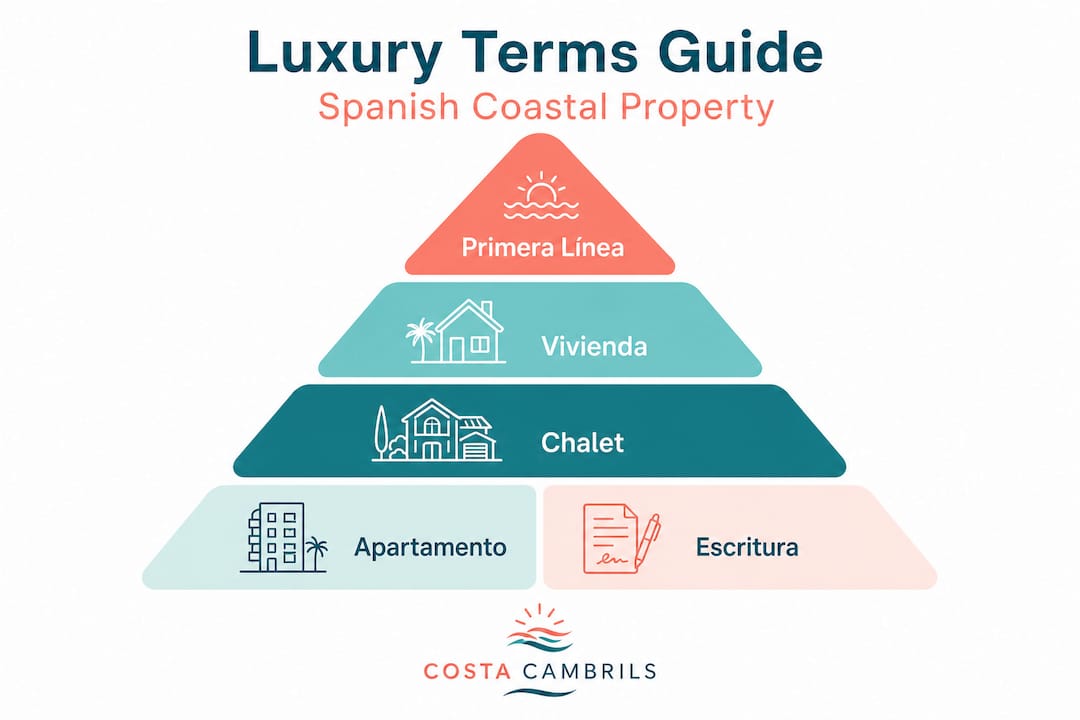
- Vivienda: The general Spanish word for a dwelling or home. It doesn’t specify size or structure, and it appears in legal documents to describe any residential unit.
- Apartamento: An apartment within a larger residential building. In Spain, “apartamento” often implies a smaller unit, sometimes studio-style, while “piso” refers to a more spacious apartment floor-through unit.
- Piso: A flat or apartment, typically larger than an apartamento, within a multi-story building. It’s the most common word for apartments in everyday Spanish usage.
- Chalet: A detached or semi-detached house, often with a private garden. In luxury coastal markets, “chalet independiente” (fully detached) commands significantly higher premiums than “chalet adosado” (terraced or semi-detached).
- Ático: A penthouse or top-floor apartment. Áticos in luxury coastal buildings usually feature wraparound terraces, panoramic sea views, and private rooftop access.
- Casa adosada: A townhouse or terraced house, typically part of a row or development with shared walls but private outdoor space.
- Bungalow: In Spain, this often refers to a single-story detached home, frequently found in coastal urbanizations with garden and pool access.
The distinction between a “piso” and an “apartamento” matters more than you might think. Spanish property registries, mortgage lenders, and tax authorities treat these classifications differently in certain regions, and what a listing agent calls a property in marketing materials may differ from its official registry classification. Working with experienced Spanish real estate agents helps you verify that the marketing label matches the legal one before you commit.
| Spanish term | English equivalent | Typical luxury context |
|---|---|---|
| Vivienda | Dwelling/residence | General legal classification |
| Ático | Penthouse | Top-floor luxury apartments |
| Chalet independiente | Detached villa | Premium standalone homes |
| Piso | Apartment/flat | Mid-to-large coastal flats |
| Casa adosada | Townhouse | Luxury gated developments |
Pro Tip: When browsing featured luxury properties, always cross-reference the listing type with the official property registry classification. The marketing description and legal classification can differ, which affects mortgage eligibility, renovation permits, and future resale value. If you plan to rent the property, property management in Spain specialists can also confirm that the classification allows tourist rental licenses.
Decoding legal language: Terms every luxury buyer must know
Legal terminology is where international buyers most often stumble. Spain’s property registration and notarial system has its own precise vocabulary, and misreading even a single term can result in purchasing a property with undisclosed encumbrances or incomplete ownership rights. Understanding legal requirements for Spanish property purchases is non-negotiable at the luxury level.
Top 5 legal terms every international buyer must verify:
- Escritura pública: The official notarized deed of sale. This document, signed before a Spanish notary, transfers legal ownership. Without a properly executed escritura, the sale has no legal standing.
- Nota simple: A summary extract from the Spanish Land Registry (Registro de la Propiedad). It confirms the property’s legal description, current ownership, and any mortgages or liens (encumbrances) registered against it. Always request this document before signing anything.
- IBI (Impuesto sobre Bienes Inmuebles): Spain’s annual property tax, similar to council tax or property tax in other countries. It’s calculated based on the valor catastral (the official assessed value, explained in the next section). Unpaid IBI charges can become a liability that transfers to the new owner.
- Cédula de habitabilidad: The habitation certificate (also called licencia de primera ocupación in some regions). This document confirms that the property meets minimum habitability standards and is legally authorized for residential use. Without it, you may not be able to connect utilities or obtain a tourist rental license.
- Cargas: Encumbrances or charges registered against a property, including mortgages, liens, easements, or community debts. A nota simple reveals all cargas. Buying a property with unresolved cargas is a significant risk that can be avoided with proper due diligence.
Important for international buyers: In Spain, certain legal obligations “follow the property,” not the seller. This means that unpaid community fees, IBI, and even some outstanding utility bills can become your responsibility after purchase. This is precisely why legal advice matters before you sign any binding contract.
Additional legal terms worth knowing include “contrato de arras” (a preliminary deposit contract that binds both parties and defines penalty clauses if either side withdraws) and “poder notarial” (a notarized power of attorney, useful for international buyers who cannot attend every stage of the transaction in person).
Pro Tip: Certified translations of all legal documents are essential for international buyers. In Spain, the legally binding version of any contract is always in Spanish. Even if an agent provides an English summary, insist on certified translations of the escritura, nota simple, and any preliminary contracts before proceeding.
Financial jargon: Understanding property taxes, fees, and valuations
Legal clarity sets the stage for understanding the financial side — here’s what you need to know about the money. Spain’s property purchase and ownership costs involve multiple overlapping terms that confuse buyers at every price point. At the luxury level, the sums involved make precision even more critical.
Key financial terms explained:
- Valor catastral: The official cadastral value assigned by Spanish authorities, used as the base for calculating IBI and some other taxes. It is almost always lower than actual market value, sometimes significantly so.
- Valor de mercado: The market value, or what the property would realistically sell for. This is the figure used by banks for mortgage appraisals and the figure buyers should use for their own valuation benchmarks.
- IBI (Impuesto sobre Bienes Inmuebles): Annual property ownership tax, calculated as a percentage of the valor catastral. Rates vary by municipality but typically range from 0.4% to 1.1%.
- Plusvalía municipal: A municipal capital gains tax charged when a property is sold. It’s calculated based on the increase in the land’s cadastral value over the ownership period, not the total sale price.
- ITP (Impuesto de Transmisiones Patrimoniales): Transfer tax paid by the buyer on second-hand (resale) properties. Rates vary by Spanish region; in Catalonia (which covers Costa Dorada), the rate is 10%.
- IVA: Spain’s equivalent of VAT (sales tax). Applied instead of ITP when buying a new-build property directly from a developer. Currently 10% for residential properties.
- Notary and registry fees: These are separate from taxes and cover the cost of the notary who certifies the escritura and the Land Registry fee to register ownership. Expect combined fees of roughly 0.5% to 1.5% of the purchase price.
| Cost item | Who pays | Typical rate or range |
|---|---|---|
| ITP (resale) | Buyer | 10% in Catalonia |
| IVA (new build) | Buyer | 10% |
| IBI (annual) | Owner | 0.4% to 1.1% of valor catastral |
| Plusvalía municipal | Seller (normally) | Varies by municipality |
| Notary and registry | Buyer | 0.5% to 1.5% of price |
Commonly overlooked charges include community fees (“cuota de comunidad”), which cover shared building maintenance, pool upkeep, gardening, and security in residential developments. In luxury urbanizations, these can run into several hundred euros monthly. You should also verify any outstanding sub-property obligations and cross-check all costs using the official property identification terminology to ensure you’re reviewing the correct parcel.

For investors looking at exclusive property classification, the financial due diligence process needs to account for all applicable taxes across multiple property IDs if you’re acquiring more than one unit within the same development.
Specialty terms for luxury and coastal properties
With taxes and fees demystified, it’s time to address advanced terms found at the high end of the market. Luxury and coastal properties in Spain come with their own vocabulary layer, one that signals status, exclusivity, and premium amenity standards.
Essential luxury and coastal terminology:
- Primera línea de playa: Literally “first beach line.” Properties directly fronting the beach with no road or building between them and the sea. This classification commands significant price premiums and is one of the most desirable designations in coastal Spain.
- Segunda línea: “Second line” properties are one row back from the beach. Still highly desirable and often more practical (less sea spray, more privacy), but priced lower than primera línea.
- Urbanización cerrada: A gated residential development with controlled access, often featuring 24-hour security, private roads, communal pools, tennis courts, and landscaped grounds. Synonymous with luxury community living in Spain.
- Domótica: Home automation technology. In Spain’s top-tier properties, domótica systems control lighting, climate, security cameras, blinds, and entertainment systems from a single app or panel. This term is a reliable marker of true luxury specification.
- Piscina infinity: An infinity pool with a vanishing edge, typically designed to appear to merge with the sea or landscape. Common in high-end coastal chalets and featured extensively in premium marketing.
- Solarium: A rooftop or elevated terrace designed for sunbathing, often with outdoor furniture, a small pool or jacuzzi, and panoramic views. Highly valued in ático and luxury villa properties.
- Licencia turística: A tourist rental license, legally required to rent a property to short-term visitors. Not all properties qualify, and some urbanizaciones cerradas prohibit tourist rentals in their community statutes.
Understanding luxury amenities in Spain gives you the vocabulary to evaluate what a property genuinely offers versus what is marketed aspirationally. Learning what makes an exclusive home feature truly exceptional helps you separate marketing language from real value.
A proper understanding of the luxury home definition in the Spanish coastal context is more nuanced than in other markets. Use the luxury buyer checklist to ensure no detail is missed, and explore the types of luxury homes in Costa Dorada to understand which format best suits your lifestyle and investment goals.
Pro Tip: Don’t assume that international luxury vocabulary translates directly to Spain. A “luxury villa” in a UK or American listing might simply mean a large house. In Spain, “villa” or “chalet de lujo” in a coastal urbanización cerrada implies very specific features: gated access, private pool, high-end finishes, and often domótica systems. The Spanish term is a quality signal, not just a marketing label.
Why knowing local terminology is your best investment safeguard
Here is the uncomfortable truth that most property guides don’t say clearly enough: terminology confusion in Spanish real estate isn’t a beginner problem. It affects seasoned investors regularly, and the consequences compound at the luxury end of the market.
We’ve seen highly experienced buyers, people with multiple international properties in their portfolios, misread the distinction between “apartamento” and “piso” in a way that affected their mortgage application. We’ve watched investors purchase properties without a valid cédula de habitabilidad, only to discover they couldn’t legally let the property or even connect utilities without costly legal remediation.
The deeper issue is that Spanish property terms carry layered meaning. “Primera línea de playa” sounds like a pure geographic description, but it has regulatory implications for building height restrictions, environmental protection zones, and coastal law compliance. “Urbanización cerrada” sounds like a lifestyle preference, but it has legal weight in terms of what the community statutes permit you to do with the property.
The hard-won lesson we’ve observed across many transactions is this: the investors who negotiate best are the ones who understand the vocabulary well enough to ask the right questions. Knowing to ask for the nota simple, knowing to check whether the valor catastral aligns with the asking price, knowing that a licencia turística is a separate approval process — these details create leverage in negotiation and protect your investment over time.
Reviewing advanced terminology for luxury investment should be treated as part of your investment research, not an afterthought after you’ve fallen in love with a property. The emotional pull of a primera línea de playa chalet with an infinity pool is powerful. The vocabulary to evaluate it objectively is your safeguard.
Ready to unlock your dream property on the Spanish coast?
Mastering the terminology covered in this guide removes one of the biggest friction points international buyers face — the feeling of navigating an unfamiliar system without a map. You now have the vocabulary to read listings accurately, understand legal documents, evaluate financial costs, and recognize genuine luxury specifications when you see them.
The team at Costa Cambrils combines deep local expertise with a multilingual approach designed for exactly this kind of buyer: internationally experienced, detail-oriented, and serious about making the right purchase. From property management expertise for existing owners to curated property searches for first-time buyers in the Costa Dorada, the platform offers the professional support that transforms terminology knowledge into confident action. Explore current listings, request a personalized property evaluation, or connect with the advisory team to take your next step with clarity.
Frequently asked questions
What is the difference between ‘vivienda’, ‘apartamento’, and ‘chalet’ in Spain?
‘Vivienda’ is a general term for any dwelling or residence, ‘apartamento’ refers to an apartment unit (typically smaller) within a larger building, and ‘chalet’ describes a detached or semi-detached house with its own garden or outdoor space.
What does ‘escritura’ mean in a Spanish property deal?
‘Escritura’ is the official notarized deed of sale, signed before a Spanish notary and used to formally register the transfer of ownership in the Land Registry.
Which taxes apply to luxury homes in Spanish coastal areas?
IBI (annual property tax), Plusvalía municipal (capital gains tax on land value increase), and ITP or IVA on purchase all apply; high-value properties may also trigger wealth tax obligations depending on the owner’s residency status.
Are legal documents for property purchases available in English?
Contracts and deeds may be provided with English translations for reference, but the legally binding version is always in Spanish, so certified translations reviewed by a qualified lawyer are essential for any international buyer.
What should international buyers check before investing?
Before proceeding, verify the nota simple for encumbrances, confirm the cédula de habitabilidad is valid, review all outstanding IBI and community fee payments, and consult a local property lawyer who specializes in international transactions.
Recommended
- Master key real estate terms for luxury investments in Costa Dorada – Inmobiliaria Costa Cambrils
- Explore Top Luxury Amenities in Spain for Elite Living – Inmobiliaria Costa Cambrils
- Understanding villas in Spain: a guide for luxury home buyers – Inmobiliaria Costa Cambrils
- Luxury property buying guide: Costa Dorada’s top real estate – Inmobiliaria Costa Cambrils