
TL;DR:
- Effective property negotiation relies on data, preparation, and trading variables beyond price to maximize deal value. Skilled agents manage psychological aspects, set strategic BATNA points, and use silence to maintain leverage during negotiations. Properly framing the entire offer package ensures both buyers and sellers achieve favorable outcomes with minimized emotional reactions.
Negotiation in property sales is the structured process of reaching agreement on price, terms, and conditions that maximize value for both buyer and seller. Skilled negotiation determines not just the final sale price but also who pays closing costs, when possession transfers, and which repairs get completed before closing. Negotiation unfolds as a series of strategic decisions from offer to closing day, requiring preparation, timing, and a credible willingness to walk away. The importance of negotiation in selling property cannot be overstated. A single well-executed counteroffer can shift thousands of dollars in your favor.
What are the core negotiation strategies that influence property sale outcomes?
Effective negotiation strategies for real estate start with one principle: data beats emotion. The Comparative Market Analysis, or CMA, is the most powerful tool in any negotiator’s kit. Effective negotiators use hard data like CMA to anchor offers, avoiding emotional decisions and maximizing value. A CMA pulls recent sale prices for comparable properties in the same neighborhood, giving you a defensible number to open with rather than a guess.
Price anchoring works because the first number stated in a negotiation sets the psychological reference point for everything that follows. If you open with a well-researched, slightly aggressive figure, the final agreed price tends to land closer to your position than your counterpart’s. Open too conservatively and you leave money on the table before the conversation even starts.
Home inspections are the second major leverage point. 86% of home inspections reveal issues, and 46% of buyers use those findings to negotiate roughly $14,000 in savings. That figure represents real money, not a rounding error. Buyers who skip a professional inspection forfeit one of the most reliable renegotiation opportunities in the entire transaction.
Timing also shapes outcomes. A seller who needs to close by a specific date has less leverage than one with no urgency. A buyer competing against multiple offers has less leverage than one in a slow market. Reading the market conditions correctly, and knowing your counterpart’s timeline, is as important as knowing the numbers.
- Price anchoring with CMA: Open with a data-backed figure to set the negotiation range in your favor.
- Inspection leverage: Use findings to renegotiate price or request repairs on structural and safety issues.
- Market timing: Identify whether conditions favor buyers or sellers before making your first move.
- Urgency signals: Watch for signs of seller or buyer urgency, such as repeated price reductions or a property sitting on market for 60-plus days.
Pro Tip: Prepare your CMA before you make or respond to any offer. Walking into a negotiation without data is like playing poker without looking at your cards.
How do negotiation tactics extend beyond price in property sales?
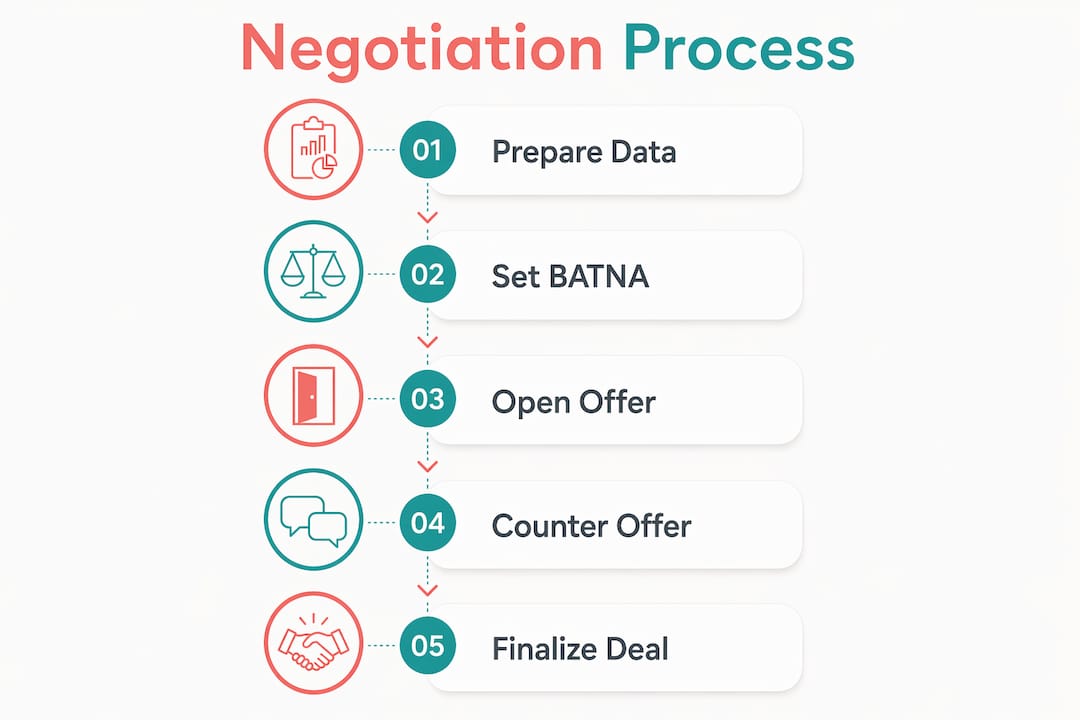
The role of bargaining in real estate deals goes far beyond the sale price. Negotiation extends to closing costs, contingencies, possession dates, and earnest money, with sellers sometimes covering up to $10,000 in closing costs as a strategic concession. Buyers and sellers who focus only on price miss the full picture of deal value.
Think of a property transaction as a package, not a single number. Every variable in that package is negotiable. Skilled negotiators trade lower-cost concessions to protect the items that matter most to them. A seller who refuses to budge on price might agree to cover the buyer’s closing costs, include appliances, or offer a flexible possession date. The buyer gets real financial value. The seller keeps their headline number intact.
Here are the most commonly negotiated variables beyond price:
- Closing costs: Sellers can cover part or all of the buyer’s closing costs, reducing the buyer’s upfront cash requirement without touching the sale price.
- Contingencies: Financing contingencies, appraisal contingencies, and inspection contingencies can each be adjusted in scope or timeline to make an offer more attractive.
- Possession timing: A seller who needs extra weeks after closing to relocate may offer a price reduction in exchange for a delayed handover. A buyer who can close quickly may use that flexibility as leverage.
- Earnest money deposit: A larger deposit signals commitment and can tip a seller toward accepting your offer over a competing one.
- Warranties and inclusions: Negotiating for a home warranty, specific appliances, or furniture items adds value without changing the recorded sale price.
Treating the entire offer package as negotiable enables sellers to hold their bottom-line price and still win deals. This “total deal” approach is what separates experienced negotiators from those who get stuck in a price-only standoff.
Pro Tip: Before you counter any offer, list every variable in the deal and rank them by importance. Trade the ones you care least about to protect the ones you care most about.
What roles do agents and buyer/seller psychology play in negotiations?
Professional negotiation by experienced agents can increase a seller’s final sale price by $30,000 or more. That figure alone justifies the commission for most sellers. But the financial benefit is only part of the story. Agents also manage the psychological dimension of negotiation, which is where most deals fall apart.

Agents act as buffers, preventing sellers from reacting impulsively and protecting deal viability. When a buyer submits a lowball offer, a seller’s instinct is often to reject it outright or respond with an angry counteroffer. An agent absorbs that reaction, responds professionally, and keeps the negotiation alive. A deal that feels insulting at first glance can still close at a fair price if both parties stay at the table.
The concept of BATNA, or Best Alternative to a Negotiated Agreement, is central to maintaining leverage. Defining walk-away points before negotiation keeps parties calm and objective, helping avoid unfavorable outcomes. When you know your BATNA clearly, you stop making concessions out of fear and start making them strategically.
“The negotiator who knows exactly when to walk away holds more power than the one who needs the deal to close.” This principle applies equally to buyers in competitive markets and sellers with motivated timelines.
Silence is another underused psychological tool. Silence after making an offer is a deliberate tactic to maintain leverage and avoid conceding prematurely. Most people feel uncomfortable with silence and rush to fill it, often by softening their position. Staying quiet after a counteroffer forces the other party to respond rather than giving them an opening to push back.
Key psychological principles that shape effective negotiation in property transactions:
- Emotional detachment: Treat the property as a financial asset, not a personal statement.
- BATNA clarity: Know your walk-away number before the first offer lands.
- Silence as leverage: Resist the urge to explain or justify your position after stating it.
- Agent as buffer: Let your agent handle direct responses to avoid impulsive reactions.
For buyers working in the Costa Dorada market, understanding the agent’s role in real estate deals is particularly valuable when navigating cross-border transactions.
What practical steps prepare you for effective property negotiations?
Preparation is the single biggest predictor of negotiation success. Most buyers and sellers underestimate how much work happens before the first offer is submitted. The groundwork you lay in the week before negotiating determines the ceiling of what you can achieve.
Before the negotiation:
- Research recent comparable sales in the area using tools like local MLS data or a CMA from your agent.
- Define your target price, your acceptable range, and your absolute walk-away point in writing.
- Identify the other party’s likely motivations. Is the seller relocating quickly? Has the property been on the market for months?
- Review the property’s inspection history or commission a pre-listing inspection to know what issues exist before they become surprises.
During the negotiation:
- Structure your first offer logically. A number with a clear rationale is harder to dismiss than a round number with no explanation.
- Respond to counteroffers within a reasonable timeframe. Too fast signals desperation. Too slow signals disinterest.
- Prioritize your requests. Experienced negotiators focus on safety and structural issues during inspection renegotiations while conceding on cosmetic items to maintain goodwill.
The table below maps common negotiation scenarios to the recommended tactic:
| Scenario | Recommended Tactic |
|---|---|
| Seller has reduced price twice | Open below asking; seller is motivated |
| Multiple competing offers | Offer above asking with fewer contingencies |
| Inspection reveals structural issue | Request price reduction equal to repair cost |
| Buyer needs fast closing | Offer flexible possession date as concession |
| Seller wants to stay post-closing | Accept leaseback in exchange for price concession |
Pro Tip: Never negotiate against yourself. If you make an offer and the other party goes silent, wait. Do not revise your offer upward before they respond. Silence is not rejection.
For buyers preparing a full purchase plan, the property buying checklist for 2026 from Costacambrils covers the pre-offer steps in detail.
Key takeaways
Effective negotiation in property transactions requires data, preparation, and the discipline to trade lower-priority variables in order to protect the terms that matter most.
| Point | Details |
|---|---|
| Data anchors every offer | Use a CMA to set a defensible opening position before any negotiation begins. |
| Inspections create leverage | 46% of buyers use inspection findings to negotiate roughly $14,000 in savings. |
| Negotiate the full package | Trading closing costs, possession dates, and contingencies protects your bottom-line price. |
| Agents prevent costly mistakes | Professional agents can increase a seller’s final price by $30,000 or more through skilled handling. |
| Know your walk-away point | Defining your BATNA before negotiations start keeps decisions analytical, not emotional. |
What i’ve learned after years of watching deals win and lose
The most common negotiation mistake I see is treating the first offer as the negotiation. It isn’t. The first offer is just the opening statement. The real negotiation happens in the response, the silence that follows, and the sequence of moves after that.
Sellers who reject lowball offers outright lose deals they could have won. Buyers who justify every counteroffer in detail give away their priorities. The parties who do best are the ones who stay calm, respond deliberately, and never let the other side see which variables they actually care about.
I’ve also noticed that preparation separates the people who feel confident in negotiations from those who feel anxious. When you walk in knowing the comparable sales, the property’s history, and your walk-away number, you stop reacting and start deciding. That shift in mindset is worth more than any single tactic.
One more thing: most people underestimate how much the “total deal” framing changes outcomes. A seller who says “I won’t move on price” but then offers to cover closing costs and include a home warranty has effectively moved on price. They just did it in a way that feels like a win for both sides. That’s the goal. Not to beat the other party, but to structure a deal where both sides feel they got what they needed.
— Oscar
How Costacambrils supports you through expert property negotiation
Negotiating a luxury property sale on the Costa Dorada requires more than general tactics. It requires local market knowledge, multilingual communication skills, and experience with high-value transactions where a single term can shift a deal by tens of thousands of euros.

Costacambrils specializes in luxury property sales and rentals across Cambrils and the broader Costa Dorada region. The team brings direct negotiation expertise to every transaction, from structuring the initial offer to managing inspection renegotiations and closing terms. Whether you are buying or selling, having a specialist in your corner changes the outcome. Explore the key criteria for evaluating luxury properties in Cambrils to understand what drives value and negotiating power in this market. Contact Costacambrils directly to discuss your specific transaction and get a personalized negotiation strategy.
FAQ
What is the role of negotiations in property sales?
Negotiation in property sales is the process of reaching agreement on price, terms, and conditions that serve both buyer and seller. It determines not just the final price but also closing costs, possession timing, contingencies, and repair responsibilities.
How much can skilled negotiation affect the sale price?
Professional negotiation by experienced agents can increase a seller’s final sale price by $30,000 or more, according to mid-2026 industry analysis. On the buyer side, inspection-based negotiation alone averages roughly $14,000 in savings.
What variables beyond price can be negotiated in a property deal?
Closing costs, possession dates, contingencies, earnest money, appliances, and home warranties are all negotiable. Sellers can cover up to $10,000 in closing costs as a strategic concession while maintaining their headline price.
What is BATNA and why does it matter in real estate?
BATNA stands for Best Alternative to a Negotiated Agreement. Defining your walk-away point before negotiations start keeps your decisions objective and prevents you from accepting unfavorable terms out of pressure or urgency.
Should buyers always negotiate after a home inspection?
Yes, especially when the inspection reveals structural or safety issues. Experienced negotiators focus on major defects rather than cosmetic ones, which preserves goodwill while securing meaningful price reductions or repair credits.